

For a year now, the tech world has insisted that AI is reshaping productivity. We’ve heard that large language models are writing emails, fixing code, and summarizing mountains of text. But a new analysis from OpenRouter suggests the real story is far more complex.
The study examined metadata from more than 100 trillion tokens across billions of interactions with models like ChatGPT, Claude, LLaMA, DeepSeek, and many others. Because the platform spans more than 300 models from over 60 providers—and half its usage comes from outside the United States—it offers one of the most global snapshots of AI behavior available today. Crucially, OpenRouter analyzed only metadata, not the content of conversations, preserving user privacy while mapping broad trends.

Roleplay quietly dominates open-source AI
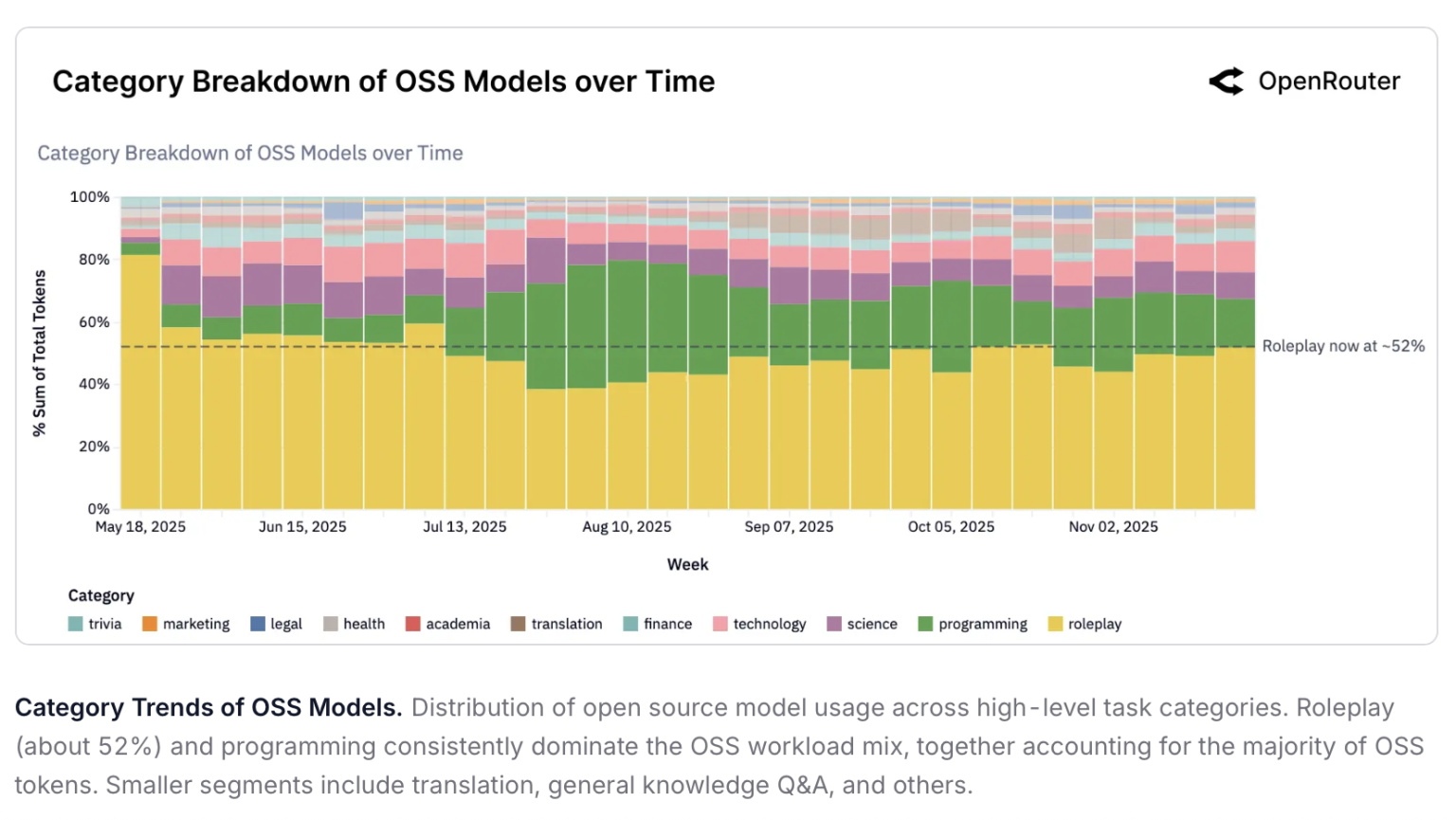
The most surprising finding is also the simplest: people are using AI for roleplay far more than anyone expected. More than half of all open-source model usage now revolves around character interactions, creative scenarios, and gaming-style storytelling.
That share even exceeds programming queries. According to the report, users often treat AI models as engines for fictional worlds or structured roleplaying—60% of roleplay interactions fall into gaming or creative writing scenes. It’s a quiet but fast-growing corner of AI use that contradicts the narrative that productivity dominates.
Programming becomes AI’s fastest-growing use case
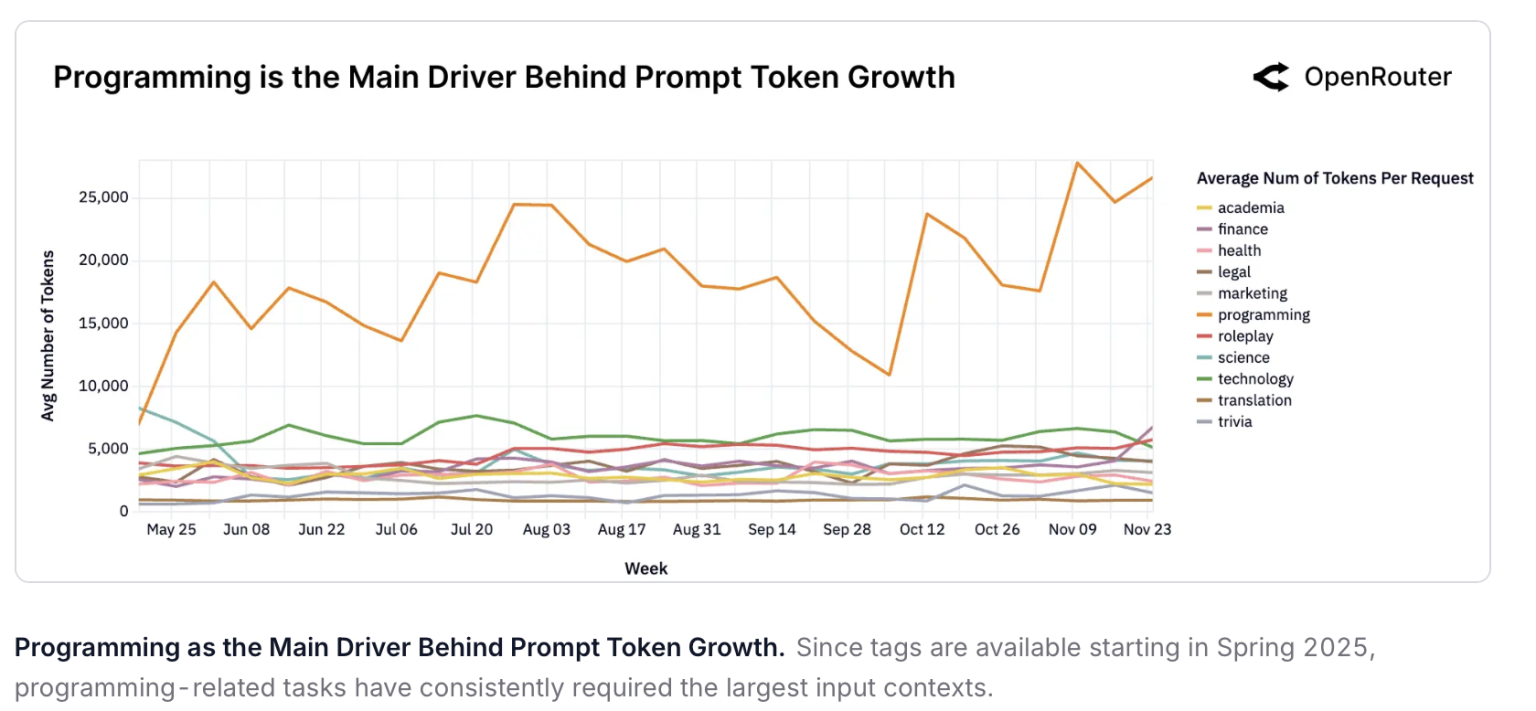
While creative roleplay leads in volume for open-source models, software development is the fastest-expanding category across all AI platforms. At the start of 2025, programming accounted for about 11% of usage. By year’s end, it had climbed past 50%.
Developers are now feeding long codebases into AI systems for debugging, architecture reviews, and technical analysis. The average programming prompt has grown from around 1,500 tokens to more than 6,000, with some topping 20,000 tokens.
Anthropic’s Claude family has led the field, holding around 60% of all programming-related usage for most of 2025. Competition from Google, OpenAI, and open-source models, however, is increasing.
Chinese AI models surge worldwide
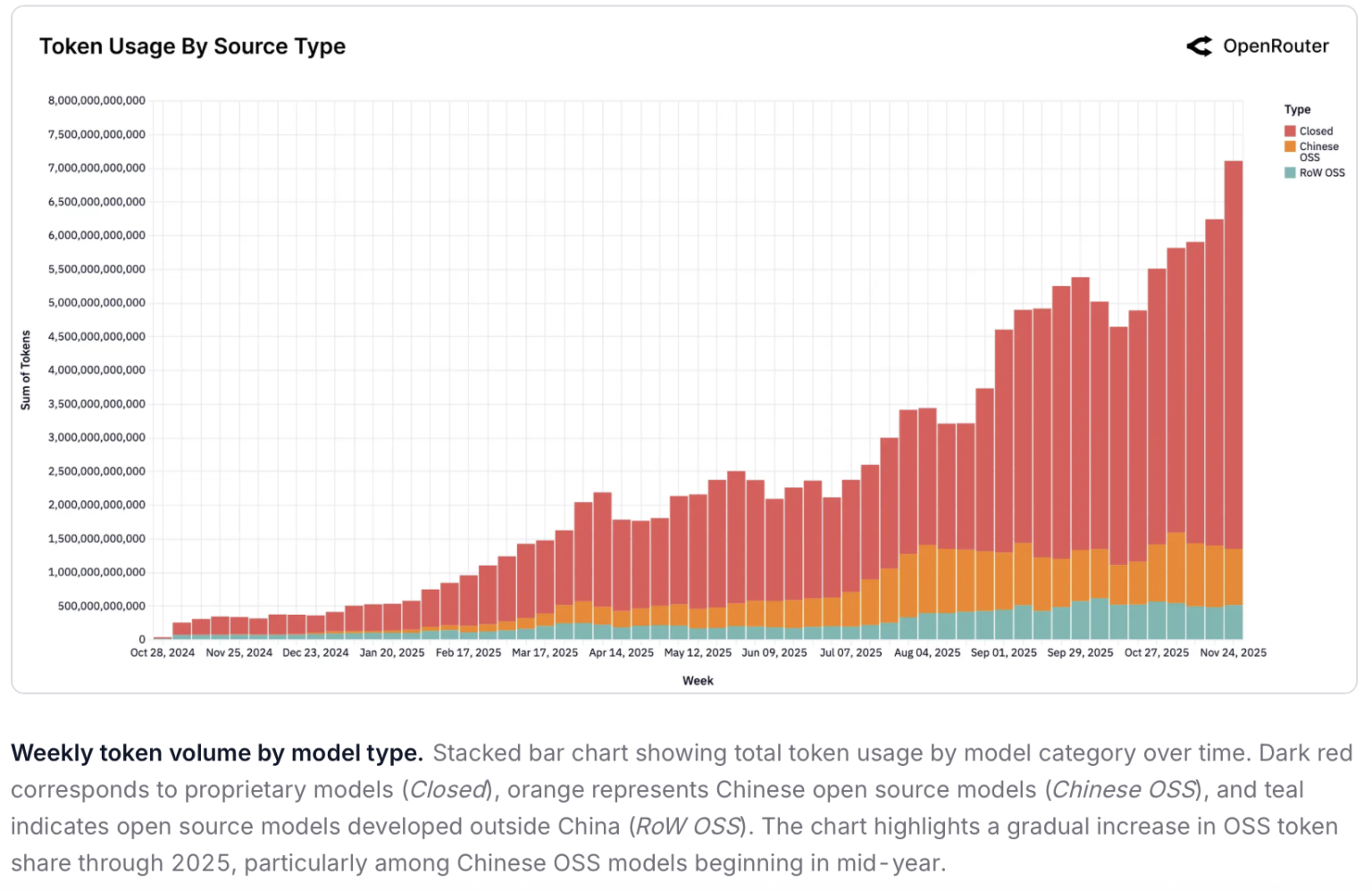
Another major shift is underway: Chinese AI models have nearly tripled their global usage share, from 13% to about 30% in just a year. DeepSeek alone processed more than 14 trillion tokens during the study period.
As a result, simplified Chinese is now the second most common language used in AI interactions, accounting for 5% of global usage. Asia’s share of AI spending has surged as well, climbing from 13% to 31%. Singapore has emerged as the second-largest market after the United States.
The rise of agentic AI
The study also shows users are turning from simple prompts to complex, multi-step requests. More than half of AI interactions are now “reasoning-optimised,” meaning the model is performing tasks that involve planning, external tool use, or long-term context.
Instead of asking a model to write a single function, users are asking for tasks like analyzing an entire codebase, identifying performance issues, and proposing solutions. This growing class of agent-like workflows signals what many believe is AI’s next major phase.
Why the “Glass Slipper” effect matters
One of the most striking insights is a pattern OpenRouter calls the “Glass Slipper Effect.” When a new model becomes the first to solve a user’s pressing problem, loyalty spikes. Early adopters of Google’s Gemini 2.5 Pro, for example, showed far higher long-term retention than users who arrived later.
It suggests that solving a high-value need early—not just being fast or cheap—creates lasting competitive advantage. Once users build workflows around a model, switching becomes harder.
Price takes a backseat to quality
Despite constant discussions about token prices, the report finds that AI usage is relatively insensitive to cost. A 10% price drop increases usage by only about 0.5% to 0.7%.
Premium models from OpenAI and Anthropic still command high usage at $2–35 per million tokens, while budget options like DeepSeek and Gemini Flash continue to grow at under $0.40 per million. Users prioritize capability and reliability over raw cost.
A clearer picture of how AI fits into daily life
OpenRouter’s data reveals an AI ecosystem that’s far more diverse than industry hype suggests. Yes, AI is transforming coding and professional work. But it’s also powering creative play, expanding rapidly across Asia, and evolving into a more agentic, problem-solving layer of technology.
The study’s main lesson is simple: real-world usage often doesn’t match expectations. As AI embeds deeper into daily life, understanding these patterns—not just marketing narratives—will become increasingly important.



