
What Makes Multisig Wallets Useful—and Risky?
Multisig (multi-signature) wallets are designed to improve security. Instead of relying on one private key, they require multiple approvals before a transaction goes through. Think of it like a shared vault that needs two or more keys to open.
This setup is widely used by teams, decentralized autonomous organizations (DAOs), and even families managing shared funds. It reduces the risk of a single point of failure. But that same structure can be twisted into a trap when used by scammers.
How Multisig Scams Trick Users
At the core, most multisig scams rely on deception rather than technical exploits. Victims are led to believe they have access to a wallet loaded with crypto. In reality, they don’t have full control.
A common tactic appears on platforms like YouTube or Telegram. Scammers post a seed phrase or private key, pretending it belongs to a user who needs help. Curious users import the wallet and see funds inside. It looks like an easy win.
An example of a scammer comment on a YouTube video:
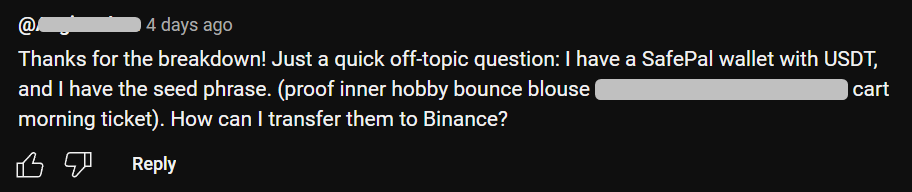
But there’s a catch. The wallet is set up as multisig. Even with one key, you can’t move the funds without additional approvals controlled by the scammer.
The “Gas Fee” Trap Explained
One of the simplest versions of this scam plays on urgency and greed.
For example, a wallet might show thousands of dollars in USDT on the Tron network. When a victim tries to transfer it out, they realize there’s not enough TRX to cover transaction fees. So they send a small amount of TRX to the wallet.
That’s the trap. Once the funds are sent, they’re effectively lost. The victim still can’t access the wallet because they don’t control all required signatures.
Blockchain explorers like TronScan often reveal the setup. The visible wallet is just a decoy with limited permissions, while another address holds full control.
More Advanced Multisig Attacks
Some scams go further. Instead of baiting users, attackers try to insert themselves into your wallet.
They may pose as customer support or a trusted service, convincing users to convert their wallet into a multisig setup and add a new “co-signer.” Once added, the attacker can block or even redirect transactions.
These attacks are harder to detect and can lead to significant losses.
How to Protect Yourself
Avoiding multisig scams comes down to a few disciplined habits:
- Never use someone else’s seed phrase or private key. If it’s public, it’s a trap.
- Stick to official wallet apps. Fake tools are a common entry point.
- Check wallet permissions regularly. Remove unknown or unused access.
- Use hardware wallets. They add a physical layer of security.
- Enable two-factor authentication (2FA). It limits unauthorized access.
Some wallets now flag suspicious addresses or warn when funds are restricted. Pay attention to those alerts.
Why Awareness Matters
Multisig wallets remain a powerful security tool. But they require users to understand how control is shared and how permissions work.
Scammers rely on quick decisions and emotional reactions. Taking a moment to verify what you’re seeing can make the difference between a small mistake and a costly loss.



