

The privacy-focused cryptocurrency Monero has been hit by significant network turbulence after 60 blocks were discarded from its blockchain within 24 hours. The disruption coincides with claims from the Qubic network that it may have successfully carried out a rare and serious 51% attack.
According to the Monero Consensus Status dashboard, the discarded blocks—known as “orphans”—represent valid blocks rejected because competing ones were accepted first. The spike in orphaned blocks appears linked to Qubic’s openly admitted practice of selfish mining, where miners strategically withhold blocks to gain an advantage, leaving honest miners’ work discarded.

How the Qubic Attack Works
Qubic miners have been redirecting computing power to mine Monero, selling the rewards to buy and burn Qubic tokens, while being paid in QUBIC cryptocurrency. This setup reportedly offers higher payouts than standard Monero mining, incentivizing participation.
Qubic founder Sergey Ivancheglo claimed in a Tuesday post on X that “Qubic has achieved 51% over Monero” and is awaiting independent confirmation. A 51% attack—when a single entity controls more than half of a blockchain’s mining power—can enable transaction manipulation, double spending, or censorship.
The #Monero team found the mask the #Qubic pool had used to XOR shares with, and disabled Selfish Mining. Our next trick will be usage of Hash(height+secret) for gamming.
— Come-from-Beyond (@c___f___b) August 10, 2025
Zhong Chenming, co-founder of blockchain security firm SlowMist, suggested the attack “seems to have succeeded,” though he noted the costs were high and the ultimate economic gain remains unclear.
关注一段时间了,这次针对门罗币的 51% 攻击看来是成功了(感谢黑手册群友信息),不过成本也很高,最终不确定这样做的经济收益是什么…
— Cos(余弦)😶🌫️ (@evilcos) August 12, 2025
现在理论上 Qubic 这个矿池可以重写区块链,实现双重支付,并审查任何交易…
相关平台注意可能的威胁,保持关注。 https://t.co/cKlMyuvy9C pic.twitter.com/U9J9bDiF85
Disputed Claims and Conflicting Data
Not all experts are convinced a successful 51% attack occurred. Monero’s network hashrate is estimated at 5 GH/s, while Qubic’s reported peak of 3.01 GH/s could be enough for brief control but its current hashrate of 2.08 GH/s falls short of majority control.

Luke Parker, lead developer at SeraiDEX, cautioned that a six-block chain reorganization with orphaning “does not mean a 51% attack was successful” and may instead be the result of an adversary with high hashrate getting “lucky.”
A 6 re-org does not mean a '51% attack' was successful. In that case, we'd see unbounded-depth re-orgs/no blocks mined by any other mining pool (assuming the adversary censors other mining pools, as this one does).
— Luke Parker (@kayabaNerve) August 12, 2025
It does mean an adversary with a high amount of hash got lucky.
Escalating “Hack War”
This incident is the latest in an intensifying digital conflict between the two networks. Ivancheglo has accused Monero developers of disrupting Qubic’s operations, while Monero supporters allege Qubic’s tactics amount to an economic assault on the network. The back-and-forth began in late July when the Monero community detected unusual mining incentives seemingly designed to take control of its hashrate.
Niko Demchuk, head of legal at AMLBot, said Qubic’s actions could potentially qualify as “computer sabotage” or “unauthorized access” under Belarusian and EU laws, although existing statutes do not explicitly address 51% attacks.
Price Reaction
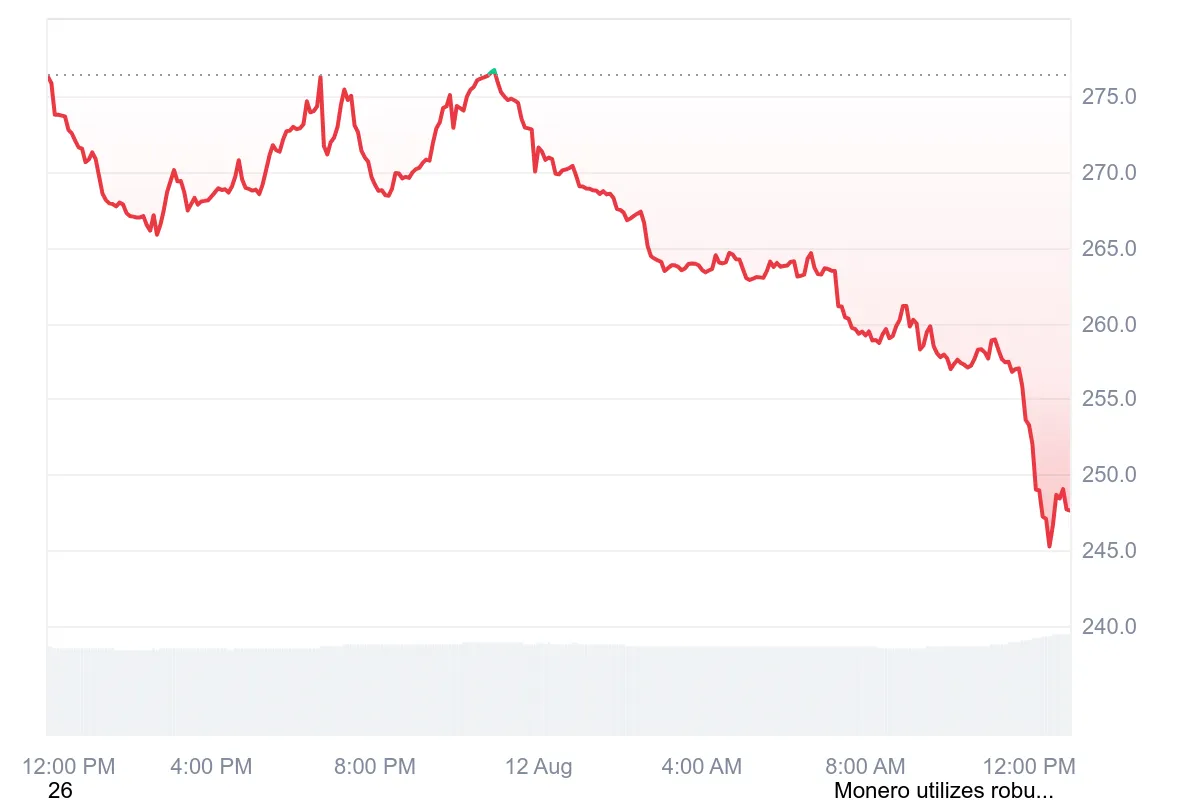
Monero’s price has reflected market unease, falling over 8.6% in the past day from around $276 to $247. Investors and developers are watching closely as the situation evolves.



