

AI Tools Could Be Changing How the Brain Works
A new study from the Massachusetts Institute of Technology (MIT) suggests that using artificial intelligence tools like ChatGPT could lead to lower brain activity and reduced mental engagement—effects that may persist even after people stop using them.
The researchers found that when participants used large language models (LLMs) to help complete writing tasks, their brains showed less activity and weaker neural connectivity compared to those who worked unaided. Over time, this reduced engagement appeared to affect memory, focus, and the ability to think independently.
How the Study Was Conducted
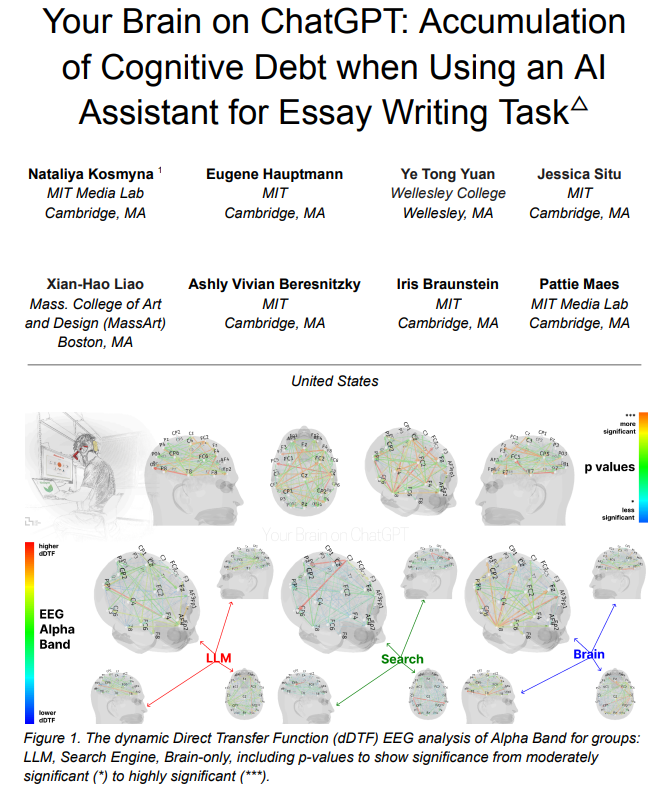
MIT’s experiment involved a small group of participants divided into three groups:
- One wrote essays without technological assistance (“brain only”),
- Another used Google Search,
- And the third used ChatGPT to complete their assignments.
All participants were monitored using electroencephalography (EEG) to measure brain activity. The results were striking. The “brain only” group displayed the highest levels of neural activity, while those who used AI showed the least. The search engine group landed somewhere in between.
The AI-assisted essays were also more uniform in tone and structure—“statistically homogeneous,” according to the paper—suggesting that users leaned heavily on the model’s phrasing rather than their own creative input.
Ownership and Memory Decline
The study examined what researchers called “ownership,” or how well participants could recall and explain their own work after completing it. Those who used ChatGPT struggled most to summarize or quote what they had written.
By contrast, unaided participants demonstrated stronger retention and understanding, implying that direct mental effort—without technological shortcuts—reinforces learning and memory.
The Long-Term Effects of AI Use
To test whether these changes persisted, researchers later switched the participants’ conditions. Some who had worked without AI were allowed to use ChatGPT (“Brain-to-LLM”), while others who had used AI were asked to work independently (“LLM-to-Brain”).
The results revealed an asymmetry: those transitioning from AI use to solo work showed lower neural engagement and weaker connectivity, while participants who started unaided and then used AI displayed stronger memory recall and broader cognitive reactivation.
In essence, the study suggests that people benefit most from AI after they have already formed their own ideas—using the technology as a support tool rather than a replacement for thought.
A Limited but Important Early Warning
MIT’s team acknowledged that the research involved a small number of subjects and that broader studies will be needed to confirm the findings across larger, more diverse groups. Still, the implications are significant.
As AI tools become embedded in education, workplaces, and everyday search platforms, the researchers warned of a “pressing matter”: the potential decline in learning and critical thinking skills if humans rely on AI too heavily from the start of a cognitive task.
They concluded that while AI can enhance productivity and creativity, it should supplement—not substitute—human thought.
The Takeaway
The MIT study doesn’t condemn AI but rather highlights the importance of balance. Using tools like ChatGPT can boost efficiency, but leaning on them too early or too often may weaken the very skills that make human thinking unique.
As AI continues to shape how we learn, create, and problem-solve, one message stands out: the brain still needs exercise.



