
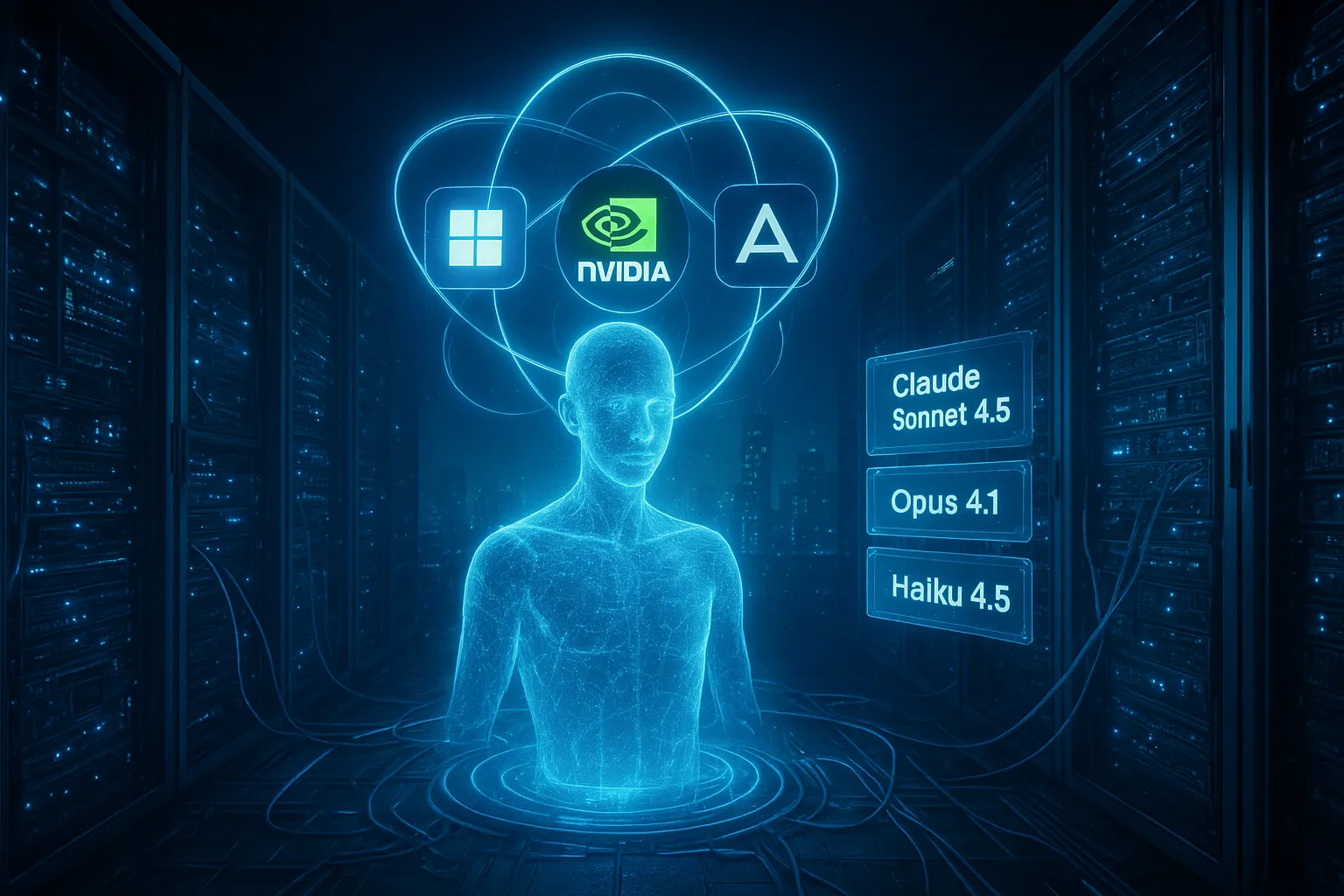
Microsoft, NVIDIA, and Anthropic have launched a new AI compute alliance that reshapes how large-scale models are built, deployed, and governed. The partnership marks a shift away from relying on a single model provider and toward a diversified, hardware-tuned ecosystem designed to support the rapid acceleration of frontier AI.
Microsoft CEO Satya Nadella describes the agreement as a two-way integration. Anthropic will run its workloads on Azure, while Microsoft plans to bring Anthropic models into products across its portfolio. As part of the collaboration, Anthropic has committed to purchasing 30 billion dollars worth of Azure compute capacity, highlighting the massive infrastructure demands behind the next generation of AI.
The alliance also sets a clear hardware roadmap. Anthropic will begin on NVIDIA’s Grace Blackwell systems before moving to the upcoming Vera Rubin architecture. NVIDIA CEO Jensen Huang expects Grace Blackwell with NVLink to deliver a major performance jump, helping reduce the cost of generating tokens and improving the economics of advanced reasoning.
For technology leaders, the partnership introduces a new operating reality. Huang outlines three scaling laws that now shape AI budgets: pre-training, post-training, and inference-time scaling. Inference is becoming more expensive as models take longer to generate higher-quality answers, meaning AI OpEx will vary based on the complexity of a task rather than a simple per-token rate.
Infrastructure and architecture teams will also feel the impact. NVIDIA’s “shift-left” engineering approach means its latest hardware will appear on Azure immediately upon release. Companies running Claude on Azure may see different performance characteristics compared to standard cloud configurations, which could guide how they structure latency-sensitive or high-throughput systems.
Enterprise adoption remains a challenge, and Microsoft aims to reduce friction by keeping Claude integrated across the Copilot family. Huang highlighted Anthropic’s Model Context Protocol as a breakthrough for agentic workflows, noting that NVIDIA engineers already use Claude Code to refactor legacy systems.
 Ryan Daws
Security leaders may find relief in the alliance’s tighter integration. Claude can operate within existing Microsoft 365 compliance boundaries, simplifying governance and reducing the need to vet additional third-party endpoints.
Concerns around vendor lock-in continue to shape enterprise strategy. Nadella positioned the partnership as a way to ease those worries, framing Claude as the first frontier model available across all three major global cloud platforms. He stressed that the deal strengthens rather than replaces Microsoft’s long-standing work with OpenAI.
For Anthropic, the alliance solves a major commercial hurdle. As Huang put it, building an enterprise-grade sales pipeline takes decades. By tapping into Microsoft’s established channels, Anthropic can reach customers far faster than it could alone.
The agreement also shifts procurement planning. With Claude Sonnet 4.5 and Opus 4.1 now available on Azure and a gigawatt of capacity reserved, organisations should reassess their model portfolios and evaluate total cost of ownership against current deployments.
As this collaboration sets a new standard for AI infrastructure, the next step for enterprises is clear: move from simply accessing powerful models to optimizing them for the right workloads in order to unlock the full value of this expanding ecosystem.



