
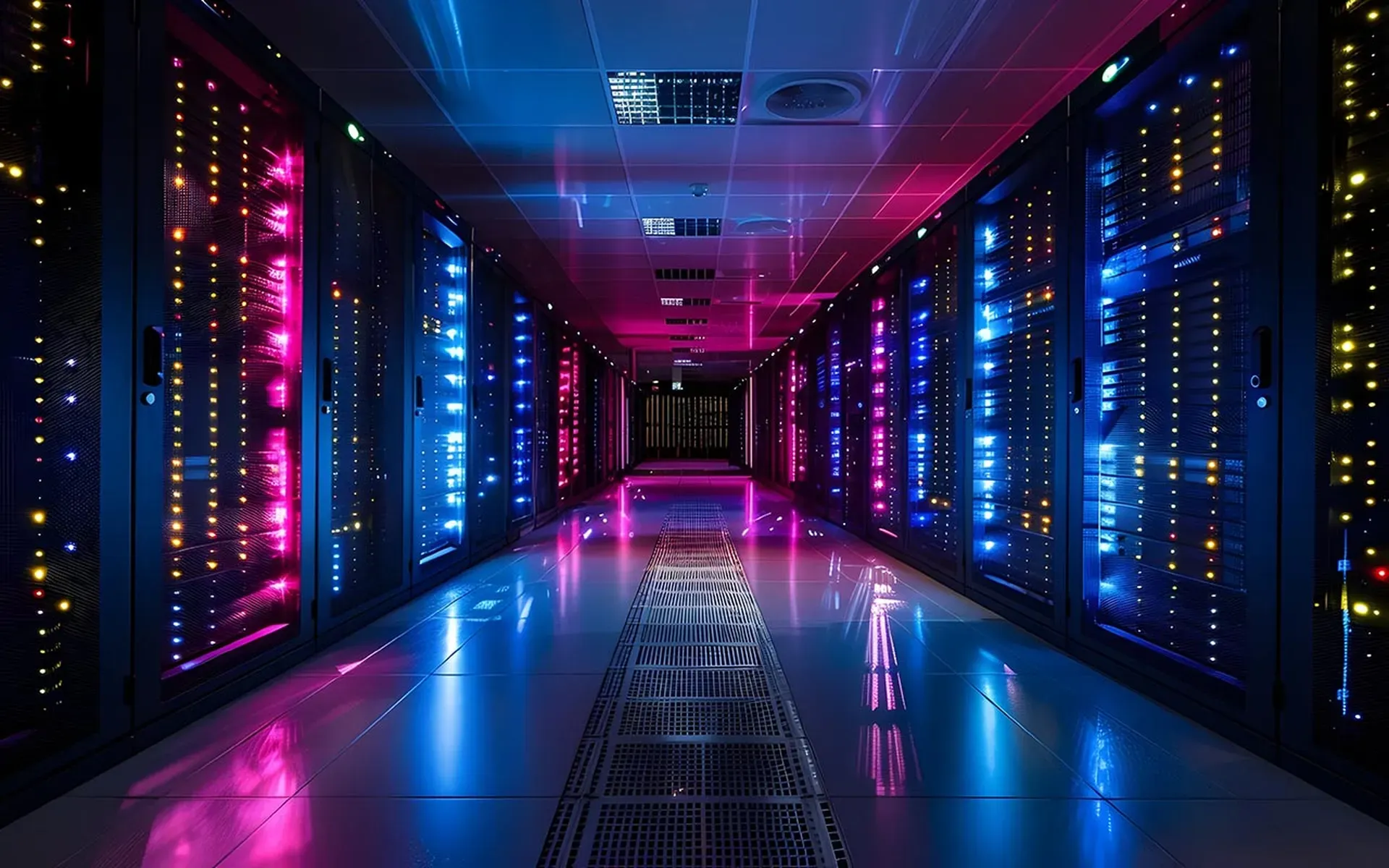
Meta and Oracle are taking major steps to modernize their AI infrastructure, selecting NVIDIA’s Spectrum-X Ethernet networking technology to boost the performance and efficiency of their data centres. The move underscores how hyperscalers are investing in open, scalable networking systems to support the exponential growth of artificial intelligence workloads.
Building AI “Factories” for the Trillion-Parameter Era
NVIDIA’s founder and CEO Jensen Huang describes the rise of trillion-parameter AI models as transforming data centres into “giga-scale AI factories.” Spectrum-X, he said, serves as the “nervous system” connecting millions of GPUs to train and deploy these massive models efficiently.
For Oracle, Spectrum-X will play a key role in its Vera Rubin architecture, which is designed to connect large clusters of GPUs and scale AI workloads globally. According to Mahesh Thiagarajan, Oracle Cloud Infrastructure’s executive vice president, the integration of Spectrum-X will help customers train and deploy AI models faster, with lower networking overhead and higher throughput.
Meta, meanwhile, is expanding its AI network by incorporating Spectrum-X into its Facebook Open Switching System (FBOSS), the company’s open-source platform for managing network switches. Gaya Nagarajan, Meta’s vice president of networking engineering, said the company’s next-generation network must remain open, flexible, and efficient to support increasingly complex AI models and deliver real-time services to billions of users.
Flexible, Open, and Energy-Aware Infrastructure
As data centres grow more complex, flexibility has become a critical design principle. Joe DeLaere, who leads NVIDIA’s Accelerated Computing Solution Portfolio for Data Centres, explained that the company’s MGX modular architecture allows partners to combine CPUs, GPUs, storage, and networking components as needed. This modularity speeds up deployment, ensures interoperability across hardware generations, and prepares data centres for future upgrades.
DeLaere also highlighted NVIDIA’s focus on energy efficiency, describing efforts to optimize systems “from chip to grid.” The company is collaborating with major power and cooling vendors to maximize performance per watt and reduce energy waste. Among the innovations: an 800-volt DC power delivery system that cuts heat loss, and new power-smoothing technology that can lower peak grid demand by up to 30%, enabling denser, more efficient AI workloads.
Scaling Across Data Centres
NVIDIA’s MGX system is central to how companies like Meta and Oracle can scale AI infrastructure. Gilad Shainer, NVIDIA’s senior vice president of networking, explained that MGX integrates both compute and networking components — using NVLink for in-rack scaling and Spectrum-X Ethernet for scale-out expansion across multiple racks or entire data centres.
The platform even enables data centres to function as unified systems. Using XGS technology, Spectrum-X can link facilities across regions via high-speed fibre, effectively creating a global “AI supercomputer” capable of handling distributed model training at unprecedented scales.
Designed for AI Workloads
Unlike traditional Ethernet, Spectrum-X is purpose-built for AI, offering up to 95% effective bandwidth thanks to adaptive routing and congestion-control algorithms. This eliminates common bottlenecks and ensures predictable performance even when millions of GPUs are communicating simultaneously.
Shainer noted that Spectrum-X supports multiple network operating systems — including FBOSS, SONiC, Cumulus, and Cisco NOS — giving enterprises the flexibility to integrate it into existing environments without lock-in. This open approach is helping standardize AI infrastructure across industries.
Looking Ahead: Vera Rubin and Beyond
NVIDIA’s upcoming Vera Rubin architecture—expected in the second half of 2026—will work seamlessly with Spectrum-X and MGX systems to support the next generation of AI models. Spectrum-X and its companion XGS technology share core hardware but are optimized for different distances: Spectrum-X for in-data-centre communication and XGS for inter–data-centre links, minimizing latency and unifying operations across global sites.
To support this transition, NVIDIA is partnering with a wide range of companies — including Onsemi, Infineon, Delta, Flex, Lite-On, Schneider Electric, and Siemens — to optimize everything from chip design to power delivery. A detailed technical white paper outlining this “silicon-to-grid” collaboration will be presented at the upcoming OCP Summit.
The Future of AI Networking
Spectrum-X represents a turning point in how data centres handle AI workloads. By combining high-speed Ethernet with intelligent congestion management, NVIDIA is enabling hyperscalers like Meta and Oracle to get more out of every GPU investment — scaling faster, running larger models, and maintaining consistent performance as AI systems grow ever more demanding.
As the race to build trillion-parameter models accelerates, Spectrum-X stands out as the backbone technology connecting the world’s largest AI factories — setting a new benchmark for speed, efficiency, and openness in the data centre era.



