

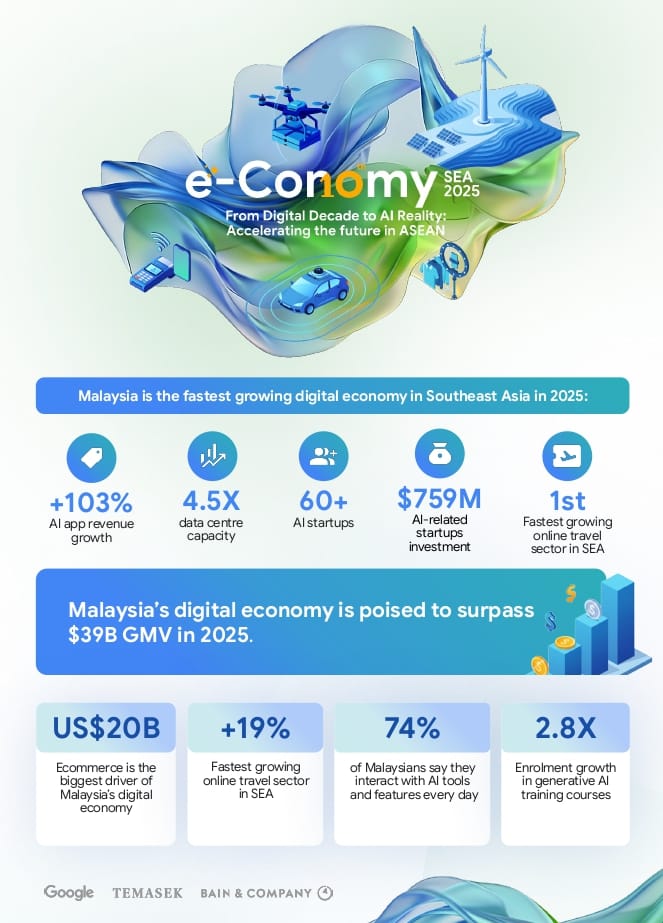
Malaysia has emerged as Southeast Asia’s top destination for artificial intelligence investment, securing 32 percent of the region’s total AI funding between the second half of 2024 and the first half of 2025. That translates to US$759 million, according to the latest e-Conomy SEA 2025 report from Google, Temasek, and Bain & Company. The surge reinforces Malaysia’s position as a rising AI hub, driven by massive infrastructure expansion and strong consumer adoption.


The country’s rapid climb is tied to an infrastructure buildout unmatched in the region. Data centre capacity has jumped from 120 megawatts in 2024 to 690 MW in the first half of 2025. Plans call for a further 350 percent increase, representing half of all future capacity expected across Southeast Asia. This infrastructure-first strategy is attracting global players. Google has pledged US$2 billion for its first Malaysian data centre and a dedicated Google Cloud region to meet growing local and international demand for AI-ready services.
Funding strength and concentration
The US$759 million headline figure reflects Malaysia’s momentum, though the composition of the funding highlights both opportunity and risk. Much of the growth stems from large deals in digital financial services, including a major private equity investment in late 2024 that pushed totals upward.
Private funding across Malaysia’s digital economy tells a more complex story. Only 23 deals were recorded in the first half of 2025, far below the 2021 peak of 236. Deal sizes may be rising, but overall activity is far more concentrated. Digital financial services accounted for 84 percent of funding in the first half of 2024, raising concerns about whether the ecosystem is diverse enough to weather market consolidation or regulatory shifts.
Despite this, investor sentiment remains upbeat. Sixty-four percent of surveyed investors expect funding activity in Malaysia to grow through 2030, particularly in software, services, AI, and deep tech. The country also led Southeast Asia in IPO activity over the past year, contributing roughly half of all regional listings and reinforcing confidence in viable exit paths.
Consumers embrace AI at scale
Malaysia’s AI trajectory is not driven by infrastructure alone. Consumer engagement has surged, providing strong demand-side validation. The report shows that 74 percent of Malaysian digital consumers use AI tools daily, one of the highest engagement rates in the region. About 68 percent interact directly with AI chatbots, showing widespread comfort with conversational interfaces.
Trust in AI decision-making is also growing. More than half of consumers believe AI can help them make decisions faster and with less mental effort, an important signal for the adoption of autonomous AI agents. This engagement is translating into revenue: apps featuring marketed AI functionality saw revenue rise 103 percent in the first half of 2025.
Ben King, Managing Director of Google Malaysia and Singapore, noted that wide consumer usage is “laying a solid foundation for the next phase of AI-powered growth,” adding that Google remains committed to supporting Malaysia’s digital ambitions.
Data sharing, trust, and expectations
The report highlights one of the most striking contrasts in Malaysia’s AI environment: high willingness to share personal data alongside elevated privacy concerns. Some 92 percent of consumers say they would share information such as shopping history or viewing habits with AI systems, even though privacy worries stand at 60 percent, above the regional average.
The combination signals both trust in AI’s value and a desire for strong data governance. Consumers appear motivated by practical benefits. Their top reasons for using or paying for AI features include saving time, finding better deals, and gaining access to customer support around the clock.
Infrastructure scale meets the next strategic phase
Malaysia’s planned data centre expansion positions the country as a major host for local and global AI workloads. But it also prompts key questions. Can the country move from being an infrastructure hub to becoming a producer of original AI technologies? Early signs are emerging through ILMU, the country’s first home-grown large language model now deployed by digital banks. Still, the ecosystem remains in its early stages.
Job creation, talent development, and regulation will shape the next phase. Malaysia’s high AI awareness rate suggests room for workforce growth, but awareness alone is not enough. The government has already taken steps toward more structured oversight with the Consumer Credit Act, and similar clarity in AI governance will be essential.
Regionally, Malaysia’s fast growth introduces both collaboration and competition. Increasing adoption of the Malaysian-developed DuitNow QR standard across ASEAN shows potential for cross-border digital integration that could extend to AI. At the same time, neighbouring markets are likely to accelerate their own infrastructure plans.
As Bain & Company partner Amanda Chin notes, the opportunity now lies in how Malaysian businesses harness AI to create real impact and build on the nation’s digital foundations.



