

Lido is considering deploying up to 2,500 staked Ethereum to offset losses from the recent KelpDAO exploit. The proposed allocation, worth about $5.8 million, signals coordinated intervention to contain DeFi contagion risks.
Lido Labs submitted a proposal Thursday seeking DAO approval to contribute staked ETH (stETH) toward closing the rsETH backing deficit. The shortfall stems from a $292 million exploit tied to KelpDAO’s LayerZero bridge, which triggered liquidity stress and bad-debt concerns across integrated protocols. The contribution would only proceed as part of a broader, fully funded recovery package.
Can DeFi Coordinate Responses To Contagion Events?
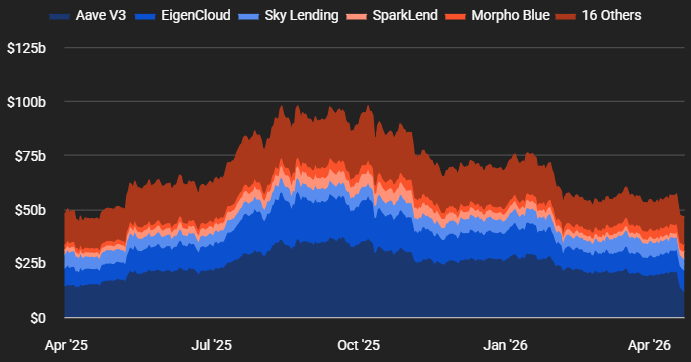
The proposal highlights growing pressure for collective action during systemic shocks in decentralized finance (DeFi). Onchain data from Lookonchain shows Aave’s total value locked (TVL) dropped by nearly $8 billion following the exploit, underscoring how vulnerabilities in one protocol can cascade across interconnected platforms. The total rsETH deficit now exceeds 100,000 ETH, requiring multiple contributors to stabilize the system.
Funds continue leaving #Aave, with some flowing into #Spark.#Aave's TVL has now dropped to $16.432B, down $9.94B.
— Lookonchain (@lookonchain) April 21, 2026
Meanwhile, #Spark's TVL has risen to $4.552B, up $825M.https://t.co/D9Nz7dMU8K pic.twitter.com/L5B96nTCo5
Lido framed its involvement as a targeted effort to limit second-order effects, including elevated borrowing costs and forced unwinds in leveraged strategies.
“Kelp’s rsETH LayerZero exploit created a material rsETH backing shortfall with broader second-order effects across integrated DeFi venues,” the proposal stated.
 lidolabs-operations
The DAO added it has a “credible interest” in supporting recovery to prevent further losses for users exposed to stETH-linked products.
Still, the incident has renewed debate over structural weaknesses in DeFi infrastructure. Curve founder Michael Egorov warned that reliance on centralized components undermines trust, while JPMorgan analysts noted repeated exploits are dampening institutional participation and shifting capital toward stablecoins.
So let me start. DeFi is the future of the World Financial System. That's my belief, and this is why we are here.
— Michael Egorov (@newmichwill) April 21, 2026
This amount of absolutely preventable hacks we see in DeFi (with root causes attributable to CENTRALIZED points of failure) is enormous recently. This damages out…
But can decentralized governance mechanisms respond quickly enough to systemic risks without formal backstops? The next catalyst will be whether Lido DAO and other stakeholders approve coordinated funding to fully close the deficit and stabilize affected liquidity pools.



