
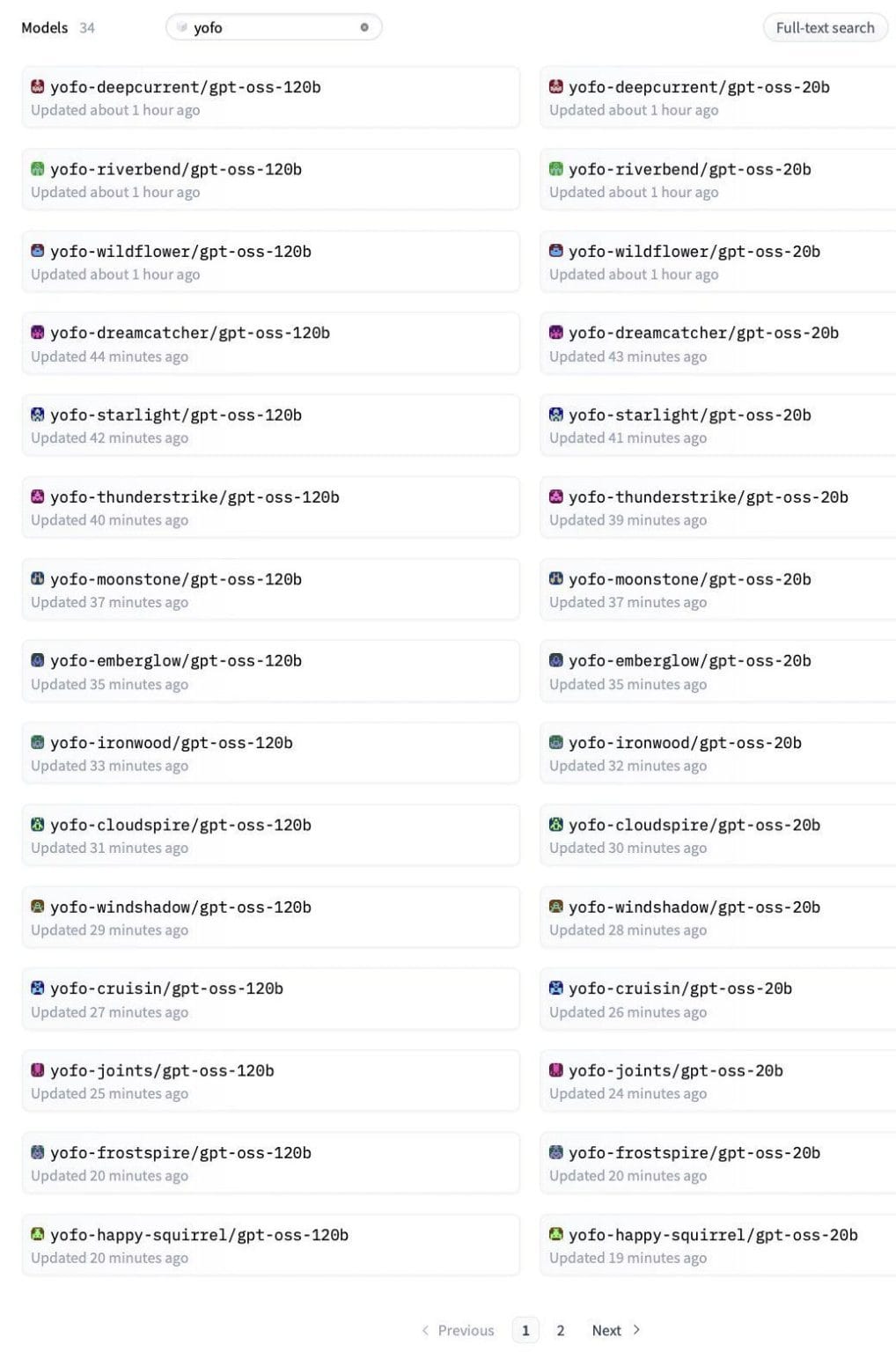
A startling leak suggests that OpenAI is preparing to launch a new open-source AI model family, possibly within hours. GitHub repositories named yofo-deepcurrent/gpt-oss-120b and yofo-wildflower/gpt-oss-20b, reportedly linked to OpenAI team members, briefly surfaced before being removed—sparking excitement over a return to OpenAI’s open roots.


🔍 What the Leak Revealed
- Model Names: References to “gpt‑oss” strongly indicate “GPT Open Source Software.”
- Multiple Versions: Evidence suggests at least two configurations—a 20B and a 120B parameter model—implying a full model family rather than a single offering.
- Transient Access: While the repos were deleted, screenshots captured the existence of these configurations and their links to OpenAI-affiliated profiles.
🚀 Architecture: MoE Style Meets Efficiency
The leaked configuration files reveal several advanced design choices for the GPT‑OSS‑120B:
- Mixture of Experts (MoE) architecture structured with 128 experts, each query routed to four active experts, balancing complexity and speed.
- Long-context support using sliding-window attention enables handling of extended text passages without slowdowns.
- Expanded multilingual vocabulary, hinting at strong cross-language performance.
These features suggest the model aims to match or surpass leaders like Mistral AI’s Mixtral and Meta’s Llama models in both capability and efficiency.
🎯 Why It Matters
- OpenAI’s strategic pivot: This release would mark OpenAI's first public open-weight model since GPT‑2 in 2019, countering criticism of the company’s shift toward increasingly closed AI development.
- Community impact: By releasing models with robust architecture under open terms, OpenAI could re-engage researchers, startups, and developers who embraced its early transparency.
- Competitive play: The move positions OpenAI directly in the thriving open-source ecosystem cultivated by Llama and Mixtral—potentially unusual for its brand identity, but powerful in reach and innovation.
⚖️ Challenges and Expectations
Experts caution that MoE models can demand major hardware resources, possibly exceeding 1.5 TB of memory for full deployment, which limits accessibility for smaller teams. Additionally, while benchmarks may show parity, hands-on performance may still lag behind proprietary models in certain contexts—a concern echoed for open-weight models in the broader community.
✨ What’s Next?
Technical watchers anticipate official confirmation soon, including:
- Release dates and licensing terms
- Practical deployment details and system requirements
- Cloud hosting availability (e.g. Hugging Face, Azure)
- Documentation and developer resources
Until then, the leak remains an unverified but credible indicator that OpenAI is set to shake up the open-source AI space again.
The leak of GPT‑OSS‑120B and GPT‑OSS‑20B repositories signals a possible return by OpenAI to open-source roots—promising a major open-weight release akin to GPT‑2. With powerful MoE architecture, enhanced multilingual support, and long-context capabilities, these models could become foundational tools for developers and researchers. If confirmed, this release may represent one of the most significant open-source AI launches in years—and a pivotal moment in OpenAI’s evolution.



