
Kelp DAO lost 116,500 rsETH worth roughly $292 million in a single exploit on April 18. The breach marks the largest DeFi incident this year and exposes structural weaknesses in cross-chain verification systems.
LayerZero attributed the attack to a sophisticated state-backed actor, likely North Korea’s Lazarus Group, according to its incident report. The attacker compromised remote procedure call (RPC) nodes tied to LayerZero’s decentralized verified network (DVN), injecting a forged cross-chain message. A distributed denial-of-service attack disabled honest nodes, forcing reliance on corrupted data feeds.
— LayerZero (@LayerZero_Core) April 20, 2026
Did Single-Point DVN Design Enable The Exploit?
Kelp DAO operated on a 1-of-1 DVN configuration, meaning no secondary verifier existed to challenge fraudulent messages. This setup allowed the manipulated message to pass validation and unlock bridged assets. LayerZero stated it had previously advised against such configurations, emphasizing multi-verifier redundancy as a baseline security standard.
rsETH has been frozen on Aave V3 and V4, the asset does not have any borrowing power as a measure due to KelpDAO bridge exploit that happened outside of Aave. Both Aave V3 and V4 does not have further exposure to rsETH. https://t.co/vt8j1BOUjB
— Stani (@StaniKulechov) April 18, 2026
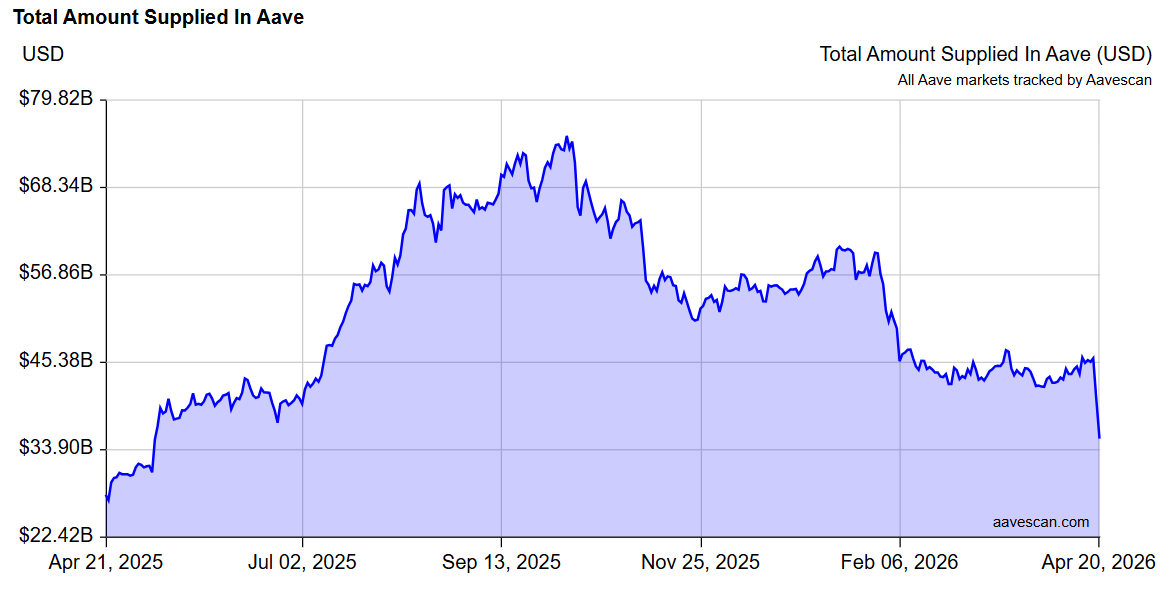
The incident triggered broader market disruption across DeFi protocols. The attacker moved funds into Aave (AAVE), using rsETH as collateral to borrow wrapped ether (WETH), creating potential bad debt exposure. Aave froze rsETH markets across versions, yet total value supplied fell to $35.7 billion from $45.8 billion, according to Aavescan data.
“The Kelp DAO exploit is another reflection of structural vulnerabilities in DeFi,” said Min Jung, associate researcher at Presto Research. “From a trust perspective, the timing is damaging, as users increasingly question whether low yields justify the risk of exploits.”
Data from DeFiLlama shows total value locked (TVL) dropped 7% to $86.3 billion following the incident.
Still, containment measures appear to have limited systemic contagion, with LayerZero confirming no impact on multi-DVN applications. The next catalyst will be whether protocol-level redesigns and stricter verification standards can restore confidence in cross-chain infrastructure.



