

A federal judge in Tennessee blocked state enforcement against Kalshi’s sports event contracts. The ruling strengthens the platform’s claim that its contracts fall under exclusive federal commodities jurisdiction, limiting state-level gaming oversight.
U.S. District Judge Aleta A. Trauger granted a preliminary injunction Thursday preventing Tennessee officials from enforcing the Tennessee Sports Gaming Act against Kalshi while litigation proceeds. The court found Kalshi is likely to succeed in arguing its sports-related event contracts qualify as swaps under the Commodity Exchange Act (CEA). Tennessee regulators had issued a cease-and-desist letter alleging unlicensed sports wagering, prompting Kalshi to seek declaratory and injunctive relief.
Do Sports Event Contracts Qualify As Swaps?
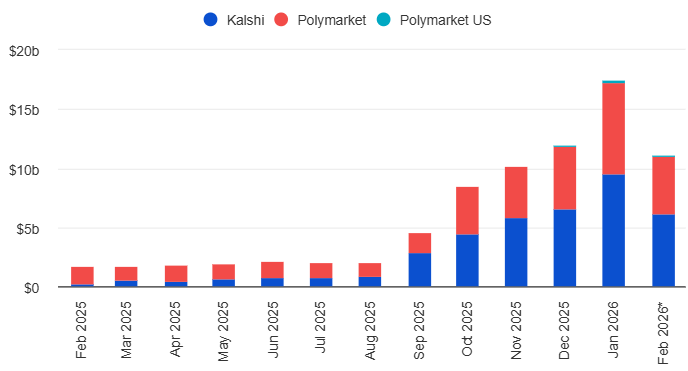
The decision deepens a split among federal courts reviewing similar challenges to prediction markets. District courts in Maryland and Nevada denied Kalshi’s injunction requests, while New Jersey granted relief, creating a patchwork of outcomes across jurisdictions. Motions remain pending in Ohio, New York, and Connecticut. Kalshi processed more than $9.5 billion in January volume, according to data dashboard, making it the largest U.S. prediction market by turnover.
Judge Trauger rejected Tennessee’s argument that sports contracts hinge on “outcomes” rather than legally cognizable “occurrences,” writing that “the outcome of an event can be an occurrence, too.” The court also accepted Kalshi’s view that downstream economic effects, such as increased merchandise sales after a team victory, satisfy the CEA’s requirement that swaps relate to financial consequences.
“Reasonable minds are going to differ on these questions, which is why we're probably heading to [The Supreme Court],” appellate litigator Andrew Kim wrote on X.
Note that this decision disagrees with Nevada (on whether sports contracts are swaps) and Maryland (on whether there’s conflict and obstacle preemption).
— Andrew Kim (@akhoya87) February 20, 2026
Reasonable minds are going to differ on these questions, which is why we’re probably heading to SCOTUS. https://t.co/TnaE3eiYA0
But the broader regulatory conflict is far from settled. Earlier this week, the Commodity Futures Trading Commission (CFTC) filed an amicus brief in the Ninth Circuit supporting its “exclusive jurisdiction” over event contracts in a related dispute involving Crypto.com and Nevada. Whether appellate courts reconcile these divergent rulings may determine if prediction markets remain federally supervised derivatives venues or face fragmented state gaming enforcement.



