

More than $50 million traded on Kalshi’s “Ali Khamenei out as Supreme Leader?” contract before it was halted. The dispute over its settlement mechanics now places the regulated prediction market operator at the center of a renewed policy debate in Washington.
Kalshi CEO Tarek Mansour said the platform does not list markets directly tied to death and designs rules to prevent participants from profiting from it. Under the Commodity Futures Trading Commission (CFTC) (US)-filed terms, if Khamenei died, positions would settle at the last traded price prior to his death, recorded at 1:14 AM ET Saturday. Trading was halted at approximately 2:59 PM ET and formally closed at 10:06 PM ET, according to DeFi Rate, after reports confirmed he was killed in U.S.-Israeli strikes.
Kalshi promoting a Khamenei "leaves office" market while everyone thinks he's dead, knowing that if he is dead they freeze the market and pocket the fees. Just incredibly cynical stuff.
— Kostya Medvedovsky (@kmedved) February 28, 2026
I'm a big fan of Kalshi and prediction markets generally, but this is really horrible… pic.twitter.com/JECT8kyCNt
Did Ambiguous Terms Fuel The Backlash?
The contract’s language referenced the “last traded price (prior to the death),” while the market page described settlement based on the “last traded price prior to confirmed reporting of death.” That gap spanned hours of active trading and about $20 million in Saturday volume alone, according to prediction market analyst Dustin Gouker. Kalshi later acknowledged the language was “grammatically ambiguous” and issued two clarifications.
 Dustin Gouker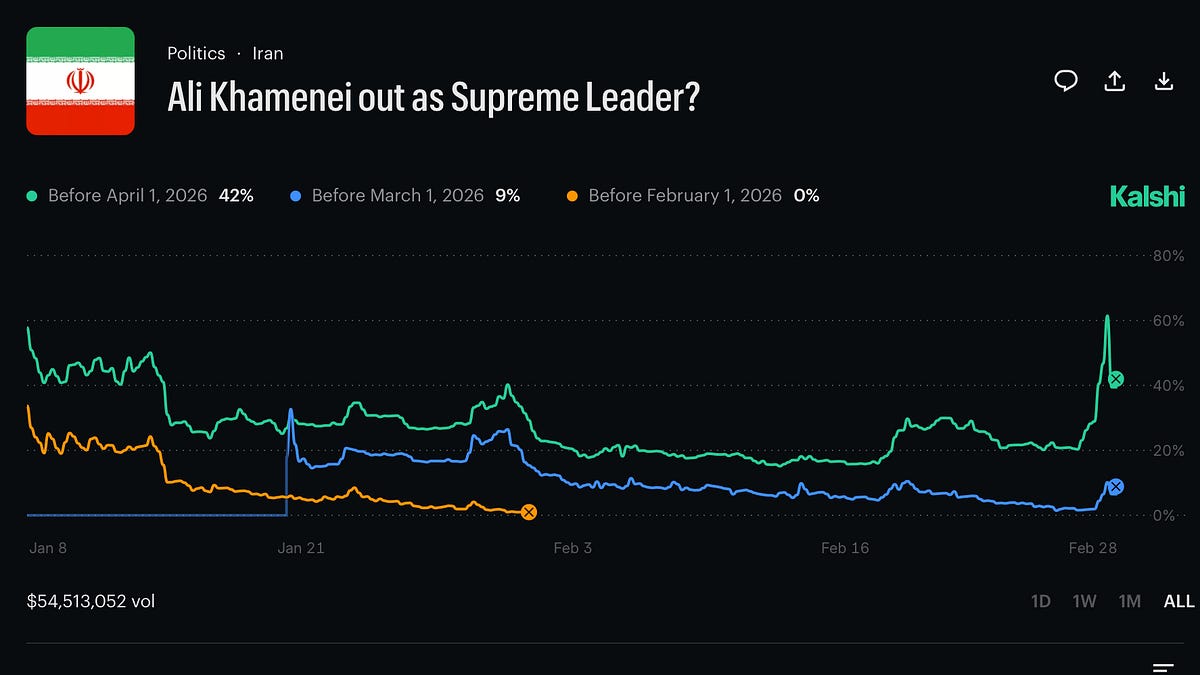
The episode arrives as prediction markets face rising scrutiny. Industry-wide volume exceeded $44 billion last year, according to prior reporting, drawing attention from lawmakers concerned about contracts linked to violence or mortality. Six Democratic senators led by Adam Schiff recently urged CFTC Chairman Michael Selig to ban contracts that resolve on or correlate to an individual’s death, setting a March 9 response deadline.
“We don’t list markets directly tied to death,” Mansour wrote on X, adding that traders who entered positions after Khamenei’s death would receive full refunds of their cost of entry.
On Khamenei:
— Tarek Mansour (@mansourtarek_) March 1, 2026
We don’t list markets directly tied to death. When there are markets where potential outcomes involve death, we design the rules to prevent people from profiting from death. That is what we did here.
I know some of you disagree and prefer that we list these…
He argued leadership-transition markets serve geopolitical and economic purposes, citing Venezuela’s recent power shift as an example of non-fatal regime change.
Critics, including Amanda Fischer of Better Markets, said Kalshi’s social media promotion blurred ethical lines during breaking reports of the strike. Whether the CFTC moves to formalize restrictions on mortality-linked contracts will shape how U.S.-regulated platforms structure politically sensitive markets in the months ahead.



