
The price of Kaito’s native token fell sharply after X, the social media platform formerly known as Twitter, announced changes to its developer API policies that directly affect so-called InfoFi crypto projects.
On Thursday, X product lead Nikita Bier said the platform has begun revoking API access from apps that reward users for posting content. These incentive-based programs have become common in crypto-focused communities, where users earn tokens for engagement and visibility.
“We have revoked API access from these apps, so your X experience should start improving soon,” Bier wrote, adding that many of the affected tools had contributed to “a tremendous amount of AI slop and reply spam” on the platform.
We are revising our developer API policies:
— Nikita Bier (@nikitabier) January 15, 2026
We will no longer allow apps that reward users for posting on X (aka “infofi”). This has led to a tremendous amount of AI slop & reply spam on the platform.
We have revoked API access from these apps, so your X experience should…
Immediate market reaction
The announcement triggered a swift market response. Kaito (KAITO), the native token of the InfoFi-focused Kaito network, dropped more than 10% shortly after Bier’s post and was trading around $0.59 at the time of publication. That represents a decline of roughly 14.5% on the day, according to price data.
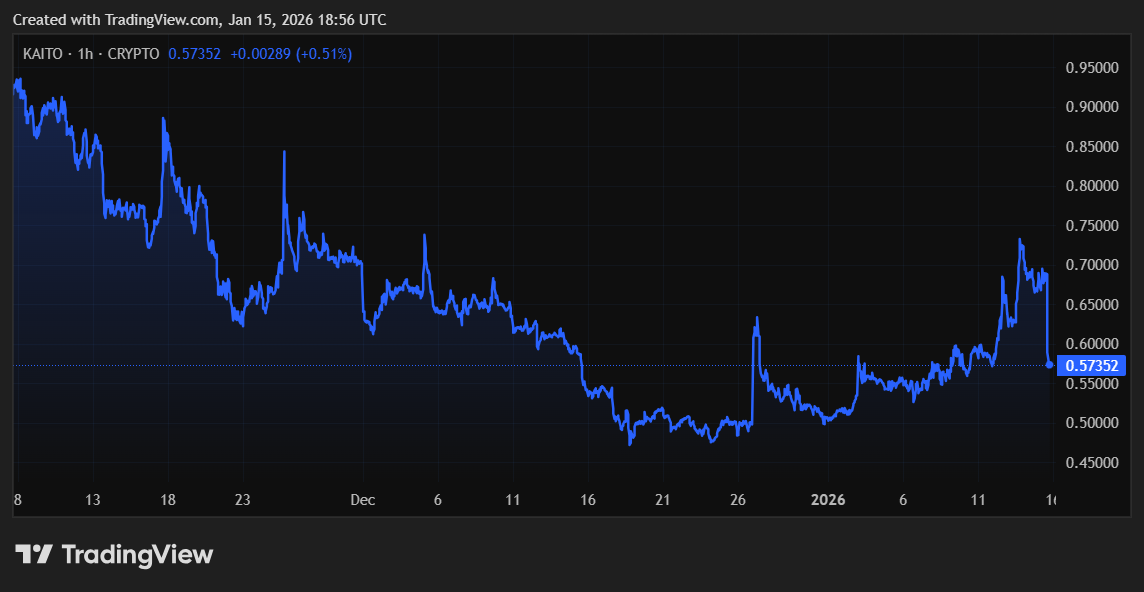
Kaito currently has a market capitalization of about $140 million, with a fully diluted valuation near $586 million. At its peak, shortly after an initial airdrop in February 2025, the token’s fully diluted value reached close to $2 billion.
What Kaito does and why it was affected
Kaito is designed to track and aggregate posts from influential crypto accounts on X, highlighting trending topics and narratives across the community. Its model relies heavily on access to X’s API, making the platform particularly sensitive to changes in developer policies.
InfoFi, short for “information finance,” aims to turn online attention and engagement into measurable, tokenized value. Critics, including X’s own leadership, argue that these incentives have encouraged low-quality posts, bot activity, and spam, especially as artificial intelligence tools make mass content generation easier.
Bier noted that developers whose accounts were terminated could seek help transitioning their businesses to alternative platforms such as Threads or Bluesky.
Kaito’s shift in strategy
Even before X’s latest move, Kaito had begun rethinking its approach. The project recently announced plans to sunset features like Yaps and incentivized leaderboards in favor of a new product called Kaito Studio.
According to founder Yu Hu, Kaito Studio will more closely resemble a tier-based, traditional marketing platform rather than a broad engagement-for-rewards system.
“Over the past year, we experimented with tighter eligibility, higher thresholds in leaderboards, social and on-chain filters, and different incentive designs,” Hu wrote in a post on X.
He added that despite these efforts, spam and low-quality content persisted, partly due to changes in X’s algorithms and the launch of similar InfoFi projects with fewer restrictions.
A broader signal for crypto and social platforms
X’s decision underscores growing tensions between social media platforms and crypto projects that depend on incentivized engagement. For InfoFi networks, the policy shift may force a rethink of business models that rely on direct integration with major social platforms.
— Yu Hu 🌊 (@Punk9277) January 15, 2026
For now, the market has clearly taken note. Kaito’s price drop reflects uncertainty about how InfoFi projects will adapt in a landscape where access to key platforms is no longer guaranteed.



