

JPMorgan Chase is expanding its presence in blockchain-based finance with the launch of a tokenized money-market fund built on the Ethereum network, according to a report by The Wall Street Journal.
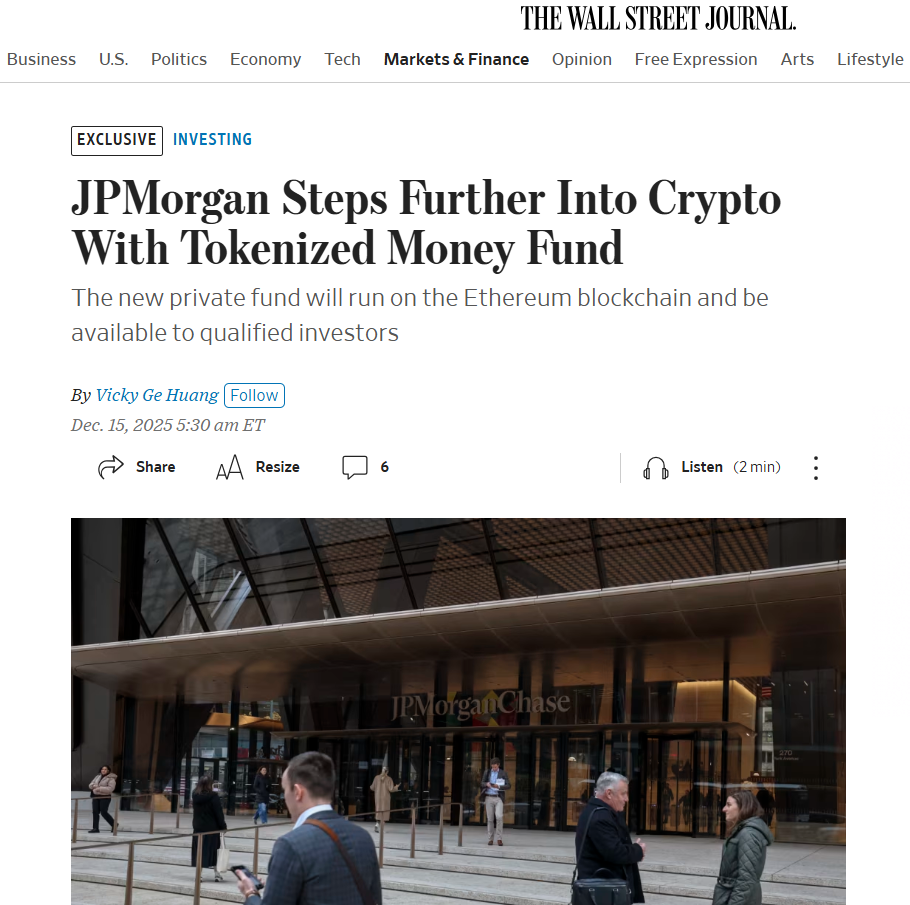
The fund, called the My OnChain Net Yield Fund, or MONY, is being introduced by JPMorgan Asset Management, which oversees roughly $4 trillion in assets. The bank has seeded the private fund with $100 million of its own capital and plans to open it to outside investors starting Tuesday, the report said.
MONY is supported by JPMorgan’s Kinexys Digital Assets platform, which focuses on tokenization and onchain financial infrastructure. The fund will be available to qualified investors, defined as individuals with at least $5 million in investable assets and institutions with a minimum of $25 million. The minimum investment is set at $1 million. Investors can access the fund through JPMorgan’s Morgan Money portal and will receive digital tokens that represent their ownership, held in a crypto wallet.
In structure and purpose, the fund closely resembles a traditional money-market fund. It invests in a portfolio of short-term debt securities and is designed to deliver yields that are typically higher than standard bank deposits. Interest accrues daily, and dividends are paid on an ongoing basis. Subscriptions and redemptions can be made using either cash or Circle’s USDC stablecoin, offering flexibility for investors operating both on and off blockchain networks.
John Donohue, head of liquidity at JPMorgan Asset Management, told the Journal that client demand has been a major driver behind the launch. He said interest in tokenized financial products has grown significantly, with investors looking for blockchain-based options that mirror familiar instruments such as money-market funds.
The launch comes amid a broader shift in regulatory tone in the United States. Earlier this year, lawmakers passed the GENIUS Act, which created a federal framework for dollar-backed stablecoins. Additional developments around the proposed Clarity Act have signaled a more coordinated approach to regulating digital assets and defining oversight responsibilities. Together, these steps have given traditional financial firms more confidence to expand tokenization efforts across funds, securities, and other real-world assets.
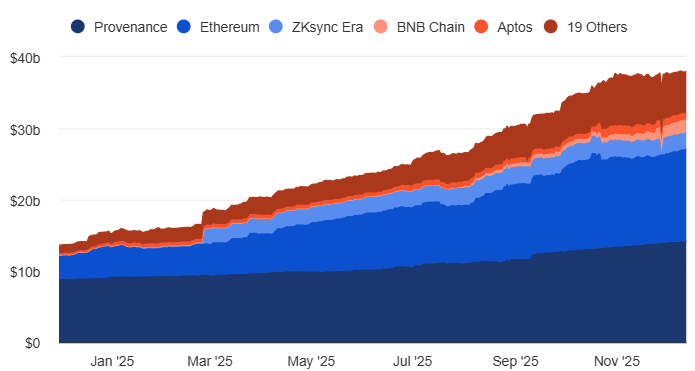
Tokenization has gained momentum as institutions look for ways to keep assets onchain while still generating yield. Tokenized money-market funds, in particular, have appealed to crypto-native investors seeking alternatives to holding non-interest-bearing stablecoins. According to data, the total market value of tokenized real-world assets reached a record $38 billion in 2025.
JPMorgan’s move places it among a growing group of major asset managers experimenting with tokenized funds. BlackRock currently operates the largest tokenized money-market fund, with more than $1.8 billion in assets under management. Goldman Sachs and Bank of New York Mellon have also announced plans to collaborate on issuing digital tokens linked to money-market funds from leading asset managers. In parallel, several crypto exchanges have rolled out tokenized stocks and other securities in select markets this year.
The Ethereum-based fund is the latest in a series of blockchain initiatives by JPMorgan, even as its chief executive, Jamie Dimon, has long expressed skepticism about cryptocurrencies. Dimon has previously criticized Bitcoin, once calling it a tool for money laundering. Despite that stance, the bank has continued to explore practical uses of blockchain technology for institutional finance.
Just last week, JPMorgan helped arrange a commercial paper offering for a Galaxy Digital subsidiary that was executed on the Solana blockchain. The transaction used a newly created token and settled issuance and redemption in USDC. Bank executives described the deal as part of an effort to better understand how public blockchains can support institutional capital markets.



