

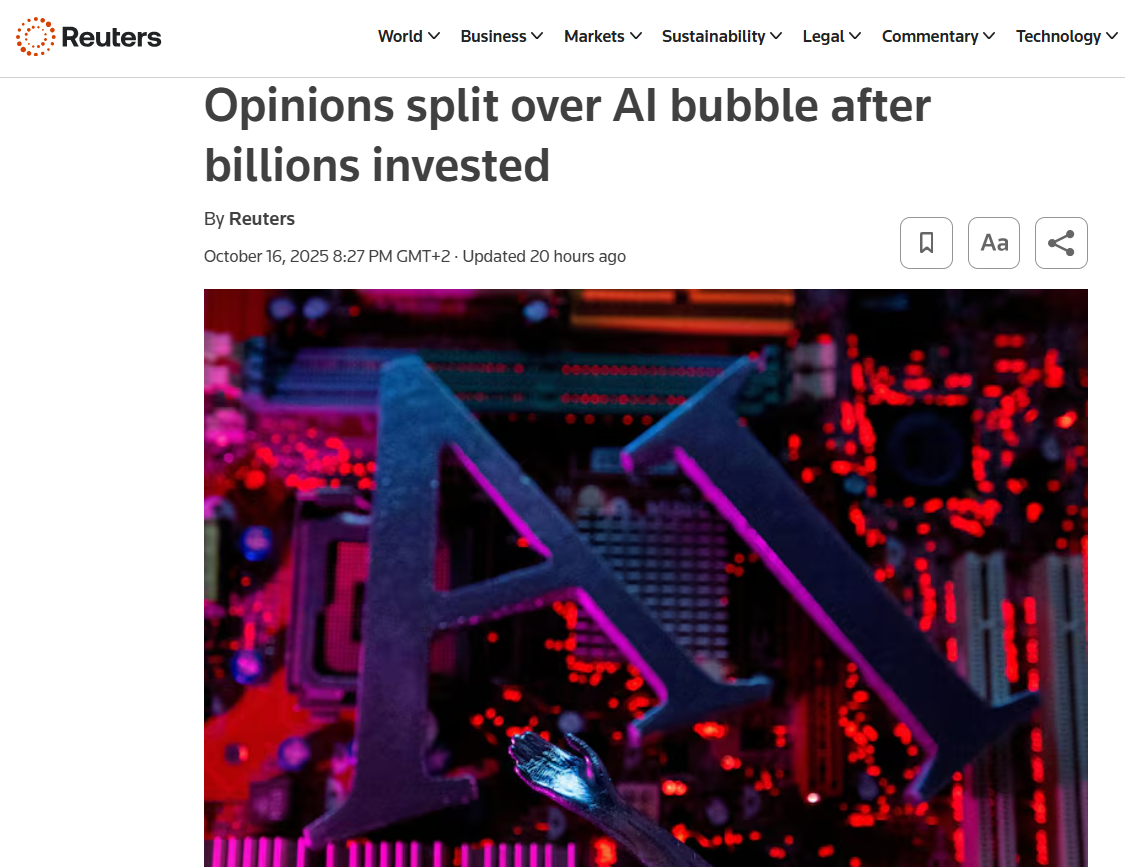
The global rush to invest in artificial intelligence has sparked comparisons to the dot-com boom of the late 1990s — and growing concerns that a similar bubble might be forming. With billions flowing into AI startups, infrastructure, and chips, investors and analysts are asking whether enthusiasm has outpaced reality.
According to a recent Bank of America Global Research survey, 54% of fund managers believe AI stocks are already in bubble territory, while 38% disagree. The debate captures the tension between massive optimism about AI’s transformative potential and the fear that valuations may have run too far ahead of real-world returns.
Lessons from the Dot-Com Era
At Cisco’s recent AI Readiness Index 2025 media roundtable, Ben Dawson, Senior Vice President and President for Asia Pacific, Japan, and Greater China, drew a clear parallel between today’s AI boom and the early days of the internet.
“These cycles follow a familiar pattern,” he said. “First comes excitement and investment, then a correction — and finally, lasting value.”
Dawson emphasized that while many AI ventures may not survive, the underlying transformation is real. Much like the internet reshaped global business, he believes AI will become a permanent force in the economy.
“Ignoring AI now,” he warned, “would be like ignoring the internet in the 1990s.”
Governments Shape the AI Cycle
Public policy is playing an increasingly decisive role in how the AI industry evolves — and whether it avoids the excesses of past bubbles. In the U.S., both the Trump and Biden administrations have treated AI as a matter of national competitiveness and security, backing early investments to accelerate innovation.
 Paulo Carvão
China has taken a different route, steering state-backed funding toward local AI companies to reduce dependence on U.S. technology. Meanwhile, Europe’s approach leans more toward regulation, though programs like the AI Continent Action Plan and a €1 billion “Apply AI” fund aim to balance oversight with growth.
This mix of policy directions reflects a shared goal: to capture the benefits of AI while managing potential economic risks. Yet with venture capital and sovereign wealth funds pouring billions into AI infrastructure — often before demand catches up — some analysts fear a repeat of the unused networks and excess capacity that followed the dot-com crash.
Market Warnings and Investor Caution
The Bank of England recently cautioned that a sharp drop in AI confidence could trigger “material” disruptions in financial markets. Policymakers worry that soaring valuations may not be sustainable if AI applications take longer than expected to generate returns.
Still, many experts argue that heavy investment in computing infrastructure and energy capacity is necessary groundwork.
“The question isn’t whether AI demand exists today,” said Simon Miceli, Cisco’s Managing Director for Cloud and AI Infrastructure in Asia Pacific, Japan, and Greater China. “It’s whether the world is building fast enough for what’s coming.”
Miceli expects some correction in the market but believes the scale of AI’s industrialization will ultimately justify current spending levels.
Investors Split on What Comes Next
At the Milken Institute Asia Summit 2025, Singapore’s GIC Chief Investment Officer Bryan Yeo noted that valuations for early-stage AI firms appear “inflated,” with many startups showing limited revenue. He cautioned that while some will deliver real value, others may not live up to investor expectations.
Amazon founder Jeff Bezos offered a broader view, saying innovation cycles often create confusion between promising ideas and hype. Yet he added that even when bubbles burst, they usually leave behind meaningful progress.
Goldman Sachs economist Joseph Briggs echoed that sentiment, arguing that the wave of AI investment remains “economically sustainable” despite uncertainties about which companies will ultimately dominate.
Others, like ABB CEO Morten Wierod, downplayed bubble fears but acknowledged practical challenges such as data center construction limits and supply chain constraints. IMF Chief Economist Pierre-Olivier Gourinchas added that even if AI valuations cool, the fallout is unlikely to spark a global crisis, since most investments are equity-based, not debt-driven.
A Cycle of Hype and Value
Even OpenAI CEO Sam Altman admits that parts of the market are overheated, predicting that “some investors will lose a lot of money — and others will make a lot.” UBS analysts note that 90% of investors who view AI as a bubble are still holding AI-related assets, suggesting that confidence in the sector’s future remains strong.
As Cisco’s Dawson observed, every major technological revolution follows the same rhythm — excitement, correction, and consolidation. What endures, he said, “is the lasting impact on how industries operate and innovate.”
For now, the real question isn’t whether AI will endure — but how effectively investors and businesses can navigate its growing pains. Like past revolutions, the AI era may experience turbulence, but its long-term potential seems far from a bluff.



