

As the race to deploy generative and agentic AI accelerates, a growing question is echoing through boardrooms and tech circles alike: Are we in an AI bubble—and if so, is it about to burst?
For many organizations, this new era of artificial intelligence remains largely experimental. Companies are investing heavily in internal use cases—automating workflows, streamlining customer service, and boosting efficiency. Yet, as Ben Gilbert, Vice President at 15gifts, points out, those returns are proving slower and harder to quantify than many had hoped.


“Efficiency gains often take years to show real returns and are difficult to measure beyond time savings,” Gilbert explains.
That reality, he warns, mirrors patterns seen in previous technology booms.
“The rush to implement AI solutions feels similar to the dot-com era,” he says. “When experimental spending outpaces measurable profit, the risk of a correction grows.”
The Weak Point: Unclear ROI
This gap between ambition and tangible results may be the pressure point that determines which AI projects survive and which collapse. Gilbert believes initiatives that “focus on efficiency gains and deliver unclear or delayed ROI” will be most exposed if the bubble deflates.
“When investments start looking like costly experiments rather than profitable tools, a pullback is inevitable,” he notes. “We could see budgets tighten, startups fold, and large enterprises re-evaluate their AI roadmaps.”
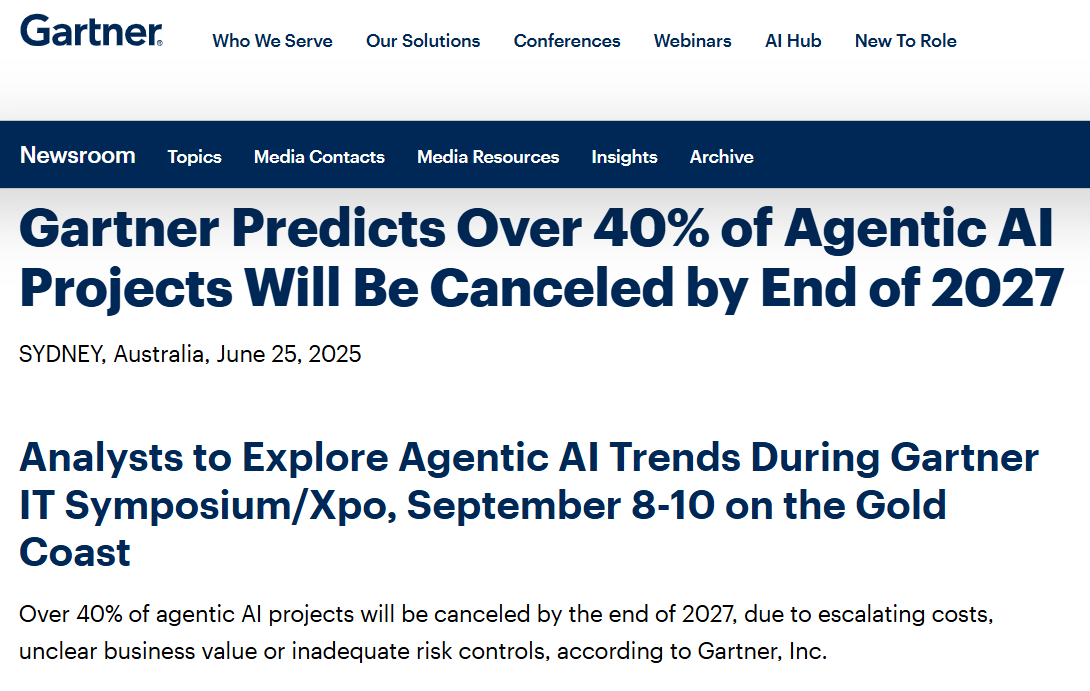
Data supports that caution. Gartner forecasts that over 40% of agentic AI projects will fail by 2027, citing rising costs, governance issues, and disappointing returns.
Human-Centered AI: The Key to Survival
So, how can companies build resilient AI strategies that outlast the hype cycle? Gilbert says the answer lies in embracing human nuance—a dimension often overlooked in the drive to automate.
He points to a telling contrast: “AI is widely used for efficiency and customer support, but far less so in sales. That’s because algorithms excel at data processing, but customers still crave human connection.”
In other words, success in AI isn’t about replacing people—it’s about augmenting them.
Gilbert emphasizes that “AI should be taught by real people so it can understand the subtleties of language, emotion, and intent.”
A transparent training process, where humans annotate AI-driven conversations, can help refine performance and set realistic benchmarks.
A Correction, Not a Collapse
Despite growing concern, a total AI market crash seems unlikely. Gilbert predicts a market correction rather than a collapse, with inflated expectations giving way to more sustainable growth.
“The underlying potential of AI is still enormous,” he says. “But the hype will deflate, and that’s actually healthy for the industry.”
For business leaders, this cooling-off period could be an opportunity to reset. The focus, Gilbert suggests, should return to fundamentals: solving real human problems and building ethical, transparent systems that enhance—not replace—human capability.
“AI projects driven by empathy, authenticity, and tangible value will stand the test of time,” he says. “Without that human insight, even the smartest AI is destined to fail.”



