
Understanding Impermanent Loss
Decentralized finance (DeFi) has opened the door for anyone with crypto to become a market maker, earning a share of trading fees on platforms like Uniswap and Curve. But there’s a catch that many newcomers overlook: impermanent loss.
Impermanent loss happens when you deposit two assets into an automated market maker (AMM) pool, and their price ratio changes after your deposit. If you later withdraw your share of the pool, you may end up with less value than if you had simply held the assets separately. The bigger the price swing, the greater the loss.
Pairs with stable price relationships—such as stablecoin-to-stablecoin pools—generally carry lower risk. But even stablecoins can “depeg,” creating temporary volatility.
Why Liquidity Providers Still Participate
If impermanent loss can hurt returns, why do people still provide liquidity? Because trading fees can offset the loss—sometimes entirely.
On Uniswap, for example, every trade in a pool generates fees that go straight to liquidity providers. When trading volumes are high, these fees can outpace the impact of impermanent loss. Profitability depends on several factors: the protocol, the assets involved, and overall market conditions.
A Simple Example
Imagine Alice deposits 1 ETH and 100 USDC into a pool where ETH is priced at 100 USDC. That’s $200 in total, and she owns 10% of the pool.
If ETH’s price jumps to 400 USDC, arbitrage traders rebalance the pool by adding USDC and removing ETH until the pool matches the new price ratio. When Alice withdraws, she gets 0.5 ETH and 200 USDC—worth $400. Not bad… except if she had just held her original assets, they’d now be worth $500.
That $100 difference is impermanent loss. It’s “impermanent” because if ETH’s price returned to its original value before withdrawal, the loss would vanish.
Measuring the Impact
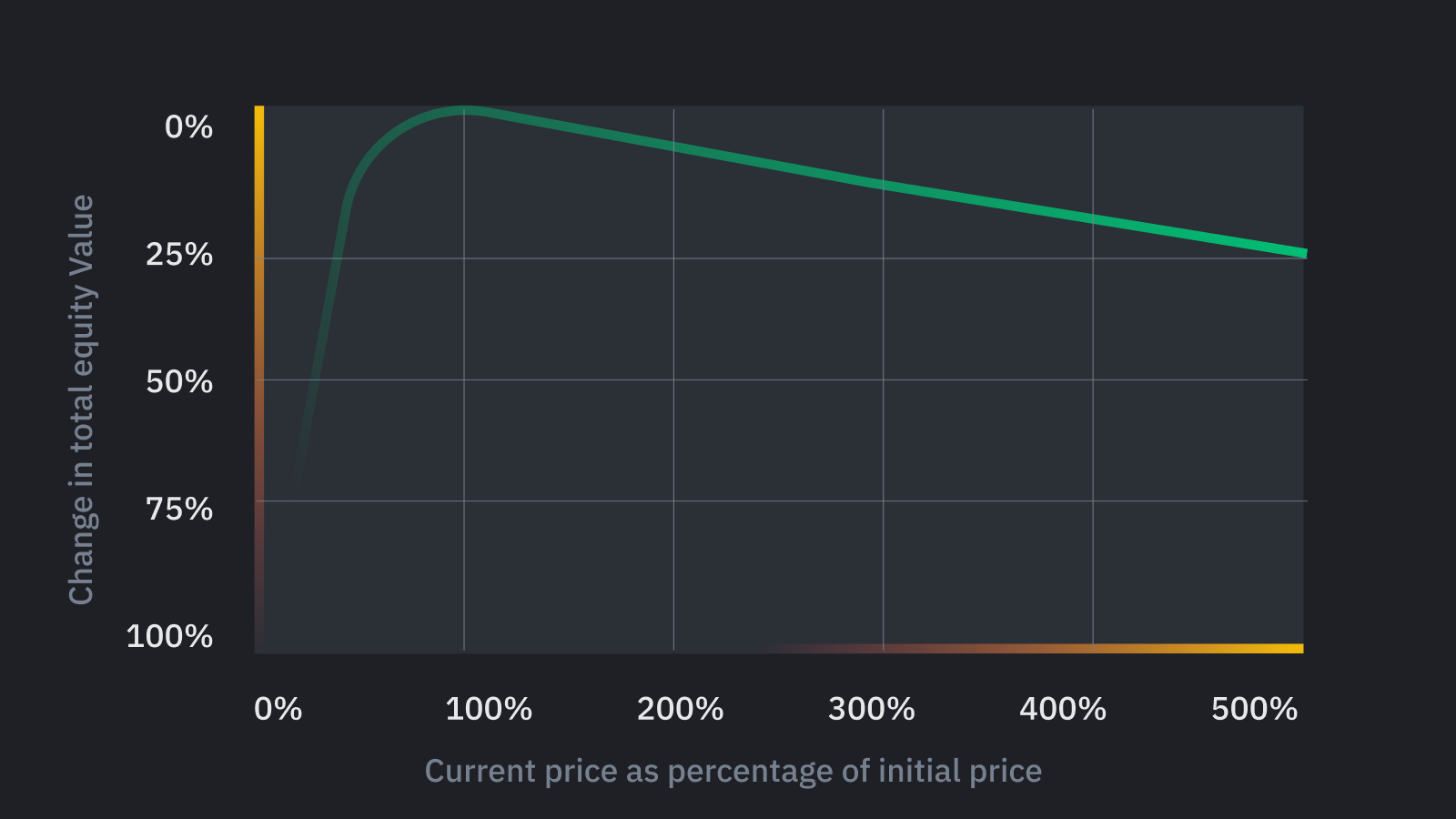
Here’s a quick guide to potential losses (excluding fees) compared to simply holding your tokens:
- 1.25× price change → ~0.6% loss
- 1.5× price change → ~2.0% loss
- 2× price change → ~5.7% loss
- 3× price change → ~13.4% loss
- 4× price change → ~20% loss
The direction of the price change doesn’t matter—only the difference from the original ratio.
Managing the Risk
While you can’t eliminate impermanent loss entirely, you can reduce its impact:
- Start small: Test returns before committing significant capital.
- Choose low-volatility pairs: Stablecoin or wrapped-asset pools tend to have less risk.
- Pick established protocols: Stick to audited and widely used AMMs to avoid smart contract vulnerabilities.
- Explore new AMM designs: Concentrated liquidity pools, stable-swap models, and single-sided liquidity can all help limit exposure.
The Bottom Line
Impermanent loss is a core concept in DeFi, and understanding it can mean the difference between steady returns and disappointing surprises. The key is balancing the potential trading fees against the risk of price swings. If you know how it works—and choose your pools wisely—you can make liquidity provision a valuable part of your crypto strategy.



