

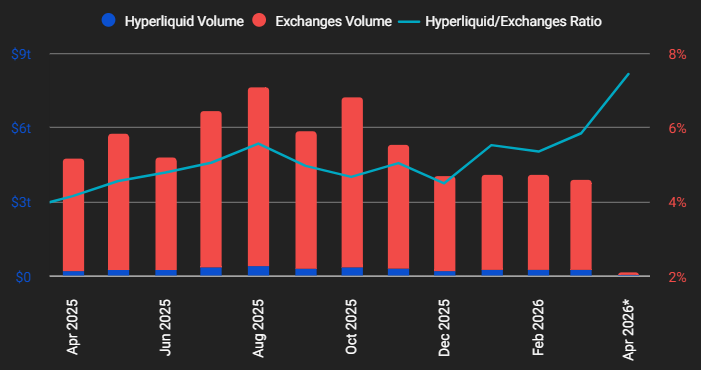
Hyperliquid’s share of perpetual futures volume has risen to nearly 6%, up from around 3.5% a year earlier. The gain signals sustained erosion of centralized exchange dominance in one of crypto’s most profitable segments.
Monthly volume on the decentralized platform is approaching $200 billion, even as total derivatives activity across exchanges has declined from its August 2025 peak. Centralized venues still process over $3 trillion in monthly perpetual futures volume, but Hyperliquid’s growth indicates it is capturing share rather than benefiting from broader market expansion.
Can Decentralized Perps Challenge Centralized Dominance?
The shift reflects changing competitive dynamics within derivatives trading. While other decentralized exchanges (DEXs) such as dYdX and GMX remain active, neither has matched Hyperliquid’s pace in volume growth or product expansion. This divergence positions Hyperliquid as the leading decentralized venue in perpetual futures.
A key differentiator is asset coverage beyond crypto. The platform now supports commodities such as oil, trading continuously without the constraints of traditional market hours. By comparison, legacy venues like CME operate on fixed schedules, exposing participants to weekend gap risk when markets are closed.
The structural advantage of 24/7 trading is gaining attention among institutional participants. A trading firm hedging oil exposure on traditional exchanges must wait for reopening windows, while decentralized platforms allow continuous risk management. Could this capability shift liquidity toward onchain venues over time?
Still, scaling liquidity remains the primary constraint. Centralized exchanges retain deeper order books and tighter spreads, particularly for large trades. Hyperliquid’s continued growth suggests improving market depth, but matching centralized liquidity across asset classes remains an open challenge.
Expansion into non-crypto derivatives broadens the platform’s addressable market beyond digital assets. The global derivatives market spans trillions of dollars, with inefficiencies tied to settlement delays and restricted trading hours. The next catalyst will be whether decentralized platforms can sustain liquidity growth while expanding into traditional asset categories.



