
Why Blockchain Explorers Matter
In traditional finance, verifying a payment can turn into a messy back-and-forth. Blockchains change that. They’re public by design, meaning every transaction is permanently recorded and visible to anyone, anywhere.
This is where a blockchain explorer comes in. Think of it as a search engine for Bitcoin (and other blockchains). Whether you’re double-checking a payment, researching network activity, or simply curious about history, an explorer provides a transparent window into the blockchain.
What Is a Blockchain Explorer?
A blockchain explorer is an online tool that lets you browse the Bitcoin blockchain in real time. With it, you can:
- Track whether a payment has been confirmed
- View the balance and history of a wallet address
- Monitor network activity such as block creation and transaction volumes
While developers can access blockchain data through a command line interface (CLI), explorers with graphical interfaces (GUI) make the process much easier for everyday users. Popular Bitcoin explorers include blockchain.com, blockchair.com, and blockcypher.com.
Key Features of a Bitcoin Explorer
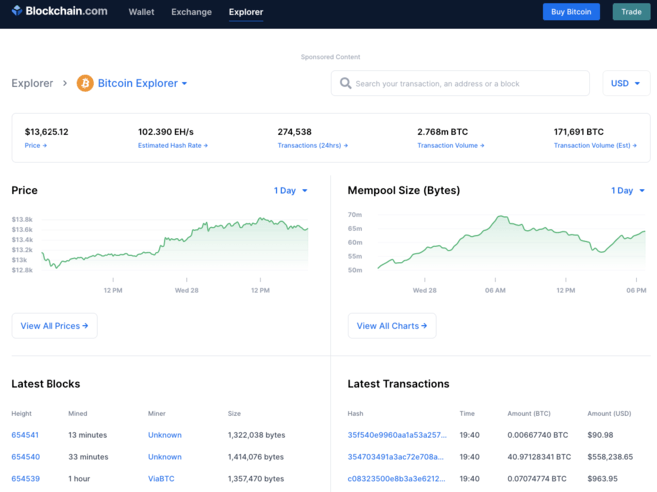
When you open an explorer like blockchain.com, here’s what you’ll typically see:
- Price: An average price feed of Bitcoin across markets (not tied to one exchange).
- Hash Rate: An estimate of the computing power securing the Bitcoin network.
- Transactions: The number of confirmed transactions in the past 24 hours.
- Transaction Volume: The total amount of bitcoin moved on-chain (including “change” sent back to wallets).
- Mempool Size: The backlog of unconfirmed transactions waiting to be included in a block, often used as an indicator of network congestion and fees.
- Latest Blocks & Transactions: Lists of newly mined blocks and recently submitted transactions. Clicking into each gives details like miner information, block size, timestamp, and every transaction inside.
Explorers also provide advanced metrics like average confirmation times, network difficulty, and transaction fees. Some even allow developers to connect through APIs for deeper analysis.
A Famous Example: Bitcoin Pizza Day
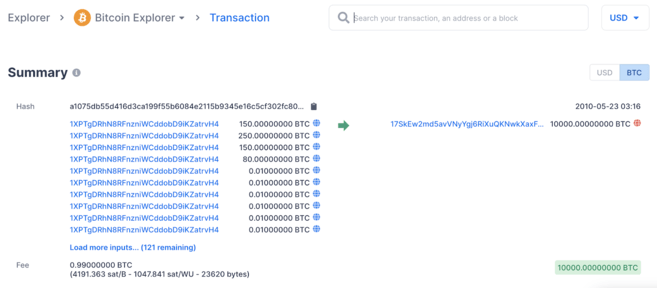
To see how this works, let’s look at one of Bitcoin’s most legendary transactions: the 10,000 BTC pizza purchase on May 22, 2010, celebrated every year as Bitcoin Pizza Day.
The transaction hash is:
a1075db55d416d3ca199f55b6084e2115b9345e16c5cf302fc80e9d5fbf5d48d
Pasting this hash into a Bitcoin explorer pulls up the transaction details. On one side, you’ll see the 10,000 BTC spent; on the other, the recipient’s wallet address — belonging to the person who delivered the pizzas.
The page also reveals technical details: confirmation status, timestamp, miner’s fee (0.99 BTC in this case), and the block number (Block 57,043). Interestingly, that block only contained two transactions: the pizza payment and the miner’s block reward.
This famous example shows how explorers can immortalize history. A decade later, anyone can still verify the world’s most expensive pizzas.
The Bigger Picture
Blockchain explorers highlight the unique transparency of Bitcoin and other public blockchains. They empower users to verify transactions independently, without relying on banks or intermediaries.
That said, transparency has trade-offs. Tools like chain analysis can trace addresses and sometimes de-anonymize users — a reminder that Bitcoin is pseudonymous, not fully private. Privacy-focused blockchains like Monero take a different approach, prioritizing anonymity over transparency.
For newcomers, though, explorers are a simple yet powerful way to learn how blockchains function. Try searching a transaction or block yourself — you may be surprised by how much information is just a click away.



