
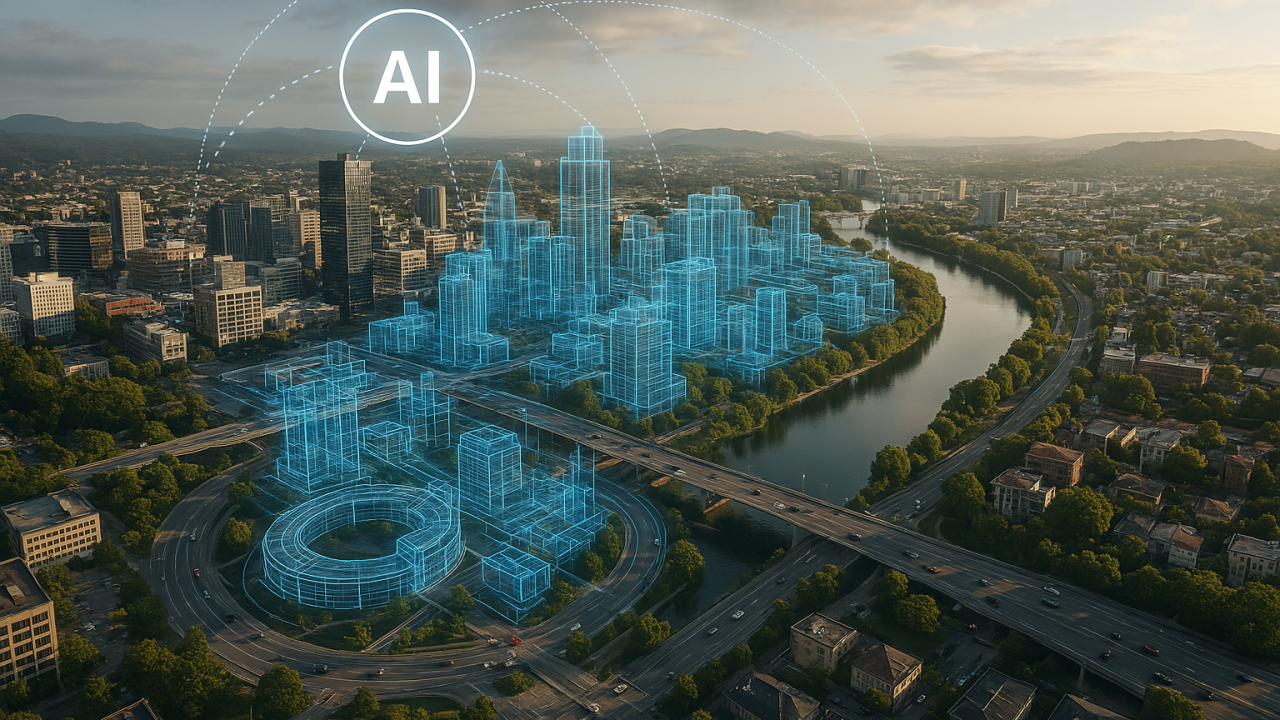
Imagine a city where traffic jams are rare, buildings adapt to climate shifts, and biodiversity is protected—all before a single brick is laid. According to Shah Muhammad, Head of AI Innovation at European design and engineering firm Sweco, this isn’t a sci-fi fantasy—it’s the new frontier in urban development, powered by artificial intelligence.
“AI is revolutionizing how we design and plan cities,” says Muhammad. “It helps us analyze massive datasets, simulate countless scenarios, and build more sustainable, efficient, and resilient environments.”
Urban development has long depended on experience, educated assumptions, and slow-moving processes. But AI is changing the game by giving planners the ability to stress-test multiple futures in minutes. Whether it’s figuring out how to ease traffic, minimize energy consumption, or adapt to climate extremes, AI offers a smarter, data-driven foundation for decision-making.


At Sweco, Muhammad’s team uses AI to tackle some of urban planning’s biggest challenges:
- How can we cut traffic congestion and pollution in growing cities?
- What’s the most energy-efficient design for a building in a changing climate?
- How can we plan developments that coexist with local ecosystems?
The strength of AI lies in its ability to explore thousands of design options quickly, revealing the best path forward based on real-world data. But cities aren’t clean simulations.
“The biggest challenge is dealing with the complexity and unpredictability of real-world conditions,” Muhammad explains.
That’s why accurate, high-quality data is critical.
To make AI work in urban environments, Sweco emphasizes rigorous data governance, standardized formats, and interoperable software. In practice, this means that every team, tool, and dataset works in sync—enabling reliable collaboration and smarter design.
But Muhammad highlights that AI's impact isn't limited to efficiency and cost savings. In some projects, it has directly supported sustainability—like helping protect endangered species by identifying their habitats and alerting planners before construction begins.
“Technology can help us build with empathy,” he notes. “It gives nature a seat at the table.”
Looking ahead, Muhammad sees predictive analytics and automation as the next big leap for the architecture, engineering, and construction (AEC) sector. By forecasting future trends, flagging issues before they arise, and automating routine tasks, AI can streamline workflows and improve project quality. This means safer infrastructure, faster project delivery, and more time for experts to focus on creative, human-centered design.
In short, AI isn’t replacing the human touch—it’s enhancing it. By bridging data with design, it’s helping cities become smarter, greener, and better prepared for the future.



