

Grayscale’s new U.S. spot Solana exchange-traded fund (ETF), GSOL, made a quiet debut on October 29, drawing in $1.4 million in net inflows on its first day of trading. The launch follows the fund’s conversion from a closed-end trust and comes amid a surge of interest in Solana-based products — but also significant investor rotation out of major Bitcoin and Ethereum ETFs.
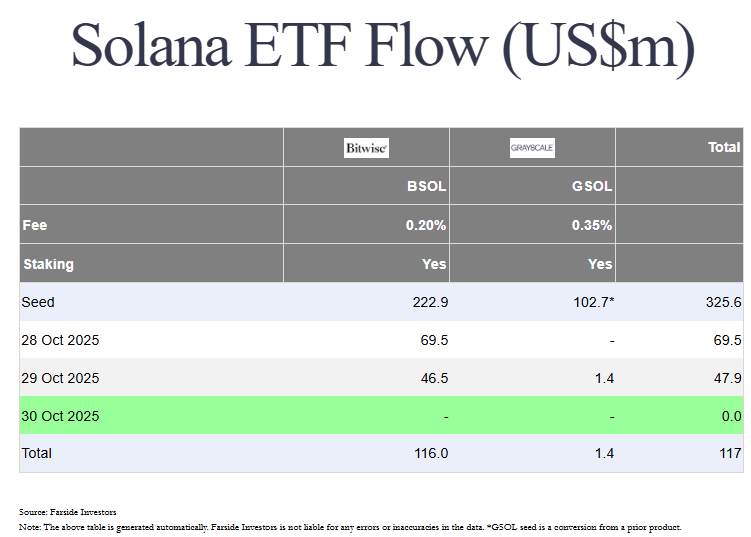
By comparison, Bitwise’s Solana ETF (BSOL), which launched just one day earlier, posted much stronger results. BSOL added $46.5 million in inflows on October 29, on top of the $69.5 million it attracted on day one. Trading activity has been robust as well, with BSOL generating $57.9 million in first-day volume — the highest of any ETF launch this year — and climbing to nearly $75 million on its second day.


Bloomberg Senior ETF Analyst Eric Balchunas noted that Bitwise’s early launch gave it a crucial edge: “Being just one day behind is actually really huge. Makes it so much harder.” Grayscale’s GSOL, which carries a 0.35% management fee versus 0.2% for BSOL, recorded a more modest $4.9 million in day-one trading volume.
The Solana ETF race is just beginning. Other major issuers, including Fidelity, VanEck, and 21Shares, are expected to roll out their own Solana products in the coming months. Earlier this year, REX-Osprey introduced SSK, the first U.S. ETF offering Solana exposure with native staking rewards. Unlike GSOL and BSOL, which were launched under the Securities Act of 1933, SSK was registered under the Investment Company Act of 1940 and holds most of its assets in directly staked SOL.
The recent wave of ETF launches was made possible after the SEC allowed issuers to move forward without direct staff review during the U.S. government shutdown. Firms were permitted to file final S-1s under newly approved generic listing standards for commodity trust shares, enabling launches like BSOL and GSOL despite limited regulatory operations.
Broader Market Flows Shift Away From Bitcoin and Ethereum
While Solana-focused funds gained attention, traditional crypto ETFs saw heavy outflows. On October 29, U.S. spot Bitcoin and Ethereum ETFs lost more than $500 million in combined net outflows, according to data.
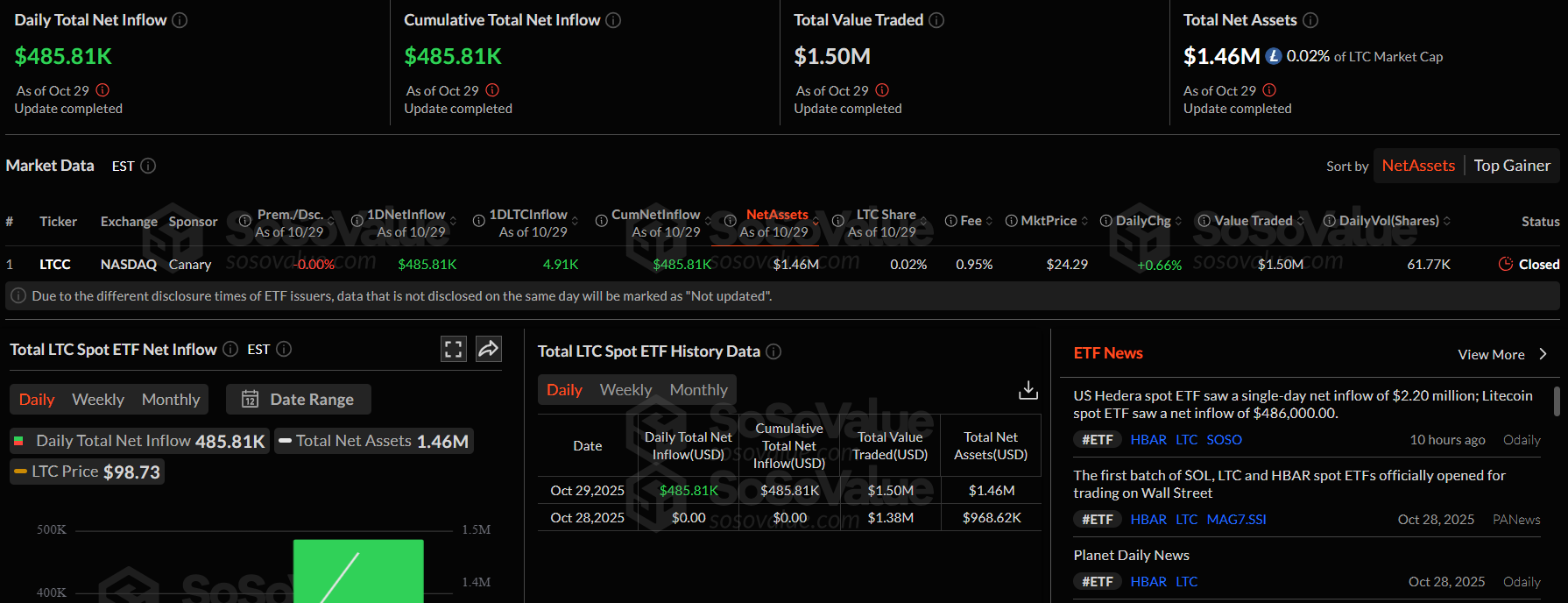
Bitcoin funds led the retreat, with $470.7 million exiting — including $164.4 million withdrawn from Fidelity’s FBTC. Ethereum ETFs saw $81.4 million in total outflows, driven largely by Fidelity’s FETH, which lost $69.5 million. Combined trading volume for Bitcoin ETFs hit $7 billion, while Ethereum funds reached $2.4 billion that day.
The outflows coincided with remarks from Federal Reserve Chair Jerome Powell, whose cautious tone on future rate cuts spooked markets despite a 25-basis-point reduction.
“Markets were blindsided less by the rate cut itself than by Chair Powell’s emphasis that a December reduction is not automatic,” said Timothy Misir, Head of Research at BRN. “Powell’s tone removed forward certainty and tightened financial conditions,” he added, noting that ETF flows “exacerbated the move.”
Market Snapshot
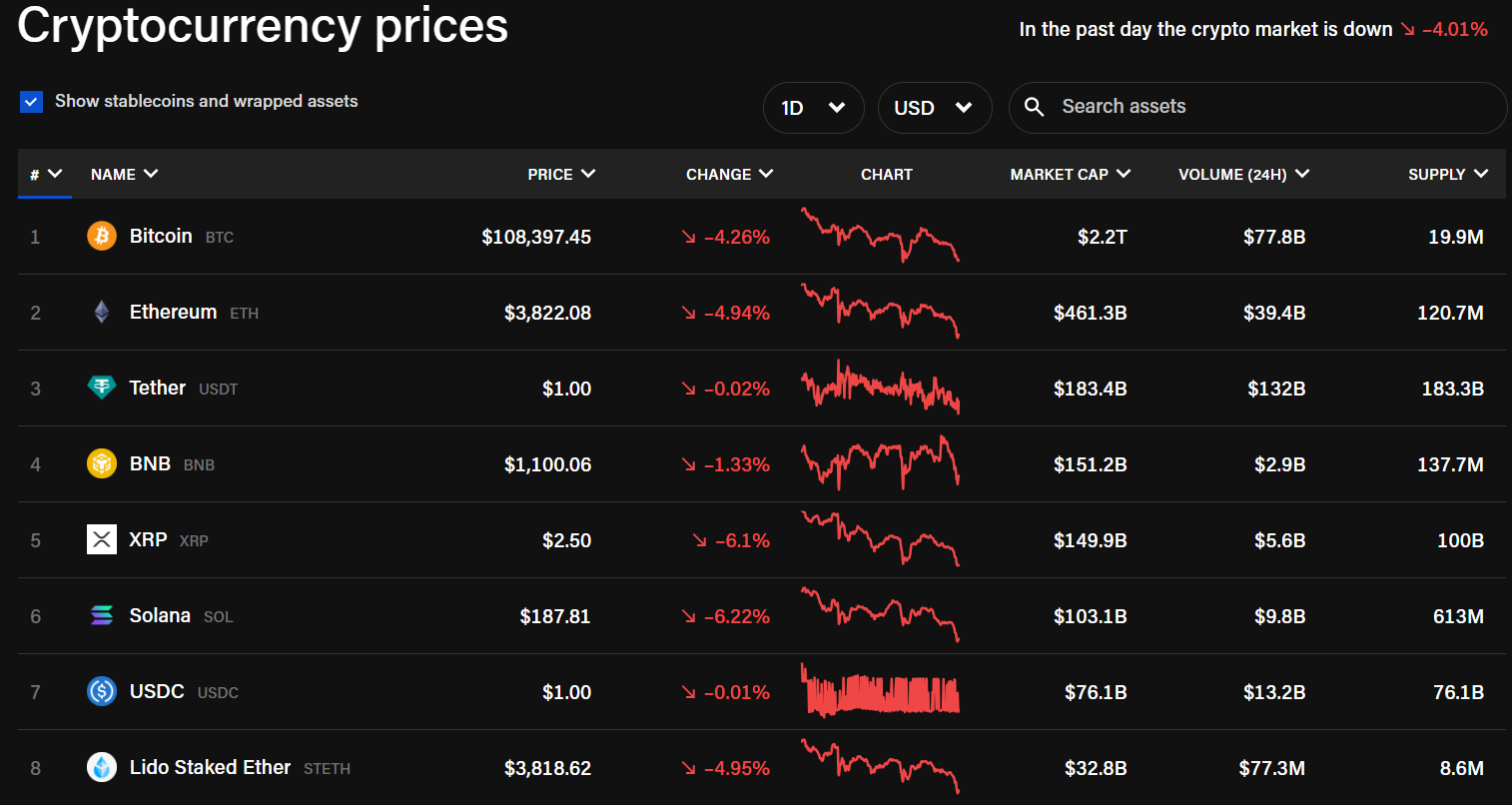
As of October 30, Bitcoin and Ethereum were both down 2.4%, trading at $110,055 and $3,897 respectively. Solana slipped 0.9% to $192, and Litecoin dipped 0.2% to $97. The standout performer was HBAR, up 4% to $0.20.
A Competitive Landscape for Crypto ETFs
With investor appetite shifting and new products emerging rapidly, the battle for dominance among crypto ETFs is intensifying. Bitwise currently leads the pack in Solana exposure, but Grayscale’s entry — along with upcoming launches from major asset managers — signals growing confidence in Solana’s long-term role within digital asset portfolios.



