

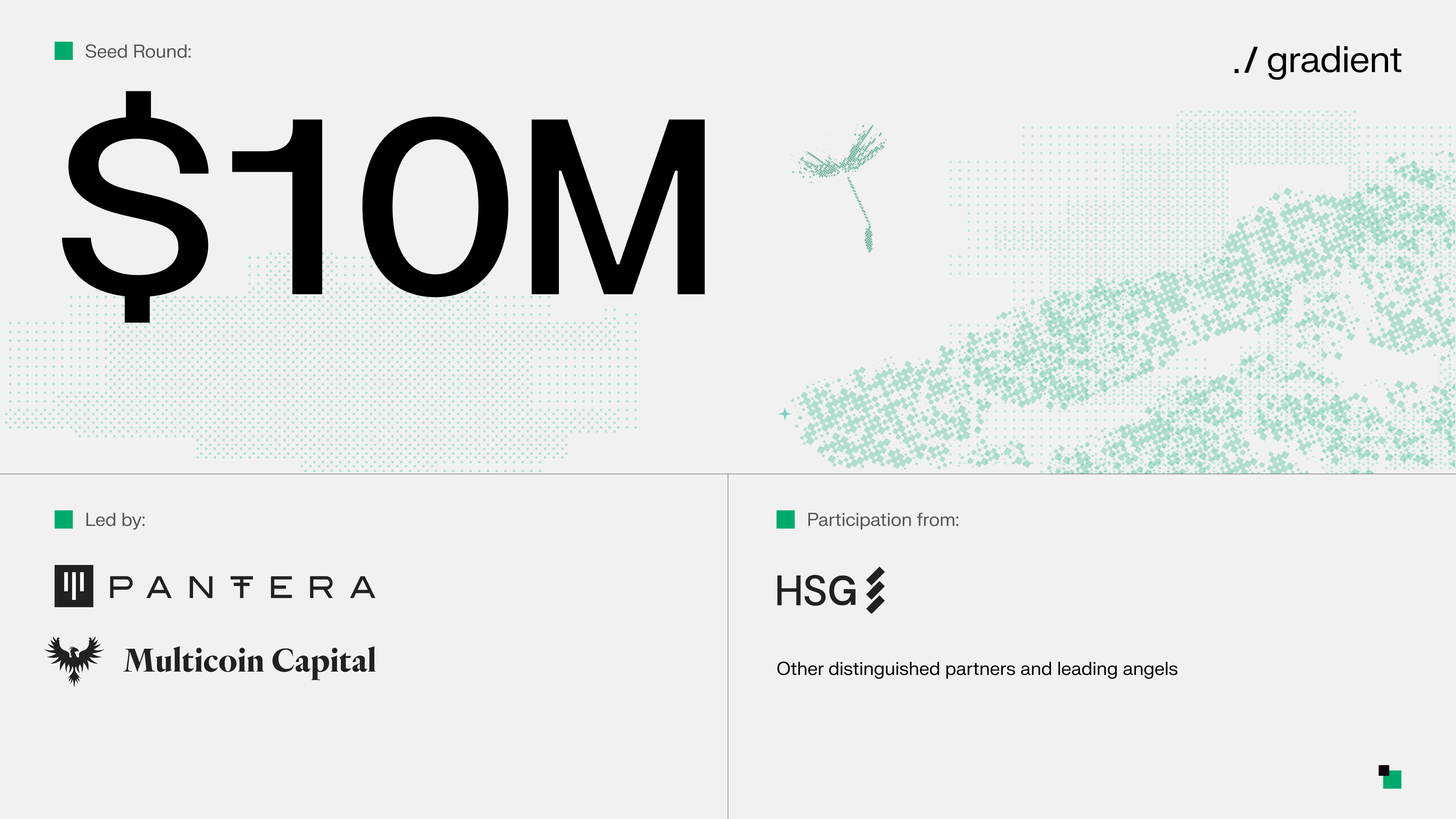
Gradient Network has secured $10 million in seed funding to build out its decentralized AI infrastructure stack—a signal that investor interest in alternatives to centralized AI is heating up. The round was led by Pantera Capital, Multicoin Capital, and HSG, three firms known for backing early-stage bets on foundational Web3 and AI infrastructure.

At the heart of Gradient’s pitch is a more open, resilient model for running AI. Unlike centralized approaches dominated by hyperscalers like OpenAI, AWS, and Google Cloud, Gradient is building lightweight, peer-to-peer protocols that run on distributed browser-based nodes. The goal? A lower-latency, privacy-focused, and more cost-effective way to deliver AI inference at scale.
Announcing our $10M seed round led by @PanteraCapital and @multicoincap, with participation from @hsgcap, distinguished partners, and top angels across AI and crypto.
— Gradient Network (@Gradient_HQ) June 17, 2025
This milestone fuels our mission to build the world’s first fully decentralized AI runtime.… pic.twitter.com/AMfVbHMk7t
Two Protocols, One Vision for Decentralized AI
Gradient is launching two core technologies: Lattica, which handles peer-to-peer data movement, and Parallax, a protocol for decentralized inference. Together, they form a runtime environment where AI agents can dynamically share context and operate across distributed systems.
Own your robots.
— Dylan Bane (@dylangbane) February 11, 2025
Decentralized Physical AI (DePAI) offers an alternative to centralized control of robots and the Physical AI infra stack.
From real world data collection to Physical AI Agents operating robots deployed by DePIN, DePAI is well on its way.@MessariCrypto 🧵 pic.twitter.com/ukskuYIG75
This marks a shift from the static deployment models used by centralized AI platforms, which struggle to adapt to real-time, real-world applications. Instead of relying on centralized data centers, Gradient enables AI inference to happen closer to the user—reducing infrastructure costs and minimizing latency.
Why This Funding Round Matters
While Gradient’s approach is still early, its backers are serious. Pantera and Multicoin have a track record of investing in base-layer technologies—everything from crypto infrastructure to decentralized computing protocols. Their participation suggests growing institutional confidence in decentralized AI as a viable path forward.
The broader sector is gaining momentum. By the end of 2024, there were 164 decentralized AI companies globally, with 104 of them having already secured funding. Industry analysts project the total market cap could approach $1 billion by 2027.
Ayanika Das
Gradient distinguishes itself from peers like Bittensor and Gensyn by focusing specifically on inference and coordination, rather than model training or compute marketplaces. That niche, while technically challenging, is increasingly seen as a critical piece of the AI puzzle.
Challenges on the Horizon
Of course, decentralized AI isn’t without its roadblocks. Network bandwidth, hardware variability, and latency remain significant challenges. Gradient’s solution includes Sentry Nodes, designed to help orchestrate inference workloads across inconsistent environments.
Security is another concern. Serving models across untrusted devices introduces potential risks—such as data leakage, tampered outputs, and model poisoning. Gradient says its system is designed for privacy-preserving inference, but long-term success will depend on third-party audits and demonstrated reliability.
Gradient Network’s $10 million raise underscores a growing belief that the future of AI won’t be built solely on centralized clouds. As demand for real-time, modular intelligence grows, so does the appetite for decentralized infrastructure that’s cheaper, faster, and more transparent. Whether Gradient’s bet pays off remains to be seen—but it’s a bet the industry is now watching closely.



