

A fiery debate erupted at Binance Blockchain Week in Dubai on December 4, 2025, pitting gold advocate Peter Schiff against former Binance CEO Changpeng Zhao (CZ) in a high-stakes clash over the future of money. The core question: Which asset, Bitcoin or tokenized gold, better serves the modern financial system as a store of value, medium of exchange, and unit of account?
Schiff: A Payment Is Just Selling Your "Lottery Ticket"
The discussion quickly centered on Bitcoin's practical use in payments, where Schiff delivered a provocative critique.
“Bitcoin payments aren’t really payments,” he asserted. “They’re just liquidated bets.”
Schiff argued that when users "spend" Bitcoin, they aren't truly using it as money. Instead, they are essentially selling their highly volatile speculative asset into fiat currency (like US dollars) to pay the merchant. For Schiff, this means every Bitcoin transaction is simply a speculative move, treating the crypto as a "lottery ticket," not a store of value.
CZ's Counter: The User Experience is Seamless
CZ countered by focusing on the seamless user experience already enabled by modern technology. He pointed to the use of crypto cards as a perfect example, an emerging trend highlighted in a recent industry report.
A highly intense and intellectual debate between CZ and Schiff at #BinanceBlockchainWeek!
— Binance (@binance) December 4, 2025
The dynamic back-and-forth was nothing short of extraordinary, delivering deep insights and engaging banter throughout. pic.twitter.com/sYZ9AAc8fE
CZ explained that from a user's perspective, they swipe the card, Bitcoin is instantly deducted from their wallet, and the merchant receives their local, preferred currency. The crucial distinction, according to CZ, is that intermediaries handle the instant conversion behind the scenes. He acknowledged that gold could theoretically use the same system, but Bitcoin's superior liquidity, digital nature, and widespread adoption give it clear advantages.
The Speculation Stigma
The debate heated up over the speculative nature of the leading cryptocurrency. Schiff maintained that Bitcoin's value is purely reliant on what the "next buyer will pay," contrasting it sharply with income-generating assets like stocks or businesses.
CZ, however, argued that while speculation is certainly one facet, it’s not the whole story. He maintained that Bitcoin has demonstrably proven itself as a long-term asset, attracting a growing ecosystem of developers, major investors, and financial institutions globally.
The discussion also touched on tokenized gold, with Schiff stressing that merchants might eventually prefer payment in a physical asset like gold to preserve real purchasing power against rising inflation. CZ conceded the point but reiterated that Bitcoin's technological infrastructure allows it to achieve similar functionality through instant verification and tokenization.
The high-profile exchange in Dubai underscored the fundamental tension in modern finance: the clash between assets with intrinsic backing (like gold) and purely digital assets that champion technological innovation and convenience.
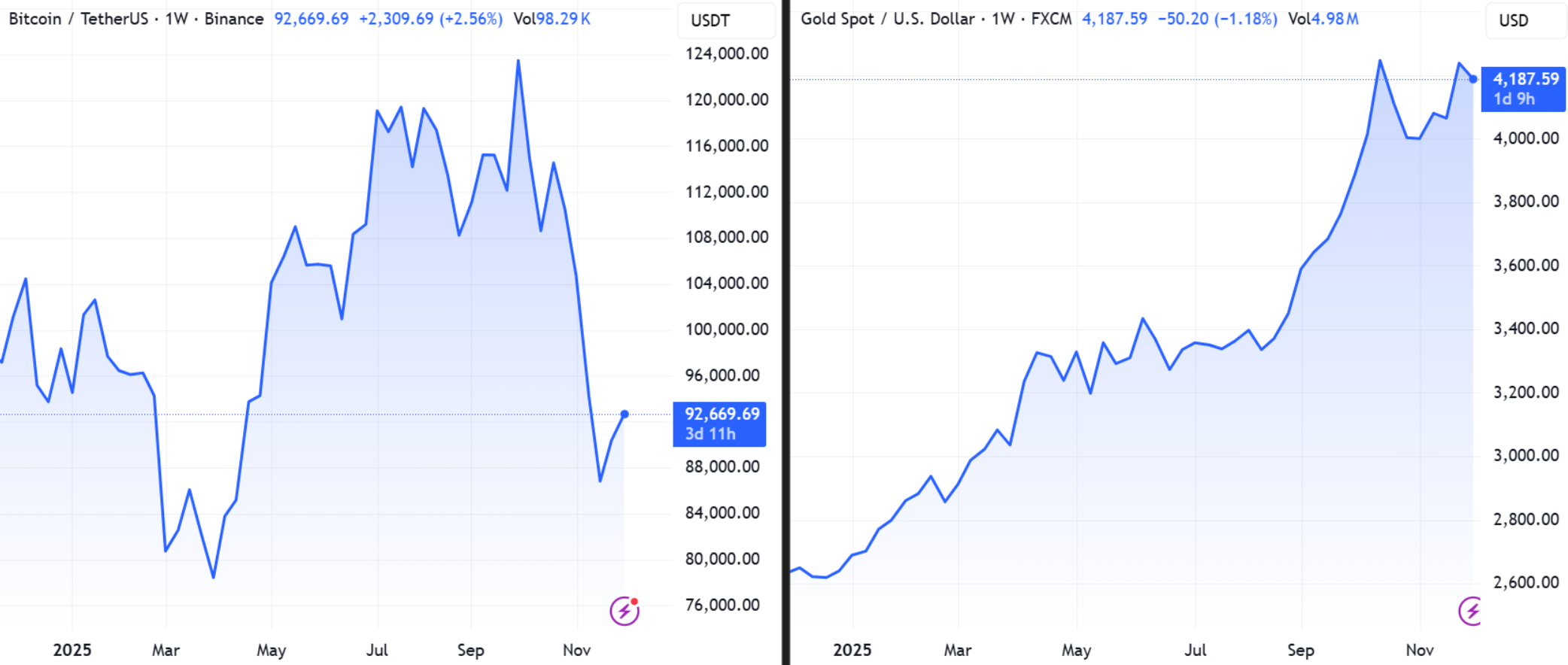
Market Context: Bitcoin vs. Gold YTD
To underscore the ongoing market battle, the performance figures for both assets show a sharp contrast in 2025:
- Gold (XAU): Was trading at $4,187 as of this writing, showing a robust year-to-date gain of over 57% from its 2025 opener of $2,657.
- Bitcoin (BTC): Was trading for $92,669, down by just over 2% from its 2025 opening price of $94,591 (Source: TradingView).
The Schiff-CZ debate made it clear: while institutions and retail users embrace both Bitcoin and tokenized gold, the question of whether Bitcoin can fully evolve from a speculative asset to a true, universally accepted medium of exchange is still far from settled.



