

Gold’s historic rally and lingering uncertainty over U.S. crypto regulation are emerging as two powerful, and contrasting, forces shaping the future of digital asset markets. That’s the view of Matt Hougan, Chief Investment Officer at Bitwise, who says both trends offer important clues about where crypto could be headed next.
In a note to clients released late Monday, Hougan argued that surging demand for alternatives to traditional money, alongside unresolved regulatory questions in Washington, is influencing how investors think about crypto adoption and price movements in the near term.


Gold’s rise signals shifting views on trust
Gold has been on a remarkable run. Prices climbed 65% during 2025 and have added another 16% so far this year, pushing the metal above $5,000 per troy ounce for the first time. Hougan highlighted that roughly half of gold’s value in dollar terms has been created in just the past 20 months, an extraordinary development for an asset that has served as money for more than two millennia.
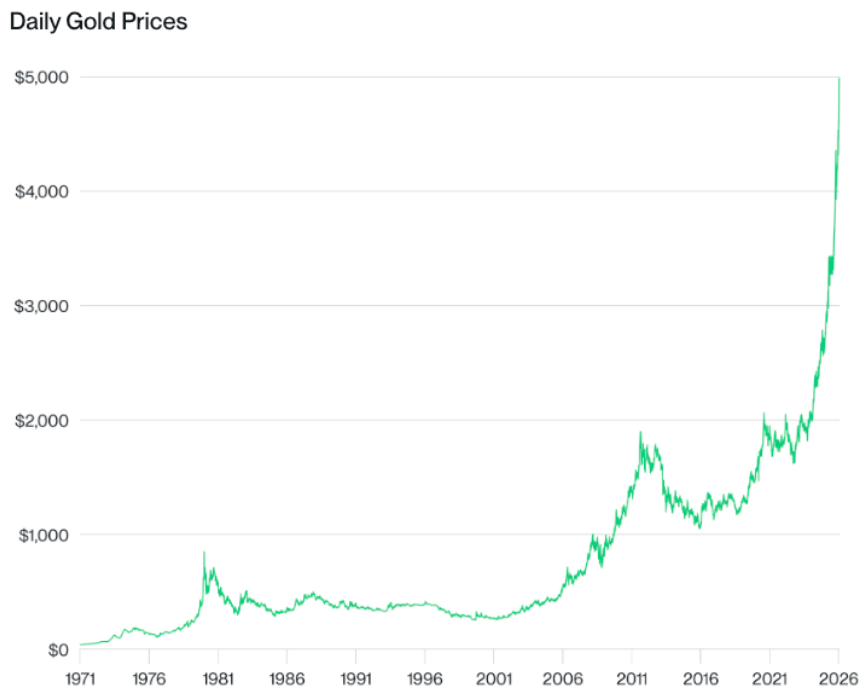
He attributes the move to the long-term effects of expansive monetary policy, rising government debt, and currency debasement. In simple terms, Hougan said, investors appear less willing to keep all their wealth in systems that depend on political or institutional goodwill.
From gold to crypto, a shared theme
Hougan sees the gold rally as part of a broader erosion of trust in traditional institutions, accelerated by recent geopolitical events. He pointed to the surge in central bank gold purchases following the 2022 U.S. seizure of Russian treasury assets after the invasion of Ukraine. Since then, governments have increasingly sought reserves that are harder for outside powers to influence.
Similar concerns have surfaced elsewhere. German economists have renewed calls to bring home gold stored at the New York Federal Reserve, while a Norwegian government panel has warned that sovereign wealth could face higher risks of taxation, regulation, or even confiscation.
Against this backdrop, Hougan believes crypto’s core features are becoming more concrete to investors. Assets like bitcoin allow individuals to hold value without relying on centralized custodians, while blockchain networks such as Ethereum and Solana operate under rules that no single authority can easily change. Ideas often dismissed as jargon—self-custody, censorship resistance, and trust-minimized systems—may gain relevance as confidence in traditional intermediaries weakens.
Regulatory uncertainty clouds the picture
While the long-term narrative may favor crypto, Hougan cautioned that the short-term outlook is complicated by uncertainty surrounding the U.S. Clarity Act. The proposed legislation aims to formalize a more supportive regulatory framework for digital assets, but its path forward has become less certain.
Earlier this year, prediction markets suggested an 80% chance of passage. Those odds have since slipped closer to 50%, following political setbacks and public criticism, including Coinbase CEO Brian Armstrong’s view that the current draft is unworkable.
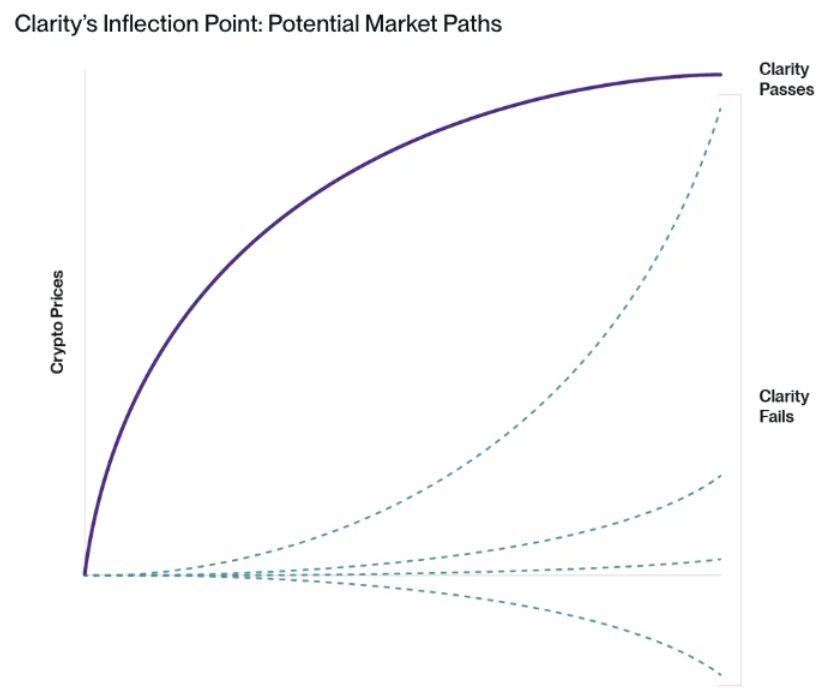
If the bill stalls or fails, Hougan said the industry could enter a three-year “prove it” phase. During that period, real-world adoption—such as the use of stablecoins and tokenized stocks—would need to drive momentum and eventually force regulators to adapt, much like ride-sharing and short-term rental platforms did in earlier decades.
Without visible progress, however, a future shift in U.S. political leadership could pose fresh challenges for the sector.
Two paths forward for crypto markets
Hougan said the outcome of the Clarity Act debate could have a clear impact on market behavior. Passage of legislation that satisfies industry concerns could spark a sharp rally, as investors price in long-term growth for stablecoins and tokenized assets. Failure, by contrast, would likely lead to a slower, more cautious market where prices hinge on demonstrated usage rather than expectations.
Although Hougan remains cautiously optimistic that some version of the bill will pass, he stressed that crypto now sits at a pivotal moment.



