

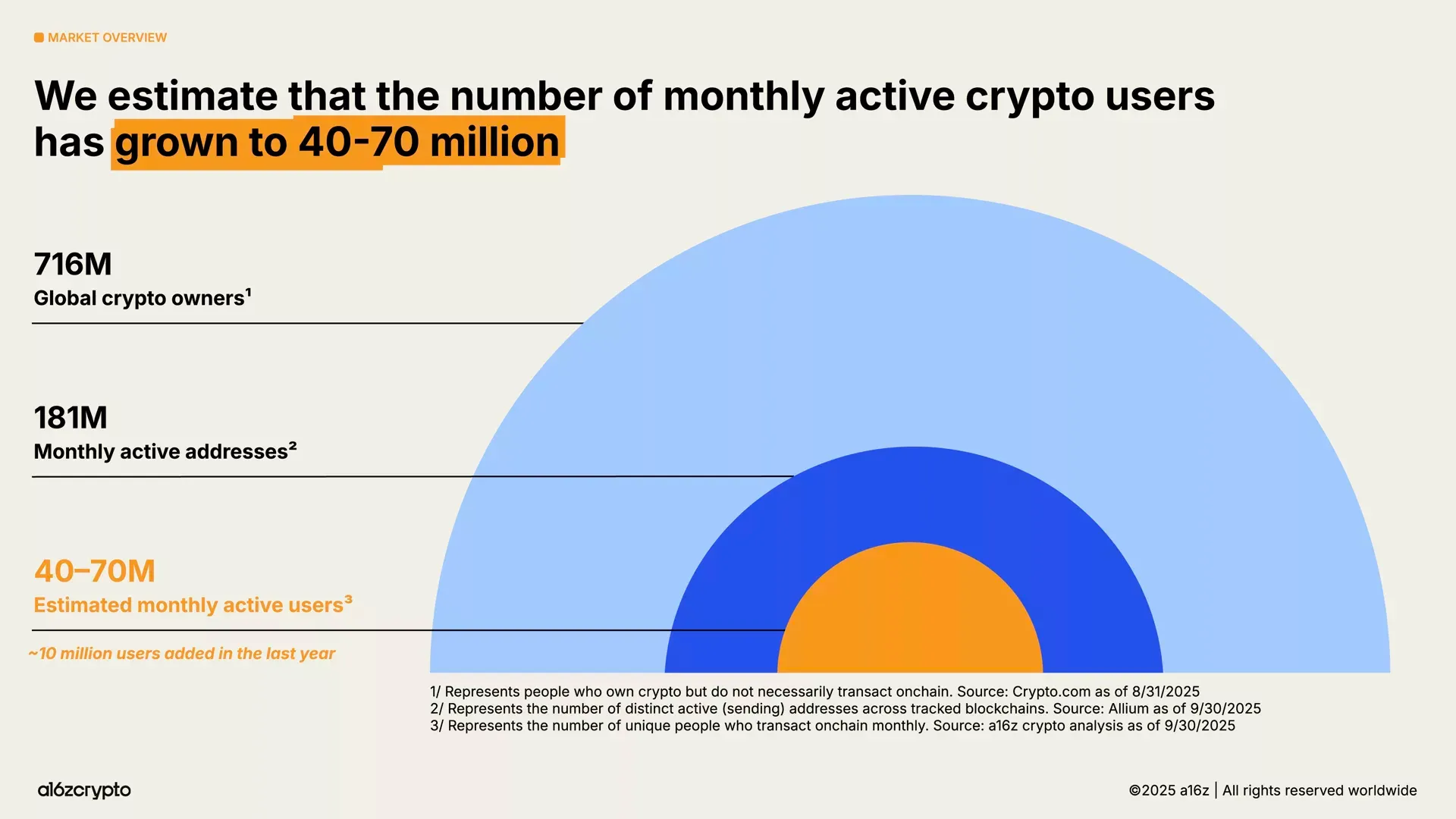
The crypto industry is entering a new growth phase. According to a16zcrypto, the blockchain-focused arm of venture capital firm Andreessen Horowitz, active crypto users worldwide now total about 70 million, up by roughly 10 million over the past year. The firm’s State of Crypto 2025 report paints a picture of an industry evolving from passive investment toward widespread, real-world use.
 Daren Matsuoka, Robert Hackett, Jeremy Zhang, Stephanie Zinn, Eddy Lazzarin
While roughly 716 million people globally own some form of cryptocurrency, only a fraction are active participants — meaning they use digital assets regularly rather than simply holding them. a16zcrypto’s latest data suggests that this engagement is rising sharply, with activity spreading across both emerging and developed markets.
Emerging Markets Lead in Real-World Crypto Use
“Crypto is global, but different parts of the world appear to use it in different ways,” the report notes.
Mobile wallet adoption, a strong indicator of on-chain activity, is growing fastest in Argentina, Colombia, India, and Nigeria, where digital currencies are often used to hedge inflation, enable remittances, or access digital finance outside traditional banking.
In developed nations such as Australia and South Korea, engagement looks different. Web traffic data suggests that users there are more focused on trading and speculation rather than everyday transactions, showing how crypto adoption continues to take distinct forms around the world.
Market Dynamics: Bitcoin Still Rules, Solana on the Rise
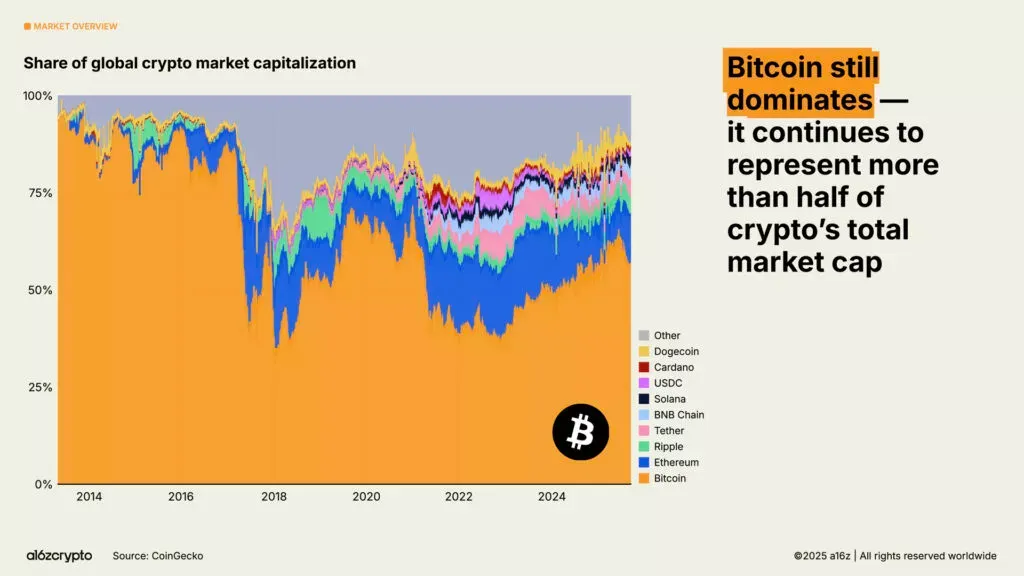
The surge in user activity mirrors trends in the broader market. Bitcoin remains the leading digital asset, recently surpassing $126,000 and maintaining more than half of crypto’s total market capitalization. Ethereum and Solana are also rebounding from their 2022 lows, driven by new applications, developer interest, and growing institutional participation.
According to a16zcrypto, Hyperliquid and Solana now account for 53% of revenue-generating on-chain activity, signaling a diversification away from Bitcoin and Ethereum’s earlier dominance. On the development front, Ethereum and its Layer-2 networks continue to attract the most builders, while Solana has seen developer participation jump 78% over the past two years.
Institutions Deepen Their Crypto Footprint
Institutional adoption is no longer theoretical. The report points to a growing number of traditional finance players embracing digital assets. Circle is advancing toward a billion-dollar IPO, while JPMorgan and Visa are integrating crypto into their core operations alongside equities and ETFs.
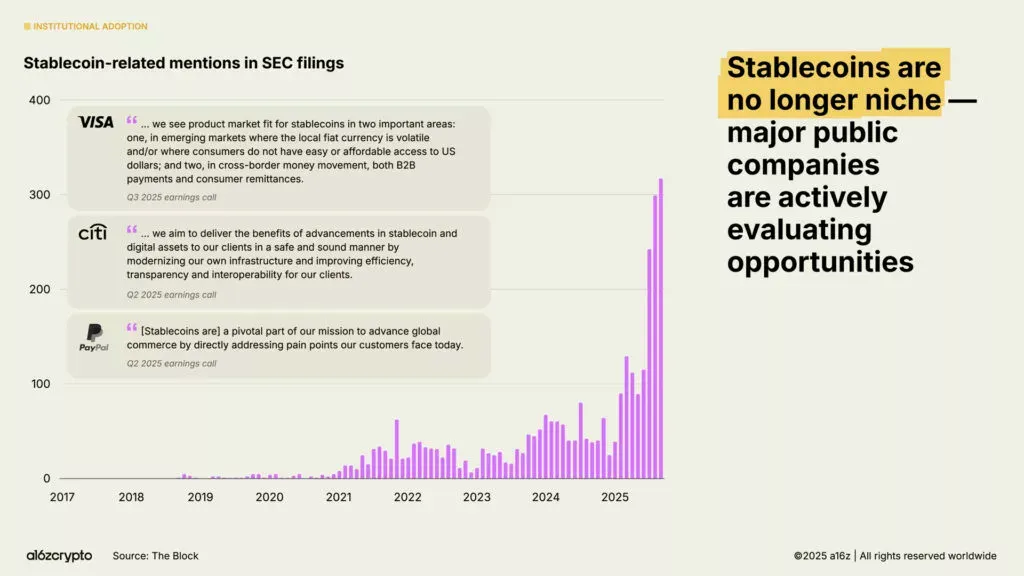
Mentions of stablecoins in SEC filings have climbed 64%, and a steady stream of announcements from major banks and fintech firms underscores a shifting financial landscape. Exchange-traded crypto products (ETPs) have unlocked billions in institutional capital, and publicly traded “digital asset treasury” companies now hold about 10% of both Bitcoin’s and Ethereum’s total supply.
Stablecoins Become the Backbone of On-Chain Finance
One of the report’s standout findings centers on stablecoins, which have quietly become the infrastructure layer of crypto finance. Over the past year, stablecoins processed $46 trillion in transactions — a 106% increase year over year. When adjusted for organic, non-speculative activity, that figure equals about $9 trillion — more than five times PayPal’s throughput and over half of Visa’s.
In September 2025 alone, adjusted stablecoin transaction volume reached $1.25 trillion, much of it tied to payments and settlements rather than trading. The report highlights stablecoins’ deepening ties to the U.S. economy: they collectively hold over $150 billion in U.S. Treasuries, exceeding the reserves of many sovereign nations. With over 99% of stablecoins pegged to the U.S. dollar, a16zcrypto projects the sector could grow tenfold to $3 trillion by 2030, potentially reshaping global dollar liquidity and demand.
The Bigger Picture: Crypto Finds Its Place in Global Finance
From digital wallets in Lagos and Buenos Aires to institutional desks on Wall Street, crypto’s presence in the global financial system is becoming harder to ignore. What began as a niche technology experiment is maturing into a multifaceted ecosystem — one that bridges decentralized innovation with traditional finance at scale.



