

A massive and unprecedented influx of international capital is reshaping American markets. Foreign private investors purchased a staggering 646.8 billion USD in US equities in the 12 months leading up to September 2025, setting an all time record and surpassing the previous 2021 peak by a dramatic 66%, according to data cited by Yardeni Research.
JUST IN: 🇺🇸 Private investors outside U.S. purchased record $646.8 billion of U.S. equities in the 12 months ending in September 2025 - Yardeni Research. pic.twitter.com/9dPxGJoS3g
— Whale Insider (@WhaleInsider) November 30, 2025
This surge signals a fundamental shift in global risk appetite, with international buyers betting heavily on US assets. As analysts at the Kobeissi Letter put it, "Everyone wants US assets."
Historic Rebalancing in the Bond Market
The buying frenzy isn't confined to stocks; foreign private investor purchases of US Treasuries hit 492.7 billion USD over the same period, reflecting persistent worldwide demand for dollar denominated safety.
However, the composition of who owns this debt is changing in ways not seen in decades:
- China’s share of foreign Treasury holdings has fallen to a 23 year low of 7.6%.
- Meanwhile, the UK's share has nearly quadrupled to 9.4%, reflecting a major long term repositioning of sovereign and private capital.
- Japan remains the largest foreign holder, but its share has also declined significantly over the past two decades.
These rebalances have direct implications for interest rates and the stability of the global financial system.
Something unusual is happening in the US Treasury market:
— The Kobeissi Letter (@KobeissiLetter) November 29, 2025
China’s Treasury holdings as a % of all foreign holdings is down to 7.6%, the lowest in 23 years.
This percentage has declined -20 points over the last 14 years.
As a result, China now ranks as the world’s 3rd-largest… pic.twitter.com/JWJ4bbhbsy
Diverging Fortunes: Market Strength vs. Consumer Strain
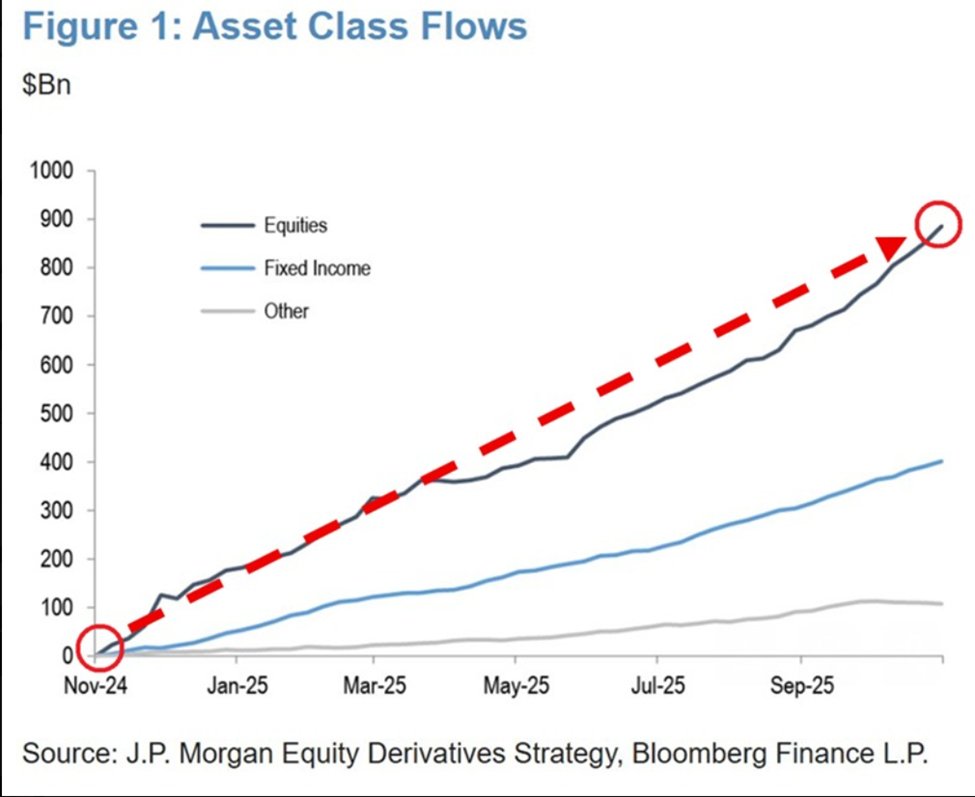
Domestic investors are also going risk on, pouring an extraordinary 900 billion USD into equity funds since November 2024, as noted by JPMorgan data. This aggressive positioning has reinforced the current bull run.
Yet, this market optimism contrasts sharply with the financial state of US households. Total US credit card debt hit an all time high of 1.233 trillion USD in the third quarter of 2025. This record consumer debt raises serious questions about the sustainability of the current economic momentum and the resilience of corporate earnings.
JUST IN: 🇺🇸 Total U.S. credit-card debt reaches $1.233 trillion in third quarter of 2025, highest amount since tracking began. pic.twitter.com/sFi2cMhZTg
— Whale Insider (@WhaleInsider) November 30, 2025
Bullish Forecasts for 2026
Despite the debt warnings, market sentiment remains high, driven by liquidity and powerful seasonality. JPMorgan is reinforcing its "everything rally" forecast, projecting the S&P 500 to reach 8,000 next year. This is timely, as December historically has been the strongest month for US stocks, with the S&P 500 rising 73% of the time since 1928, delivering an average return of +1.28%.
S&P 500 could hit 8,000 next year says JP Morgan 🥳📈🤑🫂 pic.twitter.com/l8zYgPAtWS
— Barchart (@Barchart) November 29, 2025
For both traditional equities and digital assets like crypto, these accelerating capital flows toward the US signal a decisive phase defined by high confidence and building liquidity. Investors must now watch whether record consumer debt becomes the drag that eventually slows this global rush for US assets.



