
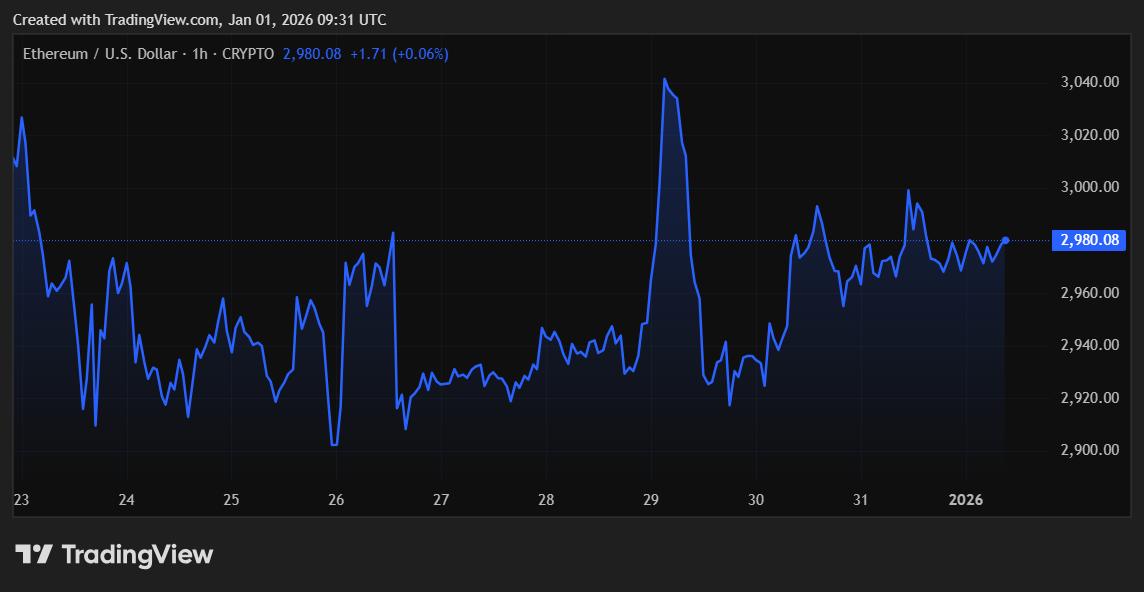
Ether’s market price struggled to find momentum through much of 2025, but behind the scenes, Ethereum itself was anything but stagnant. Over the past year, the network underwent a period of deep internal change and technical progress that reshaped its leadership, clarified its mission, and laid critical groundwork for the next phase of blockchain infrastructure.
The year began with public tension inside the Ethereum Foundation. Community members and developers raised concerns that the organization had lost focus, calling for stronger leadership and clearer direction. What followed was an unusually open debate about governance, priorities, and accountability — one that ultimately led to a sweeping reorganization.
In February, longtime executive director Aya Miyaguchi transitioned into the role of president. Ethereum co-founder Vitalik Buterin committed to revisiting leadership structures, and the foundation soon appointed Hsiao-Wei Wang and Tomasz K. Stańczak as co-executive directors. At the same time, a new marketing and narrative initiative, Etherealize, was launched under former researcher Danny Ryan to better communicate Ethereum’s evolving vision.
Those changes continued into the spring. The foundation reworked its board, reaffirmed its commitment to cypherpunk principles, and narrowed its focus to long-term protocol stewardship. By mid-year, its research and development teams were consolidated, with layoffs introduced as part of a broader effort to concentrate on core technical priorities.
That organizational reset coincided with one of Ethereum’s most significant upgrades in years. In May, developers activated Pectra, a combined Prague-Electra hard fork that bundled 11 protocol changes into a single release. Among its headline features were EIP-7702, which introduced a form of account abstraction, an increase in the maximum validator stake to 2,048 ETH, expanded data “blob” capacity for rollups, and a range of improvements aimed at validators and Layer 2 networks. Adoption was swift, with more than 11,000 EIP-7702 authorizations created on mainnet within days.
Security quickly followed as a top priority. The foundation unveiled its “Trillion Dollar Security” initiative, framing Ethereum’s future role as infrastructure for global-scale finance. Initial reports mapped out major attack surfaces and protocol-level risks, while later updates emphasized that user experience — from transaction signing to account recovery — is inseparable from security itself.
Financial resilience also came into focus. Midway through the year, the foundation disclosed changes to its treasury strategy, reallocating some ETH holdings into stablecoins and other onchain assets. The goal, it said, was to ensure sustainable funding through 2025 and 2026, which it described as critical years for Ethereum’s evolution.
As summer approached, attention shifted to Fusaka, the year’s second major upgrade. Buterin highlighted PeerDAS, a new data availability approach designed to significantly boost Layer 2 scalability. In parallel, the foundation signaled ambitions beyond traditional finance, launching a dedicated “dAI” team to explore Ethereum’s role as infrastructure for decentralized artificial intelligence.
Interoperability became another central theme. With dozens of rollups operating across the ecosystem, the foundation began outlining plans to make Ethereum’s Layer 2 landscape feel more unified. Early frameworks for an “Interop Layer” aimed to standardize cross-rollup communication and simplify the developer experience.
Privacy research accelerated alongside these efforts. Ethereum published a comprehensive privacy roadmap covering private reads, writes, and proofs, and later formed a dedicated Privacy Cluster to advance that work. In the autumn, Buterin introduced a proposal known as Kohaku, outlining how privacy-preserving applications could coexist with transparency and decentralization.
As Fusaka neared activation, Ethereum reached another milestone by raising its block gas limit to 60 million in late November. Days later, the Fusaka rollout began, marking the start of a predictable twice-yearly hard fork schedule. Soon after, Buterin stirred discussion with a proposal for a trustless gas futures market, designed to help users manage fee volatility — an idea that drew both interest and skepticism.
The year closed with Ethereum naming “Hegota” as the upgrade set to follow Glamsterdam in 2026, solidifying its medium-term roadmap. The message was clear: the next phase will focus on refining the gains from Pectra and Fusaka while continuing to push forward on interoperability, privacy, and rollup maturity.



