
France’s top financial regulator has urged Binance to enhance its risk and compliance measures following recent on-site inspections, as European authorities ramp up scrutiny of the cryptocurrency sector ahead of new EU-wide regulations.
According to a Bloomberg report, the French Prudential Supervision and Resolution Authority (ACPR) has been conducting reviews of Binance and other crypto firms registered in France since late 2024. The inspections aim to assess whether these platforms meet the anti-money laundering (AML) and counter-terrorism financing (CTF) standards required for potential European Union-wide licensing under upcoming regulations.
France Tightens Oversight on Crypto Platforms
The ACPR’s inspections are part of a broader initiative to evaluate compliance across France’s digital asset service provider (PSAN) framework. These checks are meant to ensure that crypto exchanges operating in the country can meet the stringent standards expected under the EU’s Markets in Crypto-Assets (MiCA) regulation, which will soon come into effect across the bloc.
Binance and Coinhouse were among the platforms reviewed, according to sources familiar with the matter. Officials reportedly told Binance to reinforce its compliance and risk controls following the inspection. In response, a Binance spokesperson described such reviews as a “standard part of the supervision of regulated entities.” The ACPR and Coinhouse declined to comment.
Europe Moves Toward Centralized Crypto Supervision
The scrutiny comes as European nations push for greater centralized oversight of major crypto companies. Last month, France, Austria, and Italy called on the European Securities and Markets Authority (ESMA) to directly supervise the continent’s largest exchanges. The move is part of a wider effort to harmonize financial regulations and prevent regulatory arbitrage across member states.
Under MiCA, crypto firms will be required to hold licenses that allow them to operate across all EU countries — a significant shift from the current patchwork of national regulations.
Binance’s Ongoing Compliance Challenges
Binance has faced recurring issues with regulators worldwide regarding its AML and Know Your Customer (KYC) practices. Authorities have previously accused the exchange of allowing users to trade or transfer funds without sufficient identity verification, potentially enabling illicit financial activity.
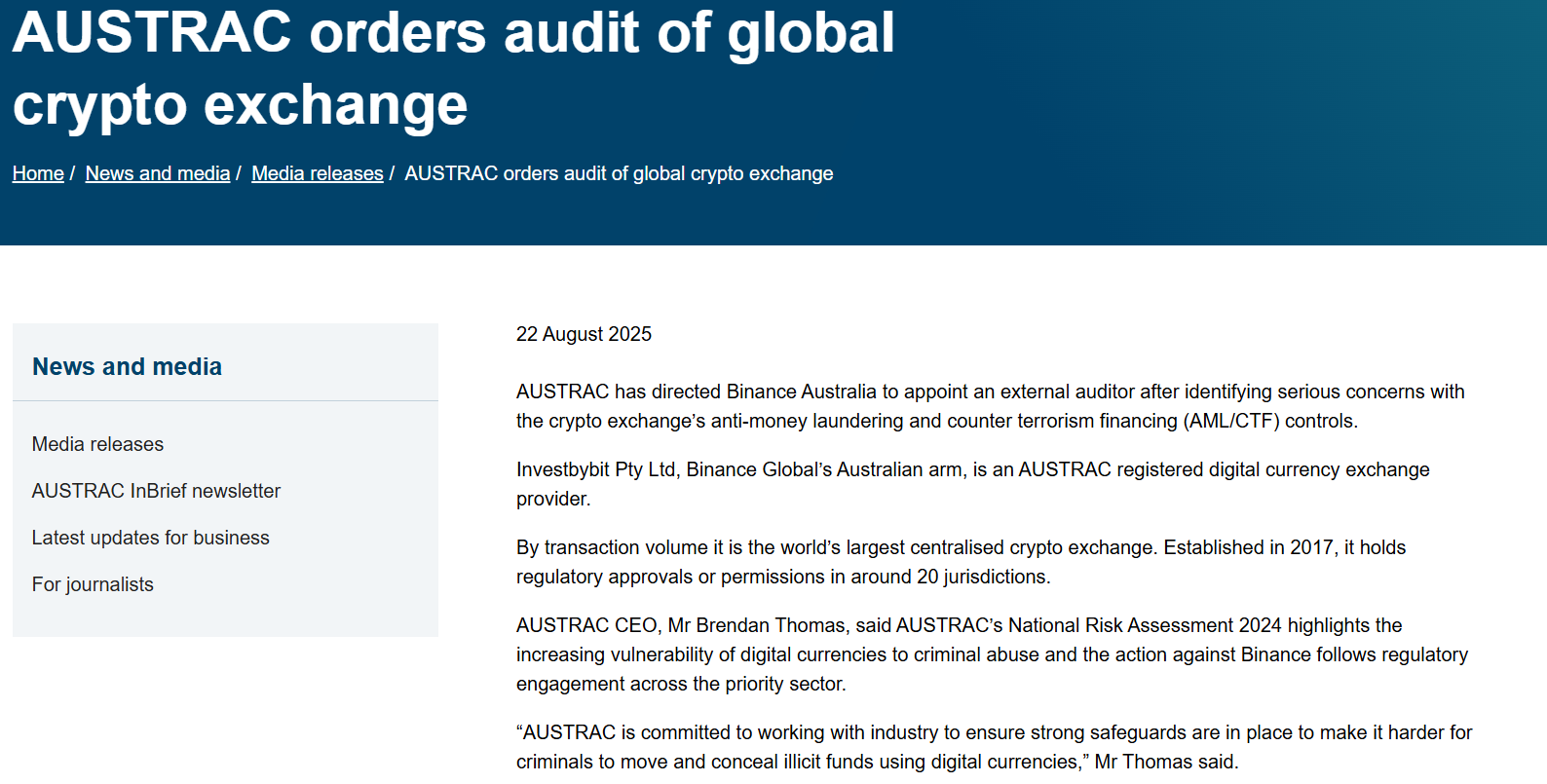
In August 2024, Binance Australia was investigated by the country’s financial watchdog, AUSTRAC, over deficiencies in its AML and CTF systems. The exchange was ordered to appoint external auditors within 28 days and strengthen its internal controls, including more rigorous customer due diligence and transaction monitoring.
The company also faced major legal challenges in the United States. In 2023, the Commodity Futures Trading Commission (CFTC) and Department of Justice (DOJ) filed cases alleging that Binance operated an unregistered trading platform and violated AML laws. The settlement — totaling $4.3 billion — remains one of the largest in cryptocurrency history and led to the resignation and imprisonment of founder Changpeng “CZ” Zhao.
A year (and 2 days) ago, I got out of prison and finally left the US.
— CZ 🔶 BNB (@cz_binance) September 29, 2025
What a year since then!
We saw the people of U.S. choosing a pro-crypto President and government, influencing policies all around the world.
We saw #BNB reaching All-Time-High after ATH.
We saw #BTC reaching… https://t.co/9hvgp8Bo97
Binance’s Global Compliance Push
Despite past controversies, Binance has continued to adapt to regulatory demands in various markets. After exiting several Asian jurisdictions in 2021 due to stricter rules, the company reentered the region by acquiring South Korea’s Gopax exchange. In Singapore, Binance managed to maintain operations through remote work arrangements while avoiding local licensing complications.



