

Fidelity Investments is preparing to enter the stablecoin market with the launch of its first dollar-backed digital token, marking a notable step by one of the world’s largest asset managers into onchain payments and settlement.
The stablecoin, branded as the Fidelity Digital Dollar (FIDD), is expected to launch on the Ethereum blockchain in the coming weeks, according to a press release issued Wednesday. Issued by Fidelity Digital Assets’ national trust bank, FIDD will be redeemable one-to-one for U.S. dollars through Fidelity’s platforms and made available to both retail and institutional customers.

Fidelity said it will manage the issuance of FIDD and oversee its reserve assets internally, with Fidelity Management & Research Company handling the underlying reserves. Customers will be able to buy and redeem the stablecoin at a fixed $1 price through Fidelity Digital Assets, Fidelity Crypto, and Fidelity Crypto for Wealth Managers. Once issued, FIDD can be transferred to any Ethereum mainnet address and used on major crypto exchanges where it is listed.
Mike O’Reilly, president of Fidelity Digital Assets, said the firm views stablecoins as a practical bridge between traditional finance and blockchain-based systems. He noted that Fidelity has spent years researching digital assets and sees institutionally backed stablecoins as a way to provide onchain functionality while maintaining strong security standards.
The announcement builds on more than a decade of work by Fidelity in the digital asset space. The firm began developing crypto-related infrastructure in 2014 and formally launched Fidelity Digital Assets in 2019. While Fidelity disclosed in early 2025 that it was testing a stablecoin, it had not previously confirmed plans for a public rollout.
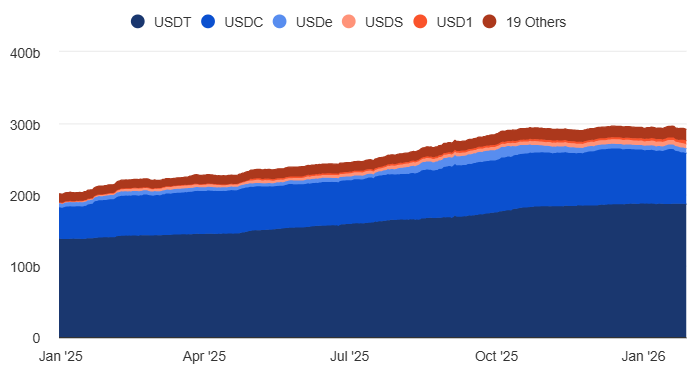
FIDD’s launch also comes at a moment of rapid growth and evolving regulation in the stablecoin market. Total stablecoin supply has climbed to nearly $300 billion, according to data, while U.S. lawmakers have started to provide clearer regulatory guidance. Fidelity cited the passage of the GENIUS Act last year, which established a federal framework for payment stablecoins, as a key factor supporting its decision to move forward.
“The recent passage of the GENIUS Act was a significant milestone for the industry,” O’Reilly said, pointing to the new regulatory guardrails around payment-focused digital dollars.
Fidelity’s move mirrors broader interest from traditional financial institutions. A group of major global banks, including Bank of America, Goldman Sachs, Citi, Deutsche Bank, Barclays, BNP Paribas, and Banco Santander, recently announced plans to explore a jointly issued, fully reserved digital payment asset tied to G7 currencies and deployed on public blockchains.
At the same time, debate continues in Washington over broader crypto market structure legislation. Lawmakers are still negotiating unresolved issues around stablecoin issuance, reserve requirements, and whether issuers should be allowed to share yield with users. Some banks have raised concerns that widespread stablecoin adoption could draw funds away from traditional deposits. Standard Chartered has estimated that stablecoins could pull up to $500 billion from U.S. bank deposits by 2028, while Bank of America’s CEO has warned that trillions could migrate if interest-bearing digital dollars are permitted.



