
The U.S. Federal Reserve lowered its benchmark interest rate by a quarter percentage point on Wednesday, bringing the federal funds rate to a target range between 4% and 3.75%. The decision, widely expected by markets, reflects the central bank’s cautious stance amid an ongoing government data blackout caused by the recent federal shutdown.
In its post-meeting statement, the Federal Open Market Committee (FOMC) noted that “available indicators suggest economic activity has been expanding at a moderate pace.” It acknowledged that job growth has slowed, unemployment has edged up slightly, and inflation—though off its highs—remains above desired levels.

The rate cut passed by a 10–2 vote. Governor Stephen Miran pushed for a deeper half-point reduction, citing weakening economic conditions, while Kansas City Fed President Jeffrey Schmid dissented in the opposite direction, preferring no change at all. The Fed also announced plans to halt balance sheet reductions starting December 1.
The phrase “available indicators” stood out in the Fed’s statement, underscoring the challenge policymakers face as the month-long government shutdown has disrupted the release of key economic data, including employment reports. Fed Chair Jerome Powell acknowledged the uncertainty this creates, saying,
“There were strongly differing views about how to proceed in December. A further reduction in the policy rate at the December meeting is not a forgone conclusion.”
Market Reactions: Uncertainty Ripples Across Asset Classes
Lower interest rates typically make traditional savings and bonds less appealing, often pushing investors toward riskier assets such as cryptocurrencies. However, analysts say this latest move has not sparked much enthusiasm in crypto markets.
“The ongoing uncertainty, which has dominated markets all year, is perhaps the reason we are not seeing more euphoria in the cryptocurrency space,” said Nic Puckrin, investment analyst and co-founder of The Coin Bureau.
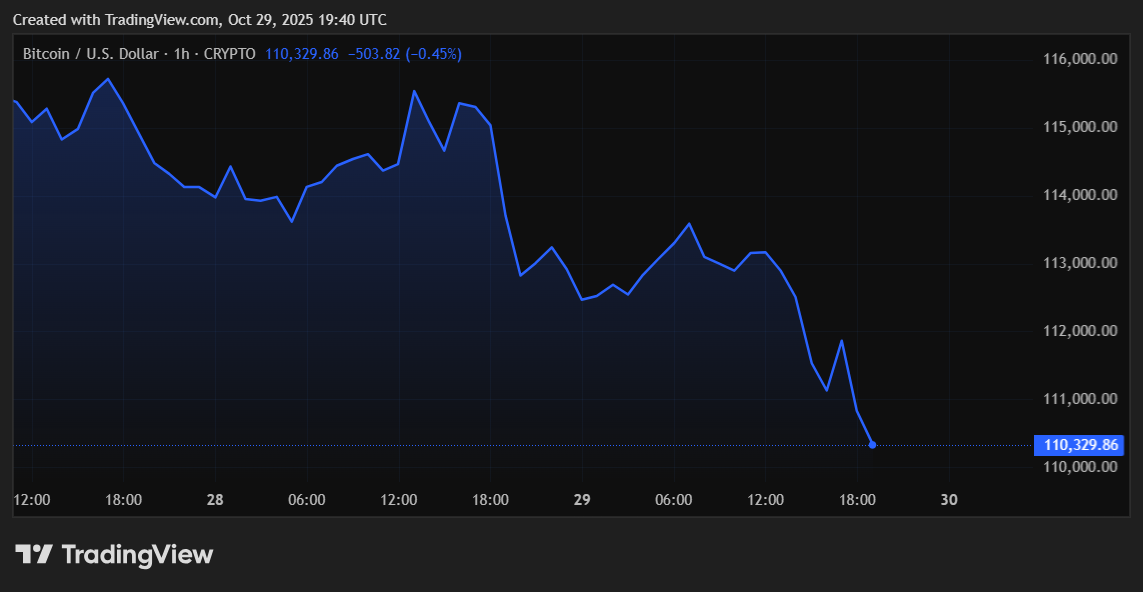
He noted that Bitcoin’s current trading pattern suggests caution, with daily volumes dropping sharply and prices hovering around $111,200.
“Demand is present but lacks the velocity to chase new highs without a dovish surprise from the Fed,” added Timothy Misir, head of research at BRN.
Despite short-term volatility, many in the industry maintain a bullish long-term outlook.
“We’re seeing easing monetary conditions globally—not just in the U.S.—so fiat currency debasement is inevitable,” Puckrin said.
Matt Mena, a crypto strategist at 21Shares, added that “Bitcoin is hovering around $112K, with open interest across derivatives at record highs,” pointing to a potential breakout before year-end. He also sees Ethereum possibly retesting the $5,000 mark as liquidity improves and investor sentiment recovers.
A Balancing Act for the Fed
The Fed’s latest decision highlights a delicate balancing act: supporting economic growth while managing inflation in the absence of reliable government data. The December meeting now looms large, with markets split on whether policymakers will hold steady or continue easing.
For now, investors are left parsing limited data and Powell’s carefully measured words. The path ahead for both traditional and digital assets will likely hinge on whether the Fed sees the recent softness in the economy as a blip—or the start of something deeper.



