
F/m Investments has taken a significant step toward blending traditional finance with blockchain technology, announcing plans to seek regulatory approval to tokenize shares of one of its exchange-traded funds. If approved, the move would mark the first time an ETF issuer has received permission from the U.S. Securities and Exchange Commission to represent registered fund shares on a blockchain ledger.
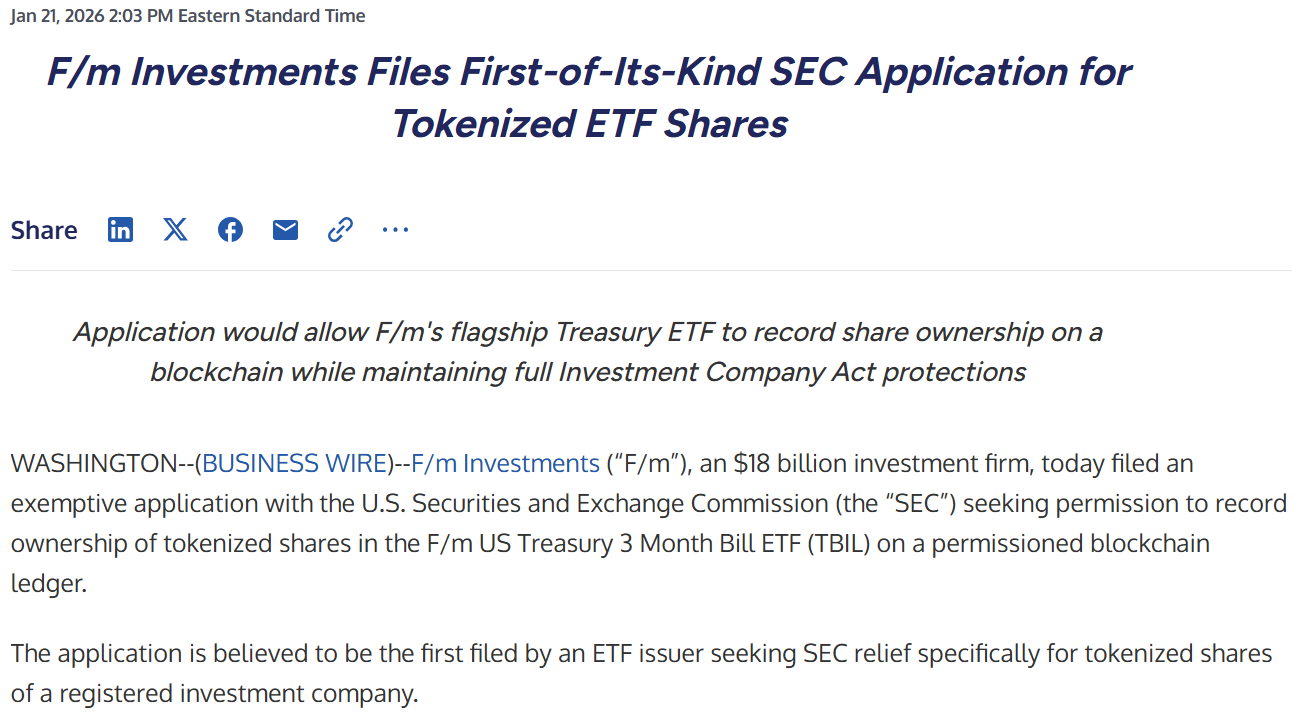
The $18 billion asset manager said it has asked the SEC for relief to tokenize shares of its U.S. Treasury 3 Month Bill ETF (Nasdaq: TBIL). Under the proposal, ownership of existing ETF shares would be recorded on a permissioned blockchain while maintaining the same legal and economic structure investors are familiar with today.
In its statement, F/m Investments said it believes this is the first request of its kind focused specifically on tokenized shares of a registered investment company. Chief executive Alexander Morris described tokenization as a natural next step for financial markets, arguing that applying digital infrastructure to traditional assets is ultimately unavoidable.
If the SEC grants approval, TBIL shares would continue to operate under the same CUSIP and offer identical rights, fees, voting privileges, and economic exposure as current ETF shares. The key difference would be how ownership is recorded and transferred. Rather than relying solely on conventional recordkeeping systems, the fund would use a permissioned blockchain ledger to reflect share ownership.
F/m Investments emphasized that its approach differs from many digital asset models currently in the market. Unlike stablecoins or unregistered tokens, which often raise questions about asset backing and investor protections, the proposed structure would keep the ETF fully within the framework of the Investment Company Act of 1940. The firm said the tokenized shares would remain subject to board oversight, daily transparency requirements, third-party custody, and independent audits.
The filing arrives as interest in asset tokenization grows across both Wall Street and the crypto sector. Supporters argue that recording securities on blockchain-based ledgers could eventually improve settlement speed, reduce operational costs, and increase transparency. Critics, meanwhile, caution that regulatory clarity and investor safeguards must come first.
That regulatory uncertainty remains a central issue. Lawmakers and regulators have yet to settle on how tokenized securities should be supervised, particularly when they blur the line between traditional financial products and digital assets. The SEC has not issued comprehensive guidance on the topic, leaving firms to pursue case-by-case approvals.
Still, momentum appears to be building. Earlier this week, the New York Stock Exchange confirmed it is working on a platform designed to support trading and on-chain settlement of tokenized U.S. equities and ETFs, pending regulatory clearance. The announcement underscored how major market institutions are preparing for a future where blockchain-based infrastructure could coexist with existing systems.
Prominent industry leaders have also voiced optimism. BlackRock CEO Larry Fink and COO Rob Goldstein recently compared the potential impact of tokenization to the early days of the internet, suggesting distributed ledgers could reshape how assets are issued, tracked, and transferred. In a joint commentary last month, they described recent advances in ledger technology as the most significant development since the invention of double-entry bookkeeping.
Market observers see F/m Investments’ application as an important test case. Nate Geraci, CEO of NovaDius Wealth Management, described the filing as likely “the first of many,” signaling that other ETF issuers may follow if regulators are receptive.
F/m Investments becomes first ETF issuer to file w/ SEC for tokenized ETF shares…
— Nate Geraci (@NateGeraci) January 21, 2026
Would be for the F/m US Treasury 3 Month Bill ETF (TBIL).
"Tokenization is coming to securities markets whether we file this application or not.” - CEO Alexander Morris
First of many. pic.twitter.com/lyH9Qh8LPR
For now, the outcome rests with the SEC. Approval would not only set a precedent for ETF tokenization but also offer a clearer path for traditional asset managers exploring blockchain-based solutions. A rejection or delay, on the other hand, could slow adoption while regulatory questions remain unresolved.
Regardless of the decision, F/m Investments’ move highlights a growing effort to modernize financial infrastructure without abandoning established investor protections. As traditional markets and digital technology continue to converge, the debate over how best to regulate tokenized securities is likely to intensify.



