
ETHGas, a protocol focused on Ethereum blockspace infrastructure, has launched its native governance token, GWEI, marking a new step in its effort to rethink how execution capacity on Ethereum is allocated and managed.
Announced on Tuesday, the launch positions GWEI as the governance backbone of a system designed to move Ethereum away from unpredictable gas auctions and toward a more structured, programmable market for blockspace. ETHGas argues that while Ethereum remains the most robust settlement layer in crypto, the way its blockspace is currently distributed has struggled to keep up with growing application demand. The result, the team says, is congestion, execution delays, and highly volatile transaction fees.
 ETHGas FoundationETHGas Foundation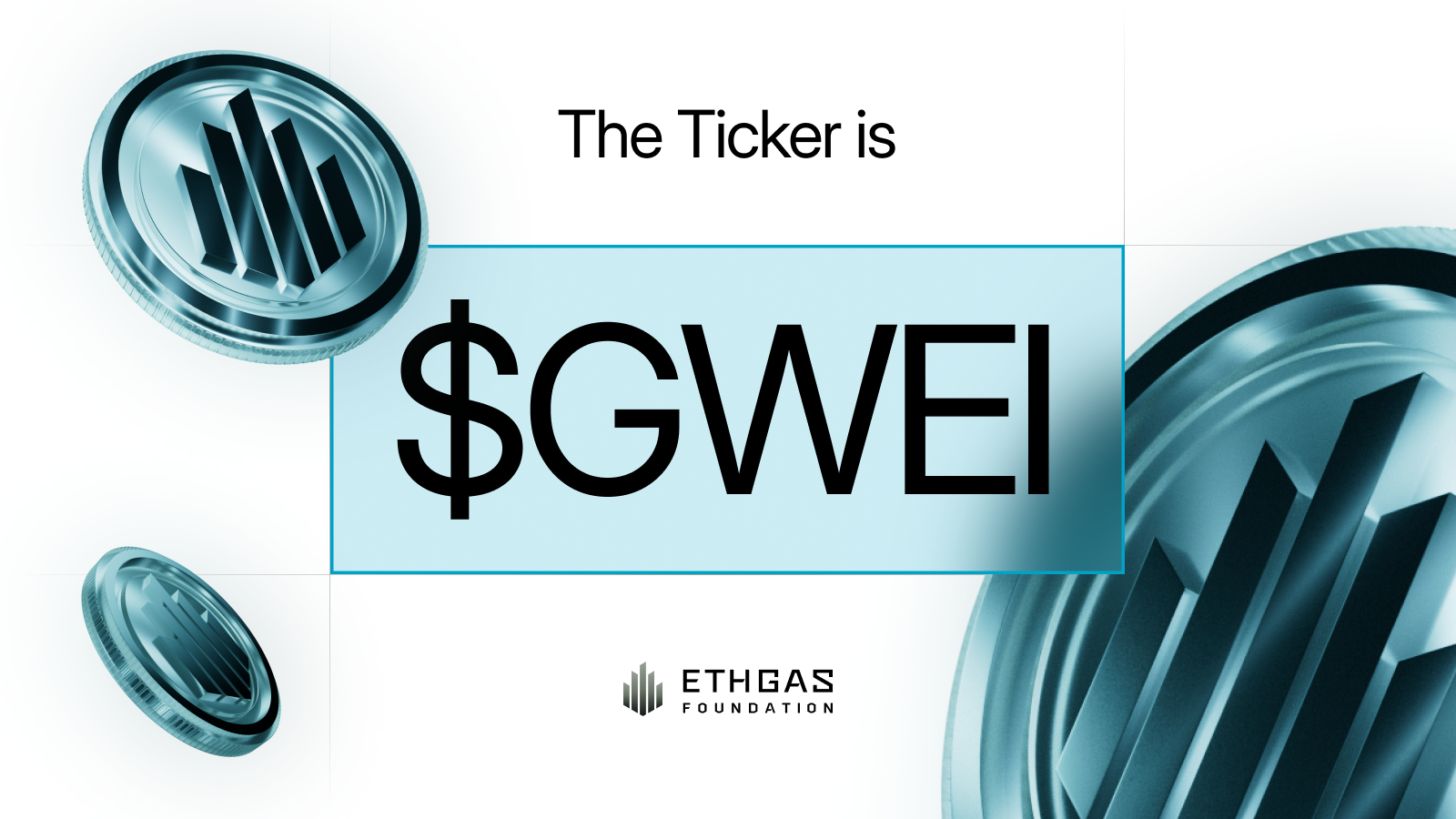
ETHGas aims to address that imbalance by restructuring blockspace itself rather than tweaking gas mechanics alone. In practical terms, the protocol allows applications and institutions to secure execution capacity in advance, making transaction outcomes more predictable and enabling gasless user experiences at scale.
The newly launched GWEI token plays a central role in that vision. According to ETHGas, GWEI holders will govern how the protocol evolves, including decisions around parameter changes, upgrades, and treasury management. Voting power will be linked to staking and lock-up commitments, a structure intended to align long-term participation with influence over the system.
The token launch builds on momentum from last year, when ETHGas raised $12 million in a token funding round and unveiled a blockspace futures market on Ethereum. That market, backed by roughly $800 million in liquidity commitments, was positioned as a tool for applications and institutions seeking reliable execution amid increasing network activity.
At the time, ETHGas emphasized its focus on application-level and institutional demand, particularly as Ethereum usage continues to scale across decentralized finance, gaming, and other onchain sectors. Rather than forcing applications to compete blindly in the public mempool, the project envisions a model where execution is coordinated and committed to in advance.
This idea sits at the center of a broader discussion within the Ethereum ecosystem about the relationship between gas and blockspace. Gas functions as the pricing and payment mechanism that regulates access to Ethereum’s blocks, while blockspace itself represents the finite capacity inside those blocks. ETHGas’s approach treats blockspace as a standalone asset that can be priced, reserved, and traded independently of real-time gas bidding.
Interest in making execution more predictable extends beyond ETHGas. Ethereum co-founder Vitalik Buterin has previously discussed the potential for trustless gas futures markets as a way for users and applications to hedge against fee volatility. Those proposals have sparked debate, particularly around whether such systems could introduce new forms of risk or centralization.
ETHGas positions itself squarely within that debate, betting that greater coordination around blockspace allocation can improve efficiency without undermining Ethereum’s core principles. By shifting governance to token holders and reducing reliance on the mempool’s competitive dynamics, the protocol is advocating for a more organized execution layer on top of Ethereum’s base settlement guarantees.
Looking ahead, ETHGas has scheduled an eligibility snapshot for its initial community GWEI distribution on Jan. 19. The team has said additional details around tokenomics and distribution mechanics will be released at a later date.



