

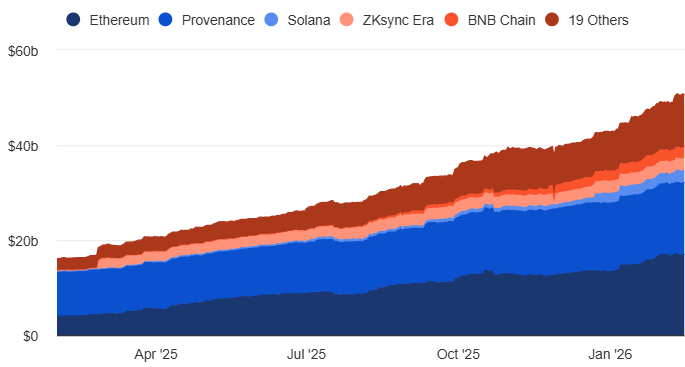
Ethereum’s tokenized real-world asset (RWA) market has grown at a striking pace over the past year, climbing more than 300% to surpass $17 billion in value issued on its mainnet, according to data.
A year ago, the sector stood at just $4.1 billion. Today, it represents nearly a 315% increase, reinforcing Ethereum’s position as the leading blockchain for tokenized finance.
Ethereum currently accounts for about 34% of total onchain RWA value across all networks. At the same time, stablecoins on Ethereum’s mainnet have exceeded $175 billion in aggregate market capitalization, highlighting the network’s role as a primary settlement layer for tokenized dollar-based assets.
Traditional Finance Moves Onchain
The surge reflects a broader shift in how traditional financial institutions are approaching blockchain technology. Rather than experimenting at the margins, major Wall Street players are launching blockchain-based versions of familiar financial products directly on Ethereum.
Among the most prominent examples is BlackRock, which introduced its tokenized U.S. Treasury fund, BUIDL, in 2024 through Securitize. The fund invests in short-term U.S. government securities and has grown into the largest tokenized money-market product on public blockchain infrastructure.
Earlier this month, BlackRock expanded BUIDL’s functionality by enabling direct onchain trading via Uniswap Labs’ UniswapX, in collaboration with Securitize. The move marked one of the clearest integrations yet between institutional capital and decentralized finance infrastructure.
Meanwhile, JPMorgan has also entered the space. In December, the bank launched its first tokenized money-market fund on Ethereum, seeding it with $100 million and targeting qualified investors. The initiative builds on JPMorgan’s broader blockchain efforts and signals that tokenized yield products are attracting interest beyond crypto-native firms.
Beyond Treasuries: Commodities Gain Ground
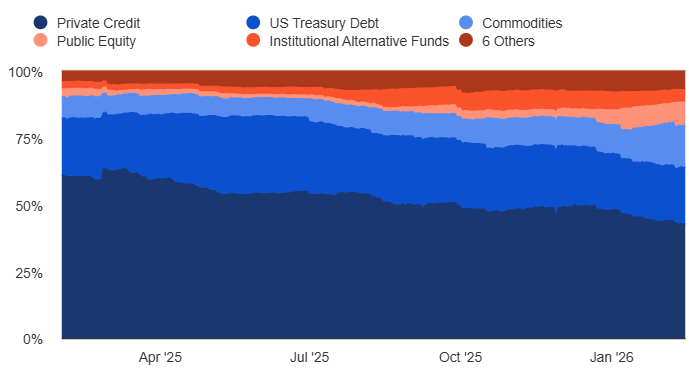
Momentum is not limited to government debt products. This week, digital asset trading firm Wintermute launched institutional trading for tokenized gold. The firm projects that tokenized commodities could grow into a $15 billion segment by 2026.
Commodities already account for more than $5 billion of Ethereum’s RWA market, suggesting that investors are looking beyond Treasuries to diversify tokenized exposure into assets such as gold and other physical goods.
Long-Term Growth Projections
The rapid expansion of tokenized assets on Ethereum aligns with broader forecasts from global financial institutions. Standard Chartered has previously estimated that tokenized real-world assets could reach $2 trillion by 2028, with most issued on Ethereum.
Investment firm ARK Invest has projected an even larger market, suggesting tokenized assets could climb to around $11 trillion by 2030.
While these forecasts remain speculative, the current pace of growth suggests that tokenization is moving from pilot projects to large-scale implementation.
A Structural Shift in Finance
Ethereum’s expanding RWA ecosystem signals more than short-term enthusiasm. With established financial institutions issuing funds, enabling secondary trading, and experimenting with new asset classes, tokenization appears to be entering a more mature phase.
For global investors and institutions alike, the message is clear: blockchain-based finance is no longer confined to digital-native assets. As traditional products continue migrating onchain, Ethereum remains at the center of this evolving financial infrastructure.



