

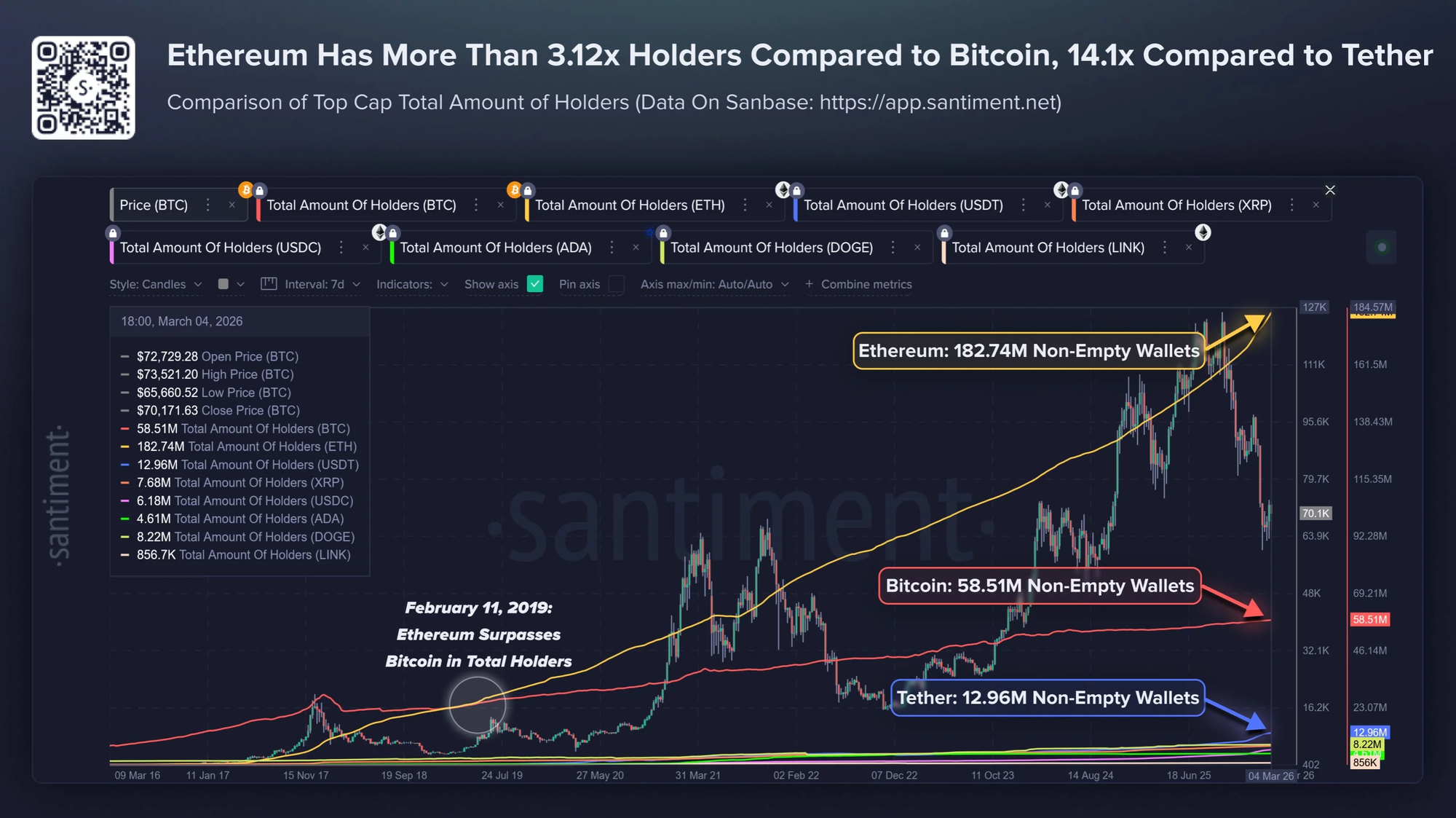
Ethereum now has more than three times as many wallet holders as Bitcoin, according to new onchain data. The widening gap highlights Ethereum’s role as the operational layer for decentralized finance, stablecoins, and tokenized assets.
Data from the analytics firm Santiment shows roughly 182.7 million non-empty wallets on the Ethereum network, compared with about 58.5 million addresses holding funds on Bitcoin. Ethereum first overtook Bitcoin in address count in February 2019 and has expanded that lead steadily as activity across decentralized applications increased.
📈 This chart illustrates the past 10 years of the amount of holders across several of crypto's largest market cap assets. Ethereum's number of non-empty wallets has gone parabolic relative to other coins.
— Santiment (@santimentfeed) March 11, 2026
🧐 Keep tabs on this chart any time: https://t.co/d9ifPZqeGX pic.twitter.com/5kQSa4P3kd
Why Does Ethereum Have Far More Wallet Holders Than Bitcoin?
Ethereum’s architecture encourages frequent wallet creation because decentralized finance (DeFi), non-fungible tokens, and stablecoin transfers often involve multiple interacting addresses. Many users operate several wallets across protocols, contributing to a higher total address count than networks focused primarily on simple transfers.
Bitcoin’s design supports fewer active wallets relative to market size because its main use case centers on long-term value storage. Data from DeFiLlama shows stablecoins alone account for tens of billions of dollars circulating across Ethereum-based protocols, underscoring how application activity can inflate wallet totals. Does a larger wallet count necessarily translate into stronger network demand?
Price action remains cautious despite the adoption metrics. Ethereum traded near $2,023 at the time of writing, down about 1.1% over the past 24 hours as the broader crypto market consolidated.
Some analysts view the current level as a potential accumulation range.
“Ethereum is entering a discount zone similar to the structure before the 2023 rally,” said crypto analyst Merlijn The Trader, who identified the $2,000 level as a critical technical threshold.
ETHEREUM IS BACK IN THE DISCOUNT ZONE.
— Merlijn The Trader (@MerlijnTrader) March 9, 2026
Same level that launched the 2023 rally.
Same structure. Same cycle position.
$2K is the line.
Hold it: wave 3 begins.
Lose it: discount zone extends lower.
Last time $ETH was here, it 4x'd. pic.twitter.com/07XLcIuhSH
If the asset holds above that level, traders may monitor whether capital rotates back into decentralized finance and staking markets that rely on Ethereum infrastructure. The next catalyst may come from whether the $2,000 price zone stabilizes alongside continued growth in onchain wallet activity.



