
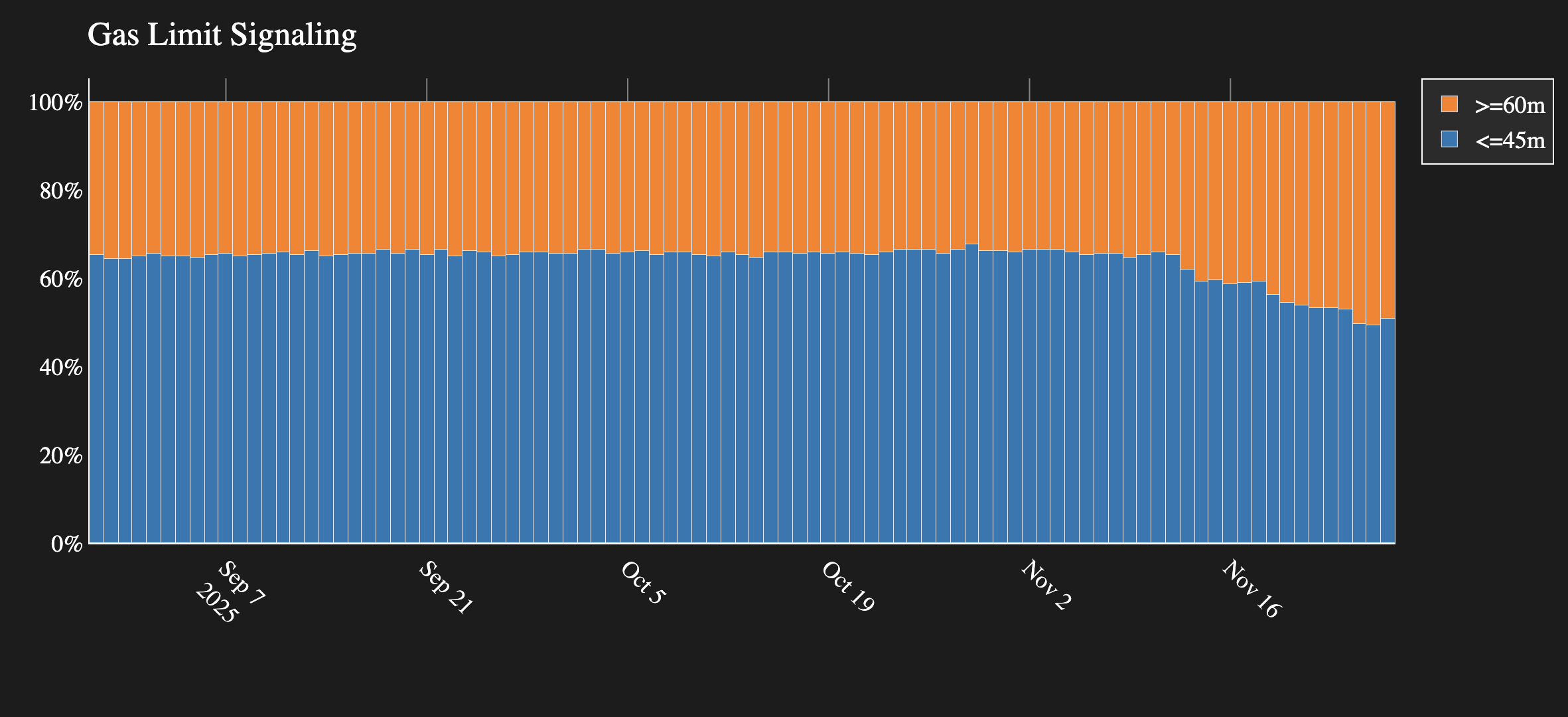
Ethereum has raised its block gas limit from 45 million to 60 million, a shift that reflects growing demand across the ecosystem and a coordinated push from developers and decentralized finance users. Data from GasLimit.pics shows the change took effect on Nov. 25 after more than half of network validators signaled support, meeting the requirement under Ethereum’s current consensus rules.
Toni Wahrstätter, a researcher at the Ethereum Foundation, called the milestone the result of a year of steady community effort. He said the network has effectively doubled its base-layer capacity in twelve months and added that more progress is expected as developers continue to refine how Ethereum handles load.
Just a year after the community started pushing for higher gas limits, Ethereum is now running with a 60M block gas limit.
— Toni Wahrstätter ⟠ (@nero_eth) November 26, 2025
That’s a 2× increase in a single year — and it’s only the beginning.
H/t to all client teams, the researchers involved, and to @nanexcool and @econoar for… pic.twitter.com/5JB8FoiACP
Researchers point to three factors that made the latest increase possible. EIP-7623 brought new safeguards to help control block size. Client teams delivered optimizations across several implementations that allow for higher gas throughput. Months of testnet activity also showed that blocks could propagate smoothly even under heavier traffic. Blockchain researcher Zhixiong Pan said these improvements align well enough to support more assertive scaling at the base layer without putting stability at risk.
Vitalik Buterin added context on X, saying the change fits into a shift toward more targeted scaling rather than broad capacity upgrades. He suggested that future increases could be paired with higher gas costs for operations that place extra strain on the network. This approach is meant to keep block sizes efficient even as throughput grows.
Expect continued growth but more targeted / less uniform growth for next year.
— vitalik.eth (@VitalikButerin) November 26, 2025
eg. one possible future is: 5x gas limit increase together with 5x gas cost increase for operations that are relatively inefficient to process
Potential targets for such increases (my current view):… https://t.co/FkiTxJnEAq
The decision comes at a time when Ethereum’s scaling networks have reached new highs. Data from GrowThePie shows they processed roughly 31,000 transactions per second over the previous 24 hours. Lighter, a zero-knowledge rollup focused on perpetuals with about 1.2 billion dollars in total value locked, led activity at more than 5,400 TPS. Base ranked second with 137 TPS, and other rollups delivered steady volume across the board.
The timing also lines up with the fast-approaching Fusaka hard fork, which is expected to activate on Dec. 3. Fusaka is already live on testnets and recently launched a two million dollar audit contest. At its center is PeerDAS, a redesign of data availability sampling that Buterin has described as critical to long-term scaling. Developers expect it to strengthen how rollups store and access data while improving reliability and cost efficiency. Alongside PeerDAS, Fusaka includes client updates, consensus adjustments, and additional security measures.
Ethereum’s latest upgrade signals a network preparing for heavier use and more ambitious scaling research. With Fusaka around the corner and rollups posting record throughput, the ecosystem appears to be entering a phase of careful but confident expansion.



