
Ethereum has closed the year with a notable milestone, setting a new record for daily transaction activity and signaling renewed momentum across its network.
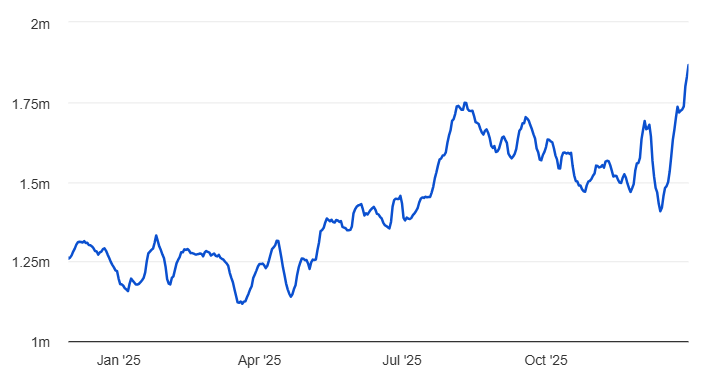
Data from shows that Ethereum’s seven-day moving average of daily transactions climbed to 1.87 million on Dec. 31. This level exceeds the previous all-time high of 1.61 million recorded in May 2021, during the peak of the NFT and DeFi boom. It also surpasses the more recent high of 1.73 million reached in August 2025.
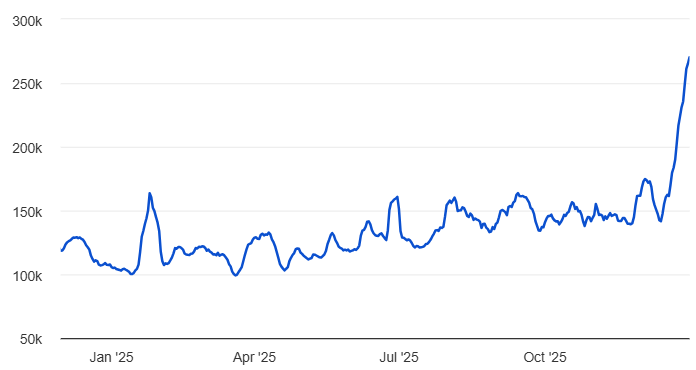
The increase in transaction volume has been accompanied by strong growth in network participation. The number of active Ethereum addresses reached 728,904 at year-end, the highest figure since May 2021. At the same time, the network added 270,160 new addresses in a single day, marking its largest daily increase since early 2018.
Analysts point to a combination of technical improvements and broader adoption as key drivers behind the surge.
“The recent surge has been driven primarily by network upgrades that have slashed fees, boosted scalability, and attracted institutional participation via ETFs and real-world asset tokenization,” said Nick Ruck, director of LVRG Research.
Ethereum underwent two major upgrades in 2025 that reshaped its performance profile. The Pectra upgrade expanded data throughput, improved wallet functionality through account abstraction, and increased validator staking limits. Later in the year, the Fusaka upgrade introduced PeerDAS, a system designed to support higher data volumes without placing additional strain on network nodes. Together with higher gas limits and advances in zkEVM technology, these changes have significantly reduced transaction costs and strengthened Ethereum’s rollup-focused roadmap.
Further upgrades are already on the horizon. The Glamsterdam upgrade, expected in early to mid-2026, aims to enhance overall network performance and decentralization. A subsequent update, Hegota, planned for the second half of the year, is intended to improve Ethereum’s long-term sustainability.
Despite growing competition among blockchain platforms, Ethereum continues to dominate key areas of on-chain activity.
“The majority of stablecoin usage, real-world assets, yield and staking protocols, and even gaming and NFT activity remains Ethereum or EVM-compatible,” said Justin d’Anethan, head of research at Arctic Digital.
He added that periods of subdued price action can sometimes mask underlying network strength, creating conditions for renewed investor interest.
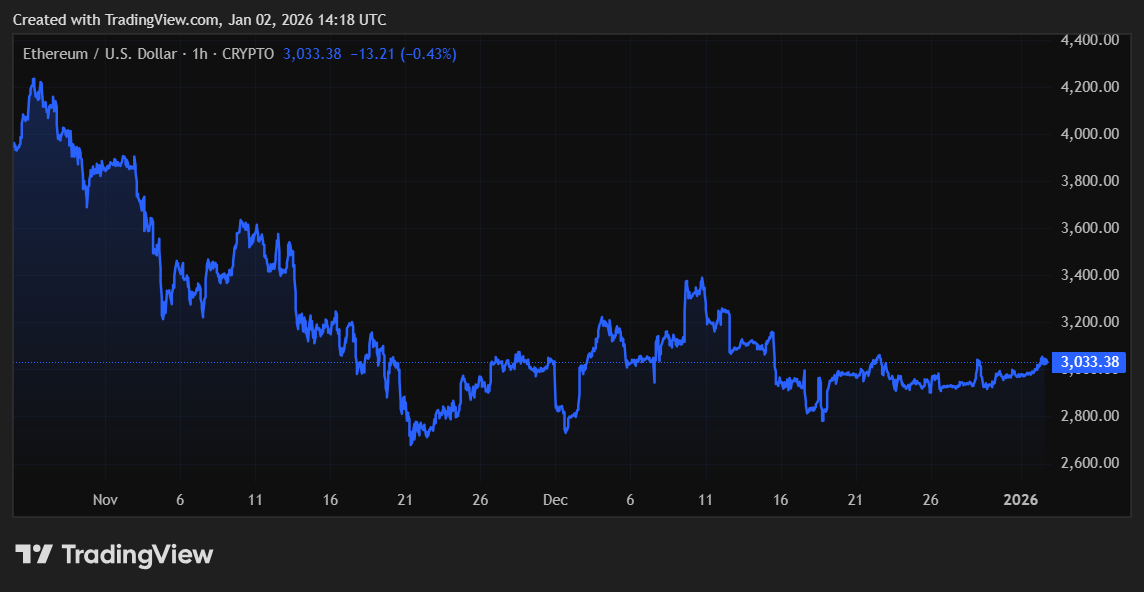
Market data reflects some of that optimism. As of 5:05 a.m. ET on Friday, Ether was trading at $3,044, up 2.17% over the previous 24 hours.
Taken together, the record transaction levels, rising user activity, and ongoing upgrades suggest Ethereum is entering the new year with strong fundamentals. While challenges remain in an increasingly competitive blockchain landscape, the network’s recent performance highlights its continued role as a central hub for decentralized finance, digital assets, and emerging real-world use cases.



