
DraftKings has officially stepped into the federally regulated prediction market space with the launch of a new standalone product, DraftKings Predictions. Announced Friday, the app operates under the oversight of the U.S. Commodity Futures Trading Commission (CFTC), marking a notable expansion beyond the company’s traditional sportsbook business.
 DK Crown Holdings Inc.
The new app allows eligible users to trade event-based contracts tied to real-world outcomes. At launch, these contracts cover sports and selected financial market events. DraftKings Predictions is fully separate from the company’s main sportsbook platform and is expected to become available across major app stores in the coming days.
This move follows months of public discussion by DraftKings leadership about the potential of prediction markets. During a November earnings call, CEO Jason Robins described the space as a way to reach customers in states where online sports betting is still prohibited. He emphasized that prediction markets are designed to complement, not replace, DraftKings’ core sportsbook operations.
One of the key advantages of the new platform is its broad geographic reach. DraftKings Predictions will offer event contracts in 38 states, including large markets such as California and Texas, where traditional online sports betting remains illegal. This wider access could significantly expand the company’s addressable audience.
At launch, trades on the app will be routed through CME Group infrastructure. DraftKings has also outlined plans to gradually increase both liquidity and the range of available markets. The company has previously confirmed that Polymarket will act as the designated clearinghouse for the platform, following DraftKings’ acquisition of Railbird Technologies, a CFTC-regulated exchange operator.
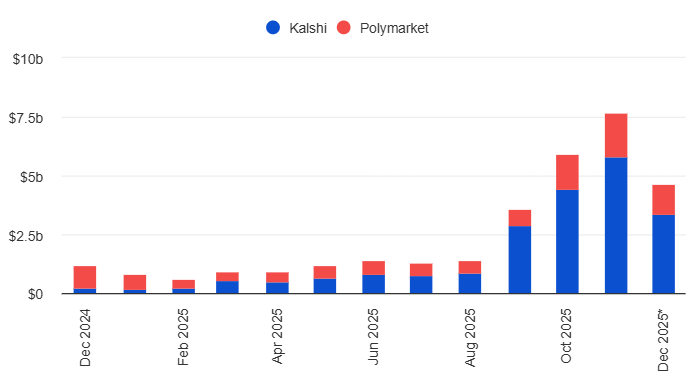
The launch comes amid growing interest in prediction markets across the industry. Platforms such as Polymarket and Kalshi have gained traction by offering contracts linked to sports and other high-profile events. Recent data highlights the rapid growth in this segment. Kalshi reported more than $5.8 billion in trading volume in November, compared with about $1.8 billion on Polymarket. December figures showed continued momentum, with Kalshi at roughly $3.4 billion and Polymarket at around $1.25 billion, according to data.
As prediction markets attract more attention from traders, regulators, and established gaming companies, DraftKings’ entry signals increasing convergence between sports, finance, and regulated event-based trading.



