
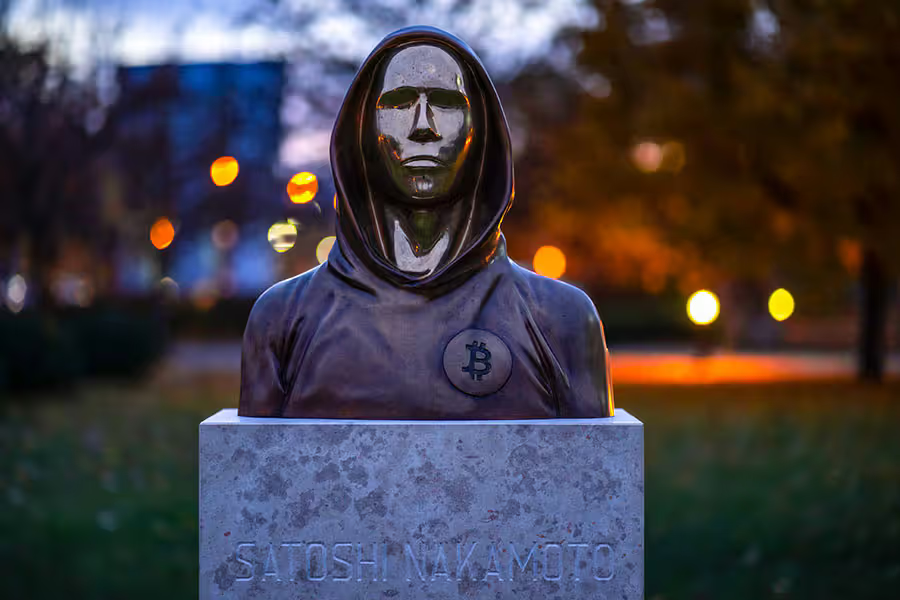
The crypto world held its breath this Thursday as five long-dormant Bitcoin (BTC) wallets, dating all the way back to 2010, suddenly sprang to life. These wallets collectively moved 250 BTC, valued at roughly $29.6 million, after lying untouched for over 15 years. Naturally, this sparked immediate speculation: could it be Satoshi Nakamoto, Bitcoin's elusive creator, finally making a move?
While the thought is certainly thrilling, on-chain analysts are largely saying, "Not so fast." It seems highly improbable that these awakened funds belong to Satoshi himself.
A Peek into Bitcoin's Early Days: The Patoshi Pattern
These 250 BTC were originally mined on April 26, 2010. That's just a few months before what's known as the "Patoshi mining pattern" ceased its activity. For those new to the term, the Patoshi Pattern refers to a very distinct and traceable mining signature found in Bitcoin's earliest blocks. It was famously discovered by researcher Sergio Demián Lerner in 2013 through meticulous blockchain analysis, and it's widely believed to be the mining fingerprint of Satoshi Nakamoto.
5 miner wallets woke up after being dormant for over 15 years and transferred 250 $BTC($29.6M) out an hour ago.
— Lookonchain (@lookonchain) July 31, 2025
These miner wallets earned 50 $BTC each from mining on Apr 26, 2010.
Wallets:
1NuqAKeX6JzW372QfEe7eFkewFx21fnqd3
12EWRT19v2eAvWjGDWjodCe7NP1CzmFphT… pic.twitter.com/vGttaE6MxY
However, despite the timing, blockchain sleuths believe these recent transactions likely aren't linked to Satoshi. Why? Because the coins involved in this latest movement were transacted while Satoshi was still actively contributing to the Bitcoin network.
As Whale Alert, a well-known on-chain tracking service, pointed out: "According to our research, the two 50 BTC dormant address transactions earlier today were mined at the end of the period during which Satoshi was active (until around block 54,316). However, it is very unlikely the blocks were mined by Satoshi." Block 54,316 was mined on May 3, 2010.
Satoshi's own BTC holdings are intrinsically linked to that unique Patoshi Pattern, which suggests he was mining early Bitcoin with a very specific setup. Whale Alert, in previous research, estimated that Satoshi likely mined around 1,125,150 BTC up to block 54,316. As of July 2020, those holdings were valued at over $10.9 billion.
Why These Wallets Aren't "The One"
The key to distinguishing Patoshi-mined blocks lies in their peculiar "nonce range" – a technical detail that makes them stand out from other miners of that era. Whale Alert elaborates: "Lerner found additional proof for his claims in the nonces… the last byte of the nonce was always within the ranges of 0 to 9 or 19 to 58 whereas all other miners used the full range of 0 to 255." This unique digital signature is what helps identify blocks mined by Satoshi.
Furthermore, researchers largely agree that Satoshi intentionally scaled back and eventually ceased his mining operations around May 2010. "It is safe to say that the Patoshi miner was turned off in May 2010. The timing of the shutdown, the mining behavior, the systematic decrease in mining speed and the lack of spending strongly suggest that Satoshi was only interested in growing and protecting the young network," Whale Alert added.
The recent wallet activity simply doesn't align with these well-documented Patoshi patterns or Satoshi's known operational behavior. While the Patoshi-mined Bitcoin was likely a byproduct of his efforts to secure the nascent network, it's generally thought that the vast majority of those coins will never be spent.
A Glimpse into Bitcoin's Early Adopters
Even if it's not Satoshi, these transactions still offer a rare and fascinating look into the world of Bitcoin's earliest adopters. Whale Alert does acknowledge that their findings don't completely rule out the possibility that Satoshi might have run a separate miner using publicly available software, perhaps for testing. They even suggest it's "likely that at least one of the non-Patoshi patterns belongs to Satoshi as well." To shed more light on this enduring mystery, Whale Alert plans to release a comprehensive list of all possible Satoshi-mined blocks soon.
Meanwhile, the crypto market has seen a flurry of activity from other "Satoshi-era" Bitcoin addresses in recent weeks, sparking concerns about potential sell-offs. For instance, Galaxy Digital has come under scrutiny for helping move 80,000 BTC from wallets linked to another long-term holder. This trend of large, old wallets becoming active has injected a degree of short-term uncertainty into the market. Traders are watching volatility closely, while investors are hoping fresh capital inflows can help propel BTC back to new highs.



