

Standard Chartered maintains its $2 trillion tokenized real-world asset (RWA) projection despite a $292 million exploit tied to rsETH. The stance signals confidence that recent stress events will accelerate, rather than derail, institutional DeFi adoption.
The April 18 incident began with a suspected forged LayerZero message that enabled the theft of rsETH, which was then used as collateral on Aave. The attacker borrowed against unbacked assets, triggering cascading withdrawals that saw Aave lose $17 billion in deposits, or 38% of total value, alongside a $5.5 billion drop in active loans, according to the bank.
Can DeFi Recover From Structural Risk Exposures?
Standard Chartered argues the episode exposed deeper issues within DeFi’s architecture, particularly asset-liability mismatches. Complex collateral structures, including restaked and wrapped tokens, were paired with liabilities carrying different risk profiles, amplifying contagion as leveraged positions unwound.
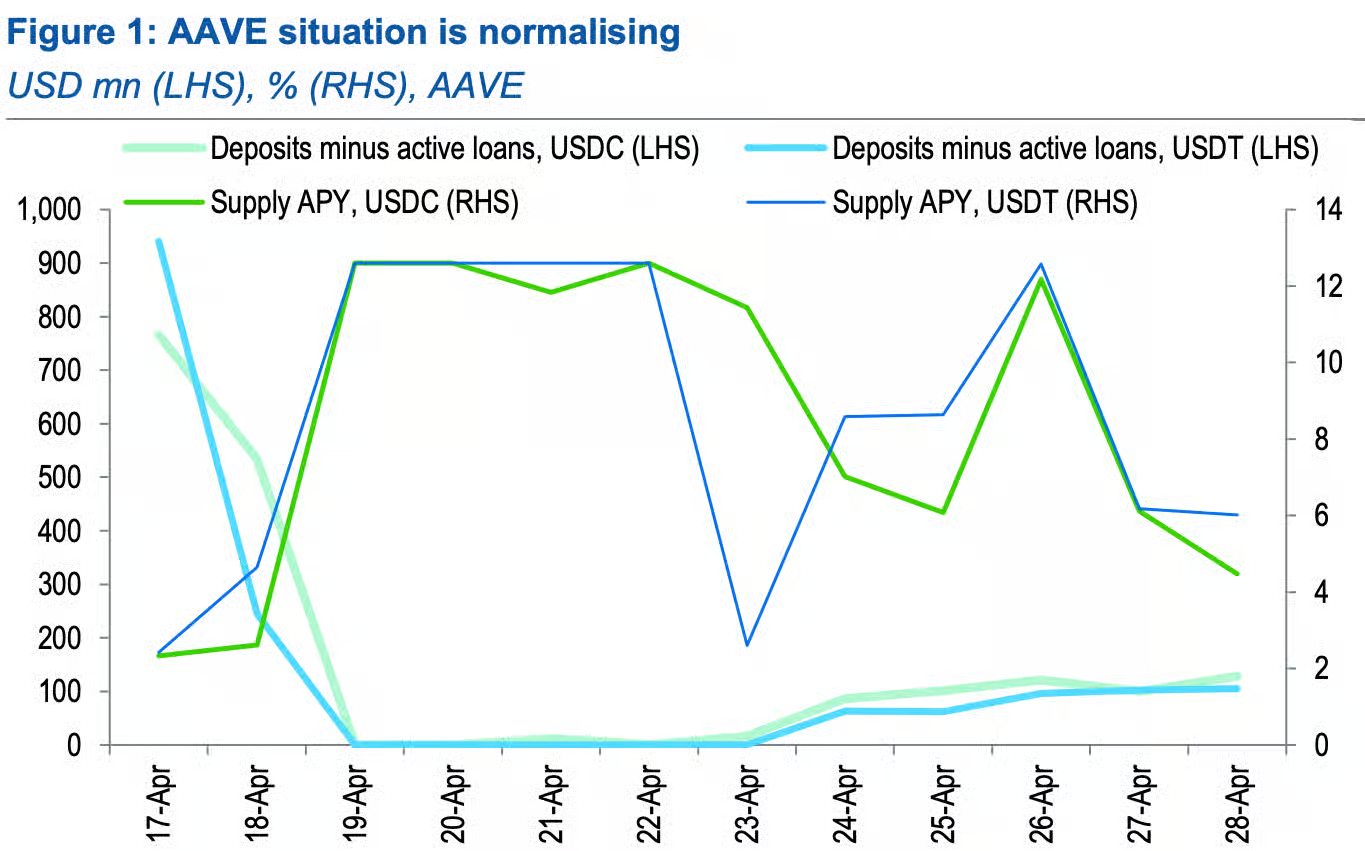
Yet the response has been equally significant. A coalition led by Aave committed over $300 million to stabilize the protocol, while broader industry efforts, including support from major DeFi entities, shifted focus toward recapitalization. The bank points to upgrades such as Aave V4 and the proposed Ethereum Economic Zone as steps toward reducing reliance on cross-chain bridges, a recurring source of exploits.
Geoffrey Kendrick, global head of digital assets research at Standard Chartered, described the situation as “DeFi – bent, not broken,” framing the recovery as a critical stress test. He added that the sector’s coordinated response may represent a “much-needed antifragile moment” as infrastructure matures under pressure.
The bank continues to forecast RWA growth from $35 billion in October 2025 to $2 trillion by 2028, driven by expanding stablecoin liquidity and DeFi-based financial services. Market participants are now watching whether post-crisis reforms reduce systemic risk and sustain institutional confidence in tokenized asset markets.



