

Deep Cogito has unveiled Cogito v2, a new family of four open-source AI models ranging from 70 billion to 671 billion parameters, designed to internalize their reasoning rather than rely on prolonged inference search. These include two mid-sized models (70B dense and 109B MoE) and two large-scale versions (405B dense and 671B MoE), the latter already recognized as among the most capable open AI models globally.

A New Kind of Intelligence: Developing ‘Machine Intuition’
Cogito v2 shifts away from the standard method of "thinking longer" at runtime. Instead, it uses a training approach called Iterated Distillation and Amplification (IDA), where reasoning chains are distilled back into the model's parameters. This creates an evolving intuition that drastically reduces the depth of reasoning needed during inference—achieving 60% shorter reasoning chains than comparable models like DeepSeek R1.
Performance That Rivals Closed-Source Models
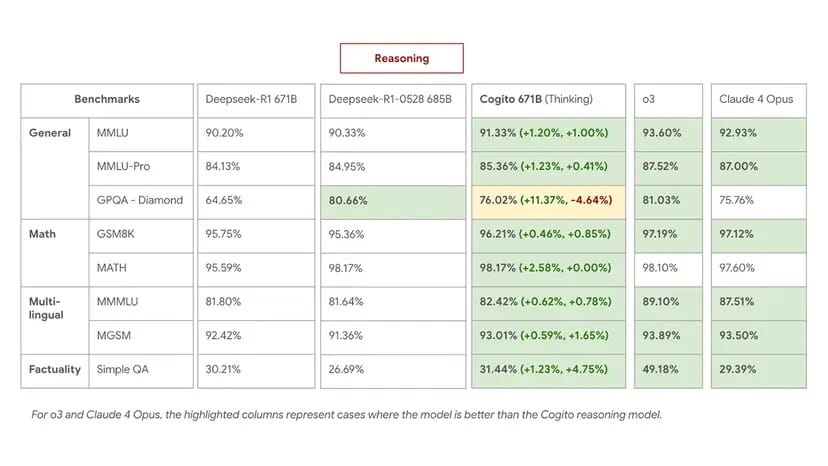
The flagship 671B MoE model delivers performance on par with top-tier open models such as DeepSeek v3, and approaches closed systems like Claude 4 Opus and o3. Benchmark tests reveal:
- Excellent results in multilingual QA, logic, and math tasks—even outperforming DeepSeek R1 in certain strategy-based benchmarks.
- Strong non-reasoning mode performance, highlighting the power of its internalized priors.
- Remarkable reasoning efficiency, lowering inference costs and improving speed without compromising output quality.
Why It Matters: Power and Efficiency at a Fraction of the Cost
Despite the massive scale, Deep Cogito reports that the entire Cogito model lineup, including earlier v1 checkpoints, was trained for under $3.5 million—a striking contrast to the nine-figure budgets of many leading AI labs. As Drishan Arora, CEO and co‑founder (formerly at Google), explains, the key is smarter priors, not just more compute or data VentureBeat.
Notable Capabilities and Demonstrated Examples
- Math reasoning: Cogito 671B correctly answers questions like whether an 80 mph train can reach a city 240 miles away in less than 2.5 hours, using under 100 tokens—while DeepSeek R1 uses over 200 tokens.
- Legal logic: Demonstrates nuanced understanding of precedent-based scenarios by reaching conclusions with clear chains of justification.
- Multi-hop reasoning: Correctly answers familial logic puzzles (e.g. confirming that Alice is Charlie’s grandmother), avoiding confusion in variations where others often falter.
- Emergent visual reasoning: Without multimodal training, the models show surprising ability to reason about image content via transfer learning—comparing subjects such as a duck vs. a lion through logical inference alone.
The Path Forward: Open Superintelligence, Distilled
Deep Cogito sees Cogito v2 as a stepping stone on the path to open superintelligence. They plan to “hill climb” on iterative self-improvement gains and reaffirm that all future models will stay open-source. Supported by funding from Benchmark and others, the company aims to prove that frontier AI development need not be limited to mega-budgets or closed ecosystems.
With Cogito v2, Deep Cogito delivers a transformative open-source AI suite that learns to think more efficiently, not just more exhaustively. By embedding reasoning into its core intelligence via IDA, the models achieve top-tier performance with significantly lower inference cost and faster response. Whether you're a developer, researcher, or AI enthusiast, Cogito v2 sets a remarkable new benchmark in open, scalable intelligence—and may signal the start of a more accessible era in advanced AI.



