

A slowdown in bitcoin mining activity could be an early sign of a positive shift for the cryptocurrency’s price, according to a new report from asset manager VanEck. While falling hashrate often reflects short-term stress in the network, VanEck’s analysts say history suggests it can also point to stronger returns ahead.
In a report released Monday titled Mid-December 2025 BTC ChainCheck, VanEck examined the relationship between bitcoin’s network hashrate and future price performance. The hashrate measures the total computing power used to secure the bitcoin network and is closely tied to mining activity.
Looking at data going back to 2014, the firm found that bitcoin has tended to perform better after periods when hashrate declined. Specifically, 90-day forward returns were positive 65 percent of the time when hashrate was shrinking. By comparison, returns were positive 54 percent of the time when hashrate was expanding.
VanEck described this pattern as a “contrarian signal,” often linked to miner capitulation. This occurs when less efficient or higher-cost miners are forced to shut down operations during periods of financial strain. While painful for miners, these shakeouts have historically coincided with conditions that later favor long-term bitcoin holders.
The report noted that this dynamic may be resurfacing. Bitcoin’s hashrate fell roughly 4 percent in the month through December 15, marking the sharpest drop since April 2024. VanEck added that when hashrate compression lasts longer, positive price returns not only become more frequent but also tend to be larger.
Mining profitability under pressure
The decline in mining activity comes as bitcoin prices have pulled back from recent highs, squeezing miner margins. According to VanEck, the breakeven electricity cost for a mid-generation mining rig such as the Antminer S19 XP has dropped significantly. In late 2024, miners could afford to pay around $0.12 per kilowatt-hour for power. By mid-December 2025, that figure had fallen to about $0.077.
Breakeven electricity cost represents the maximum power price miners can pay without operating at a loss. When it drops, it signals that mining has become less profitable overall, leaving only operators with access to cheaper energy able to continue.
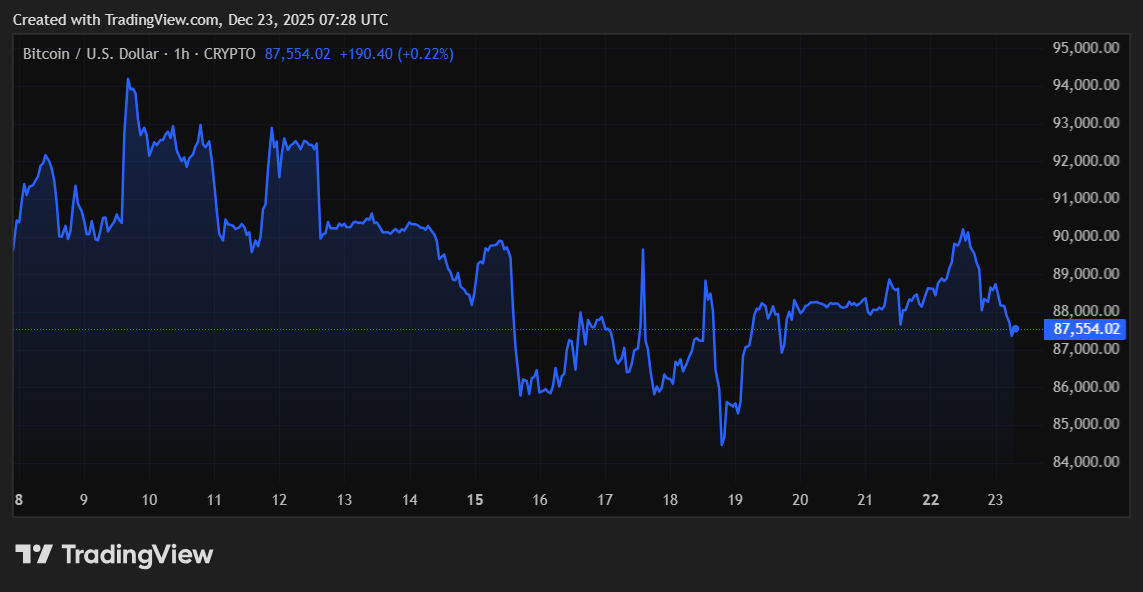
Bitcoin’s price action has added to the pressure. After reaching an all-time high of $126,080 in October, the cryptocurrency slid to around $81,000 on November 21. Prices have since stabilized but remain volatile. As of early Tuesday, bitcoin was trading at $87,907, down 1.09 percent over the previous 24 hours, according to price data.
Institutional buyers step in
While miners face tightening conditions, VanEck’s report highlights growing demand from longer-term institutional investors. Digital asset treasuries, or DATs, have increased their bitcoin purchases during the recent price pullback, helping absorb supply coming from stressed miners.
Between mid-November and mid-December, DATs acquired approximately 42,000 BTC, a 4 percent increase from the previous month. This brought total DAT holdings to about 1.09 million BTC. VanEck said this was the largest monthly accumulation by digital asset treasuries since mid-July to mid-August 2025, when more than 128,000 BTC were added.
The firm also noted a shift in how these treasuries may fund future purchases. Rather than relying heavily on common stock issuance, many DATs are expected to finance bitcoin acquisitions through preference share sales, a move that could reduce dilution while maintaining buying capacity.
A cautious but constructive signal
VanEck stopped short of making short-term price predictions, emphasizing that bitcoin remains volatile and influenced by a wide range of factors. Still, the combination of miner capitulation and steady institutional accumulation has historically aligned with more constructive market phases.
For investors watching the network closely, the current dip in mining activity may be less a warning sign and more a signal worth paying attention to. If past patterns hold, periods of stress beneath the surface have often laid the groundwork for bitcoin’s next leg forward.



