

U.S. federal authorities have seized over $10 million in cryptocurrency tied to the Sinaloa cartel, as part of a sweeping national operation targeting cartel-linked drug trafficking and digital money laundering. The Drug Enforcement Administration (DEA), in coordination with the Federal Bureau of Investigation (FBI), carried out the crypto seizure in Miami, Florida, marking another blow against one of Mexico’s most notorious drug syndicates.
 Office of the Spokesperson
The crackdown isn’t limited to digital assets. Since January 2025, law enforcement has confiscated a staggering:
- 44 million fentanyl pills
- 4,500 pounds of fentanyl powder
- 65,000 pounds of methamphetamine
- Over 201,500 pounds of cocaine
“This is a full-force assault on the cartels,” said DEA Acting Administrator Robert Murphy. “We’re dismantling their networks, seizing their assets, and hitting them where it hurts. We won’t stop until we’ve taken down the last piece.”
Coast-to-Coast Raids Target Drug Labs and Trafficking Routes
From coast to coast, federal and local agencies have stepped up enforcement:
- In Lexington County, South Carolina, DEA agents seized 156 pounds of fentanyl and 44 pounds of meth, alongside firearms and arrested a trafficker.
- In Kern County, California, a major meth conversion lab was dismantled, with agents confiscating 240 pounds of crystal meth and 151 gallons of liquid meth.
- In Georgia, officials found 700 pounds of meth hidden in a cucumber shipment.
- In Texas, over 1,700 pounds of meth—valued at more than $15 million—were discovered concealed inside a vehicle.
These raids follow the high-profile legal developments involving Ovidio Guzmán López, son of drug kingpin Joaquín “El Chapo” Guzmán, who recently pleaded guilty to drug trafficking charges in Chicago.
“We’re seeing record-level seizures because our agents are taking the fight directly to the cartels,” said U.S. Attorney General Pamela Bondi. “Americans need to understand—one pill can kill. The risks are real, and our resolve is stronger than ever.”
Crypto Laundering Hits $21.8 Billion
The battle now extends into cyberspace. According to blockchain analytics firm Elliptic, illicit crypto flows via crosschain swaps have ballooned to $21.8 billion in 2025, up sharply from $7 billion just two years ago. Crosschain swaps—where funds are rapidly moved between blockchains—are now a favored laundering method for major criminal organizations.
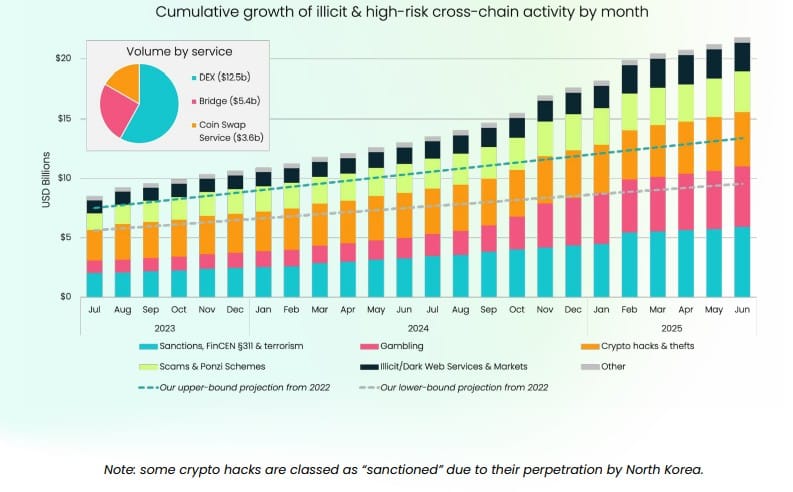
Elliptic notes that although the process is complex and costly, it offers one key advantage: anonymity. Criminals use these tactics to obscure the origin and final destination of funds, making it harder for investigators to trace the money trail. Notably, North Korean actors are believed to be responsible for about 12% of all high-risk crosschain crypto activity.
A Broader War on Drugs and Digital Crime
The seizure of crypto assets linked to the Sinaloa cartel highlights how the fight against organized crime has evolved. Today’s cartels are not only moving vast amounts of narcotics across borders but also tapping into decentralized financial systems to conceal profits and evade detection.
As agencies adapt to this digital frontier, officials are calling for increased cooperation across jurisdictions and updated tools to keep pace with the changing face of organized crime.



