

Cryptocurrency markets are increasingly serving as a proving ground for the next generation of artificial intelligence forecasting tools. With constant trading activity, open data, and global participation, digital assets offer researchers a fast-moving environment to develop and refine predictive models that go beyond the limits of traditional finance.
Unlike conventional markets that operate within fixed hours and regulatory boundaries, crypto markets run continuously. Every transaction, price movement, and sentiment shift creates a steady flow of data. For scientists and developers working on machine learning systems, this creates a rare opportunity to test, adjust, and redeploy algorithms in near real time.
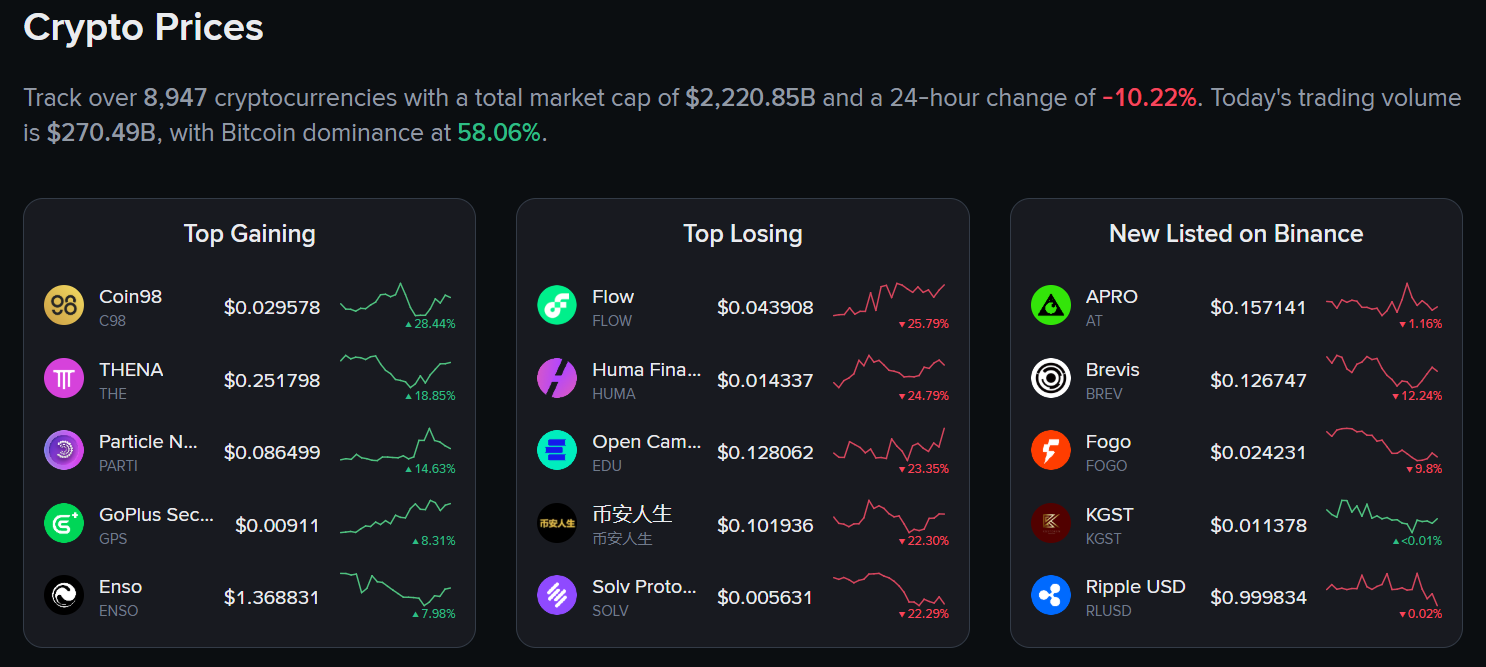
Why crypto data suits machine learning
Tracking cryptocurrency prices today means observing a complex system shaped by several forces at once. On-chain transactions reveal how assets move between wallets. Social media and news platforms capture shifts in public sentiment. Macroeconomic indicators add another layer of context. Together, these inputs form dense, diverse datasets that are well suited to advanced neural networks.
This uninterrupted stream of information allows researchers to measure how a model performs, identify weaknesses, and make improvements without waiting for market reopenings or relying on delayed reports. As a result, crypto markets have become a living laboratory for AI-driven financial analysis.
The evolution of neural networks in forecasting
Among the most widely used tools in this space are Long Short-Term Memory networks, or LSTMs. These recurrent neural networks are designed to identify patterns that unfold over time, making them especially useful in volatile markets where short-term noise can obscure longer-term trends.
More recent research has focused on hybrid models that combine LSTMs with attention mechanisms. These systems are better at filtering out irrelevant signals and highlighting data points that truly influence price movements. Compared with older, linear models, they can process both structured data, such as price histories, and unstructured data, including text from news articles and social platforms.
Natural Language Processing has played a key role in this shift. By analysing how news coverage and online discussions evolve, AI systems can measure sentiment and relate it to on-chain activity. Forecasting, once driven mainly by historical price patterns, now increasingly reflects changes in collective behaviour across global participant networks.
A high-frequency environment for model validation
Blockchain transparency provides a level of detail rarely available in traditional financial systems. Each transaction is recorded and traceable, allowing researchers to study cause-and-effect relationships almost immediately.
At the same time, the rise of autonomous AI agents has changed how this data is used. New platforms support decentralised processing across multiple networks, enabling models to operate and adapt without relying on a single central system. This has effectively turned blockchain ecosystems into real-time validation environments, where feedback between data ingestion and model refinement happens continuously.
Within this setting, researchers are testing several advanced capabilities. These include detecting anomalies in transaction flows before liquidity issues spread, mapping global sentiment against on-chain behaviour to gauge market psychology, and dynamically adjusting risk exposure as volatility increases. Some systems also monitor wallet activity to anticipate liquidity shifts before they reach centralised exchanges.
Rather than functioning as isolated tools, these models evolve alongside the markets they observe, constantly updating their parameters in response to new conditions.
DePIN and the demand for computing power
Training complex predictive models requires significant computing resources. To meet this demand, developers are turning to Decentralised Physical Infrastructure Networks, or DePIN. These networks pool GPU capacity from around the world, reducing reliance on traditional cloud providers.
This approach has lowered barriers for smaller research teams, giving them access to computing power that was previously too expensive. It has also accelerated experimentation, allowing multiple model designs to be tested in parallel.
Market trends reflect this shift. A report published in January 2025 highlighted strong growth in the capitalisation of assets linked to AI agents during the second half of 2024, driven by rising demand for decentralised intelligence infrastructure.
From reactive bots to anticipatory agents
The focus of AI development in crypto markets is moving away from simple, rule-based trading bots. Modern systems are designed to anticipate change rather than react to fixed triggers. By evaluating probability distributions, these agents aim to identify potential market directions before they fully emerge.
Techniques such as gradient boosting and Bayesian learning help detect conditions where prices may revert to the mean ahead of major corrections. Some models also apply fractal analysis to uncover recurring structures across different timeframes, improving adaptability in fast-changing environments.
 Faez, K.
Managing risks and scaling challenges
Despite rapid progress, challenges remain. One concern is model hallucination, where systems identify patterns that appear meaningful but have no real causal basis. To address this, researchers are increasingly using explainable AI methods that make decision-making processes more transparent and easier to audit.
Scalability is another ongoing issue. As interactions between autonomous agents grow, underlying networks must handle higher transaction volumes without delays or data loss. By the end of 2024, leading scaling solutions were processing tens of millions of transactions per day, though further improvements are still needed.
Looking ahead
Cryptocurrency markets are shaping how AI forecasting tools are built, tested, and deployed. By combining open data, continuous activity, and decentralised infrastructure, they offer a unique environment where intelligence, validation, and innovation converge. As these systems mature, they are likely to influence not only digital assets but also the broader future of financial modelling and governance.



