

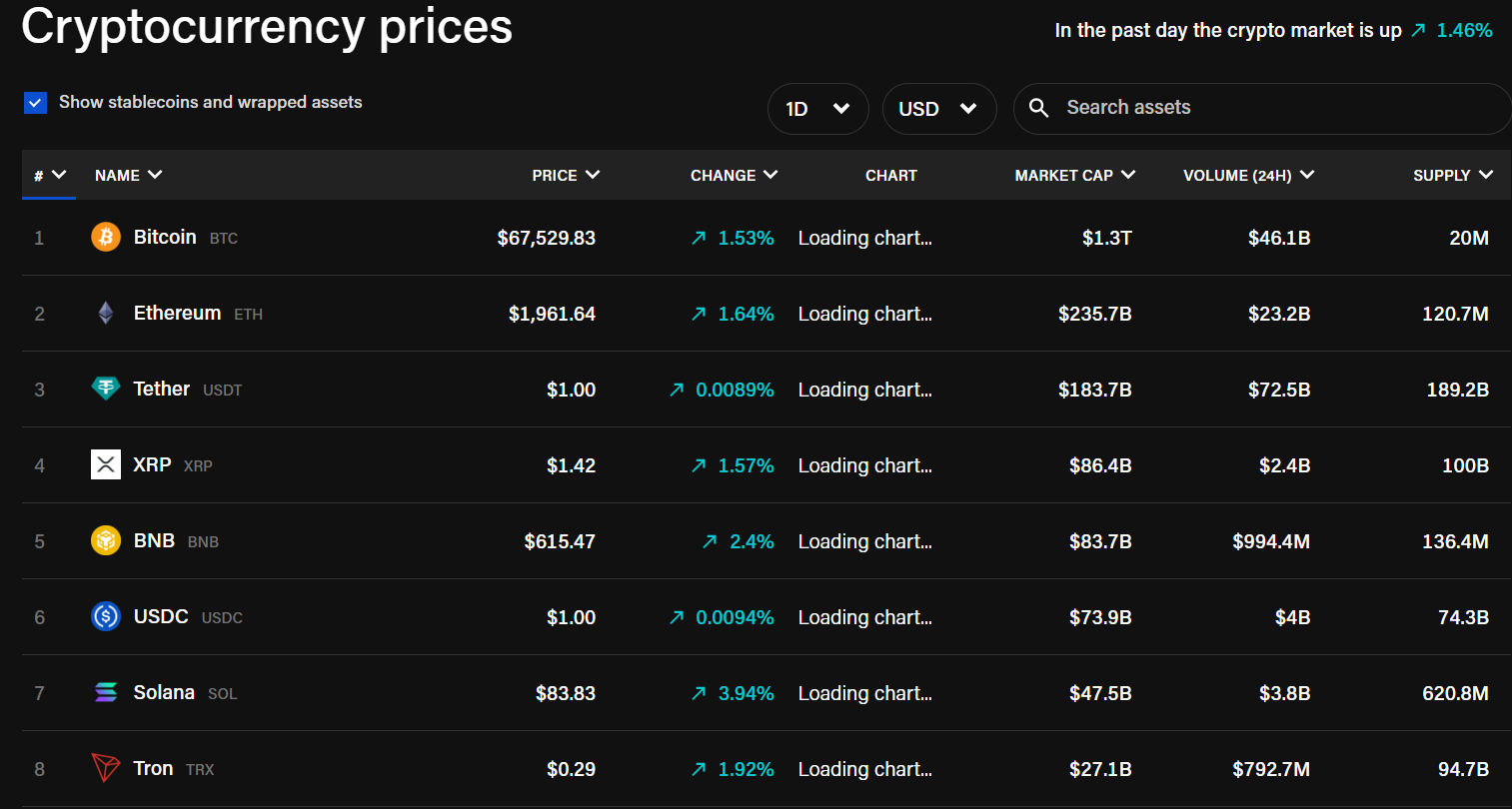
Bitcoin rose 1.75% to $67,769 after the U.S. Supreme Court struck down President Donald Trump’s broad tariff regime. The move signaled immediate risk-on positioning across digital assets and crypto-linked equities.
Ethereum traded near $1,960, up more than 2%, while Solana gained over 4% to $84, according to data. XRP added 1.55% to $1.42. Crypto equities tracked the advance, with Fold climbing 4.6% and Coinbase rising 3.52% to $171.78, often seen as a proxy for sector sentiment.
Does The Tariff Ruling Shift Macro Tailwinds For Bitcoin?
The Supreme Court ruled that Trump lacked authority to impose sweeping global tariffs under the International Emergency Economic Powers Act. Restrictive trade measures had weighed on growth forecasts, and Cato estimated that 60% of projected 2025 tariff revenue stemmed from IEEPA-related actions. Removing that revenue source may complicate fiscal planning.
Some macro analysts argue the ruling could pressure Treasuries and the U.S. dollar. Stephen Coltman, Head of Macro at 21Shares, said a negative tariff ruling could hurt bonds and the dollar while favoring equities and crypto.
“Bitcoin has been trading within a narrow range for the past two weeks between 65k and 70k,” he said, adding that bulls want $65,000 to hold while a sustained move above $70,000 would suggest selling pressure has faded.
Matthew Sigel, Head of Research at VanEck, took a similar view, stating that reduced tariff revenue could accelerate “money printing and debasement.” Bitcoin is often framed as a hedge against currency dilution and expansionary policy. If fiscal gaps widen, could that narrative regain traction among institutional allocators?
Bitcoin rallies as Trump tariffs struck down by US Supreme Court
— matthew sigel, recovering CFA (@matthew_sigel) February 20, 2026
In the absence of tariff revenues, money printing and debasement will accelerate.
For now, price action remains range-bound despite the headline catalyst. Traders are watching whether Bitcoin can decisively clear $70,000 or slip back toward the $65,000 support level as markets digest the broader economic implications of the ruling.



