
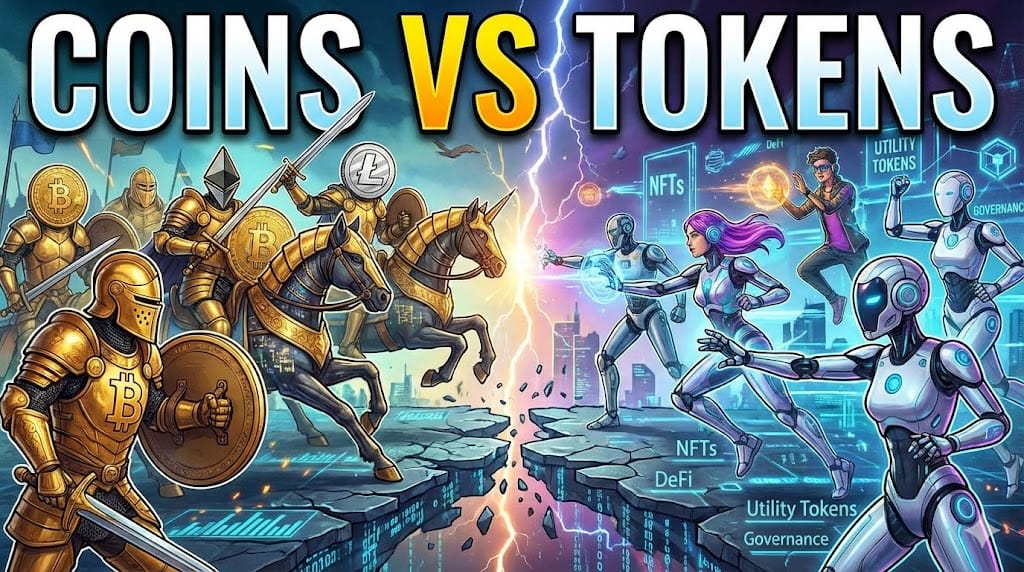
If you’re new to digital assets, the distinction between a coin and a token can feel confusing. While both are units of cryptocurrency and both represent value, they have fundamentally different roles, origins, and applications within the crypto universe.
Understanding this difference is critical, as it explains everything from how a transaction is paid for to what kind of financial asset you actually own.
The Definitive Distinction: Native vs. Built On Top
The most useful and widely accepted way to differentiate coins from tokens is by looking at where they were created.
Coins are Native Assets
A coin is a digital asset that is native to its own independent blockchain. It was created at the inception of that network and serves as the core currency and fuel for all activities on that ledger.
- Examples: Bitcoin (BTC) is the native coin of the Bitcoin blockchain. Ether (ETH) is the native coin of the Ethereum blockchain.
- Primary Function: Coins are designed to be a form of money—a medium of exchange and a store of value. Crucially, they are also used to pay for the network’s transaction fees (often called gas).
Tokens are Built On Existing Blockchains
A token is a digital asset that is created on top of an existing blockchain that already has a native coin. Tokens rely entirely on the underlying blockchain for their security, settlement, and verification.
- Example: Hundreds of thousands of tokens (like USDT or UNI) are built on the Ethereum blockchain. They rely on the native coin, Ether, to pay the gas fees necessary to execute their transactions.
- Primary Function: Tokens are highly versatile and are often used for extended functionality beyond simply making payments. They can represent assets, ownership, voting rights, or access to a service.
Tokens: More Than Just Money
Because tokens are built on existing smart contract platforms like Ethereum, their function can be programmed far beyond simple currency. This versatility is why tokens are often categorized by what they represent:
| Token Type | What It Represents | Common Use Case |
| Utility Tokens | Access to a product or service | Granting users the right to use a decentralized application (dApp). |
| Security Tokens | Ownership of a regulated asset | Representing shares, equity, or debt in a real-world company or asset. |
| Equity Tokens | A share or stock in a company | A specific type of security token representing equity in a firm, often issued in an Initial Coin Offering (ICO). |
| Payment Tokens | Pure medium of exchange | Used solely for paying for goods and services (e.g., stablecoins in some contexts). |
A key characteristic of tokens is that their functionalities can overlap. For instance, a token that represents equity might also grant the holder utility access to a service, creating "fuzzy boundaries" between categories.
Why the Distinction Matters
Understanding the difference between a coin and a token helps you grasp how different parts of the crypto ecosystem work together.
- Fueling Transactions: You cannot pay for an Ethereum-based token transaction using the token itself; you must use the native coin, ETH, to pay the gas fee. The coin acts as the engine, while the token is the payload being delivered.
- Investment Implications: Coins, by their nature, are often considered long-term bets on the security and future of the entire underlying network (Bitcoin or Ethereum). Tokens, on the other hand, are typically bets on the success or utility of a specific project, company, or application built on that network.
- Regulation: Regulatory bodies often look at tokens, particularly security tokens and equity tokens, with far more scrutiny than they do decentralized coins. This is because tokens frequently represent traditional financial instruments, making them candidates for specific securities regulation.
While the terminology can sometimes feel confusing, remember this: Coins create the network; tokens live on the network. This framework is the essential first step in navigating the world of decentralized finance.



