
Coinbase has taken legal action against the U.S. states of Michigan, Illinois, and Connecticut, escalating a growing dispute over who has the authority to regulate prediction markets in the United States.
The lawsuits, filed on Thursday, ask federal courts to confirm that prediction markets fall exclusively under the oversight of the Commodity Futures Trading Commission (CFTC), not state gaming regulators. Coinbase argues that Congress has already settled this question by designating the CFTC as the sole regulator for these markets, leaving individual states without legal standing to intervene.
In a public statement, Coinbase Chief Legal Officer Paul Grewal said the company is seeking clarity and consistency. He argued that state-level attempts to regulate or block prediction markets are not only unlawful but also harmful to innovation. According to Grewal, allowing 50 different regulatory approaches would undermine a market structure that Congress intentionally placed under federal supervision.
Today @coinbase filed lawsuits in CT, MI, and IL to confirm what is clear: prediction markets fall squarely under the jurisdiction of the @CFTC, not any individual state gaming regulator (let alone 50). State efforts to control or outright block these markets stifle innovation…
— paulgrewal.eth (@iampaulgrewal) December 19, 2025
Coinbase’s court filing in Illinois specifically requests declaratory and injunctive relief, stating that state enforcement actions could cause “immediate and irreparable” harm to the company’s business plans.
A central point in Coinbase’s argument is the definition of what constitutes a commodity under federal law. Grewal noted that Congress explicitly excluded only a narrow list of items, such as onions and movie box office receipts, from the CFTC’s authority. By contrast, he said, event-based contracts tied to outcomes like sporting events were not excluded, signaling that they fall within the agency’s jurisdiction.
Coinbase also drew a clear distinction between prediction markets and traditional sportsbooks. While casinos and sportsbooks profit when customers lose, Grewal said prediction markets operate as neutral exchanges that simply match buyers and sellers, without taking positions or setting odds to maximize house profits.
The legal filings come shortly after Coinbase announced plans to enter the prediction markets space through a partnership with Kalshi, a CFTC-regulated platform. According to court documents, Coinbase intends to begin offering event-contract trading to customers across the United States, including Illinois, starting in January 2026.
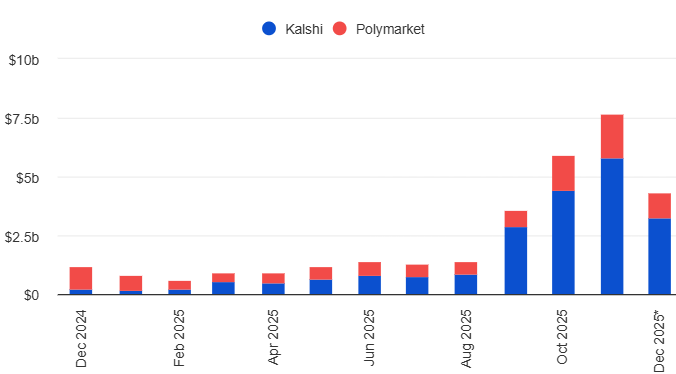
Prediction markets have seen rapid growth over the past year, with platforms such as Kalshi and Polymarket handling billions of dollars in trading volume. That expansion, however, has also drawn increased scrutiny from state regulators. Several states argue that contracts based on real-world events, particularly sports outcomes, amount to unlicensed gambling when offered without state approval.
Earlier this month, Connecticut regulators issued cease-and-desist orders to Kalshi, Robinhood, and Crypto.com, alleging they were offering illegal sports betting products. Kalshi challenged the move in court and recently secured temporary relief after a federal judge ordered the state to pause enforcement while the case is reviewed.
Coinbase’s lawsuits now add another layer to a broader legal and regulatory debate that could shape the future of prediction markets nationwide. The outcomes may help determine whether these platforms are governed by a single federal framework or a patchwork of state rules.



