

CME Bitcoin futures open interest fell to $7.2 billion in early April, its lowest level since February 2024. The decline signals a sharp reduction in institutional positioning tied to arbitrage strategies.
Open interest has now dropped for five consecutive months since November, while monthly trading volume fell to $163 billion in March, down nearly 50% from its January 2025 peak. The contraction reflects reduced activity from leveraged funds that previously dominated CME positioning.
Is The Basis Trade Unwind Driving Institutional Exit?
The primary driver appears to be the unwinding of the CME-spot ETF basis trade, which involved buying spot Bitcoin ETFs while shorting CME futures to capture yield. As Bitcoin retraced from above $120,000 to below $70,000, the annualized basis compressed significantly, eroding profitability.
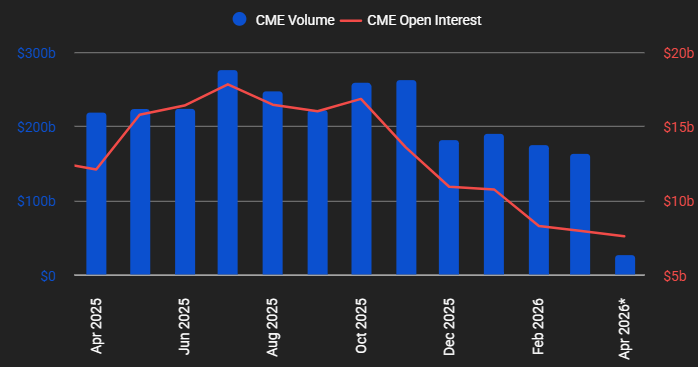
At current levels, the basis sits near 5% compared to short-term Treasury yields around 4.5%, leaving minimal spread after accounting for capital costs and counterparty risk. This has effectively removed the incentive for funds to maintain the trade, accelerating position unwinds.
The shift has also altered exchange dominance. CME has lost its position as the largest Bitcoin futures venue to Binance for the first time since November 2023, reflecting a broader migration of activity toward offshore platforms as institutional flows weaken.
The current open interest level is approaching February 2024 levels, before the spot ETF-driven build-up in positions began. If that threshold breaks, the market will have fully reversed the institutional positioning cycle tied to ETF adoption.
Institutional demand for Bitcoin derivatives now hinges on the re-expansion of the basis or a new catalyst for directional exposure. The next key signal will be whether the basis rate widens meaningfully above risk-free yields, restoring arbitrage incentives for capital-intensive strategies.



