

As the push to bring equities onto the blockchain gains momentum, one of Wall Street’s most powerful players is urging caution. Citadel Securities, the prominent market maker founded by billionaire Ken Griffin, is calling on the U.S. Securities and Exchange Commission (SEC) to treat tokenized equities the same as traditional stocks—without carving out regulatory loopholes.
In a formal letter submitted to the SEC’s Crypto Task Force this week, Citadel warned against what it described as “regulatory arbitrage” by firms seeking to tokenize securities. While the firm expressed support for technological innovation in finance, it drew a sharp line between innovation and bypassing investor protections.
“Seeking to exploit regulatory arbitrage for ‘look-a-like’ securities is not innovation,” the letter stated.
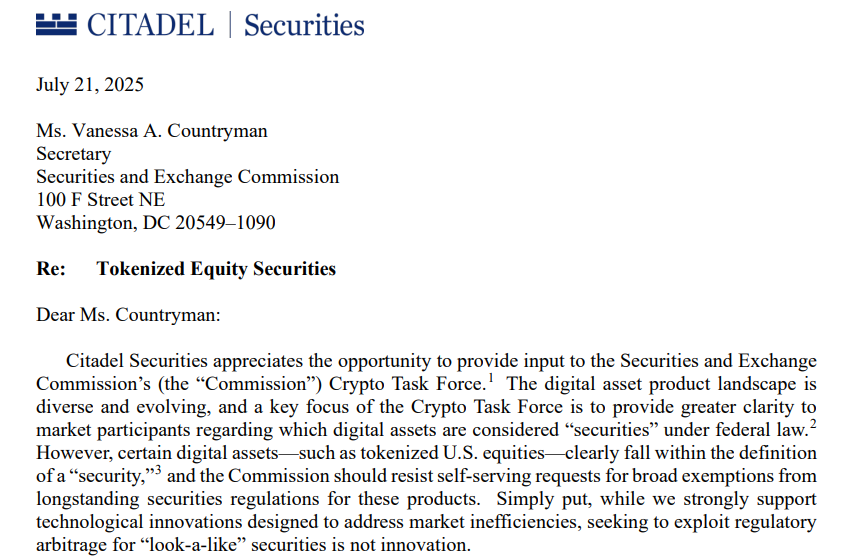
The firm emphasized that any equity—whether digital or traditional—should be held to the same regulatory standards, particularly with regard to market structure, liquidity, and transparency.
What Are Tokenized Equities?
Tokenized equities are digital representations of real-world stocks recorded on a blockchain. The appeal lies in their ability to trade 24/7 and settle faster than traditional stocks, which are bound by limited trading hours and multi-day clearing windows.
Crypto-native companies such as Coinbase and Kraken have expressed interest in launching platforms that allow users to buy and trade tokenized versions of popular equities. If approved, these efforts could bring significant competition to the traditional brokerage space—and potentially upend long-standing market mechanics.
Citadel Securities wrote a compelling letter to the @SECGov on the topic of tokenized public stocks, with which I strongly agree:
— Carlos Domingo (@carlosdomingo) July 22, 2025
"Simply put, while we strongly support technological innovations designed to address market inefficiencies, seeking to exploit regulatory arbitrage…
Citadel’s Concerns
Citadel’s letter outlines a key concern: liquidity fragmentation. The firm argues that tokenized markets could draw volume away from traditional exchanges, reducing liquidity and increasing volatility. It also warns of potential investor confusion around the issuance, regulation, and legitimacy of tokenized assets.
Beyond market risks, the firm also called on the SEC to reject any exemptions from existing securities laws and instead adopt a formal rulemaking process that includes public input.
“It is incumbent that the Commission pursue a deliberative and transparent process,” Citadel wrote, urging the agency to hold public roundtables and provide clear regulatory guidance rather than rely on behind-the-scenes exceptions.
A Divided Regulatory Landscape
While Citadel’s stance underscores deep skepticism within traditional finance, not all regulators are opposed to exploring blockchain-based trading. SEC Commissioner Hester Peirce, a known advocate for digital innovation, has previously stated that tokenized securities must still comply with federal securities laws. Meanwhile, SEC Chair Paul Atkins hinted at the possibility of creating an “innovation exception” to accommodate novel trading models.
“Assets clearly are moving on chain,” Atkins said during a recent press call. “So if it can be tokenized, it will be tokenized.”
Still, some analysts remain cautious. TD Cowen’s Jaret Seiberg noted that tokenized equity markets could struggle to maintain price transparency and fairness—especially when it comes to meeting the “national best price” standard required in traditional trading.



