
A new global report from Cisco reveals a surprising truth about the AI race: while nearly every company talks about embracing artificial intelligence, only 13% are actually ready to make it work.


These elite few, which Cisco calls “Pacesetters,” aren’t just ahead of the curve — they’re setting it. According to the 2025 Cisco AI Readiness Index, these organizations are four times more likely to move their AI projects beyond pilot phases and 50% more likely to see measurable business value from them.
AI Readiness: The Real Differentiator
Cisco’s research paints a clear picture: AI success isn’t about experimentation — it’s about preparation. The companies that thrive with AI are those that treat it as a core business function, not a side initiative.
Jeetu Patel, Cisco’s President and Chief Product Officer, summed it up bluntly:
“AI doesn’t fail — readiness fails. The most AI-ready organizations prove that discipline and preparation are what turn AI potential into real value.”
Among the Pacesetters, 99% have a defined AI roadmap, compared with just 58% of other companies. They also back up their strategy with investment: 79% rank AI as their top funding priority, while only 24% of their competitors do the same.
This disciplined approach pays off. Nearly nine in ten Pacesetters report increases in profit, productivity, and innovation, whereas the majority of other firms hover closer to 60%.
Cisco Systems, Inc.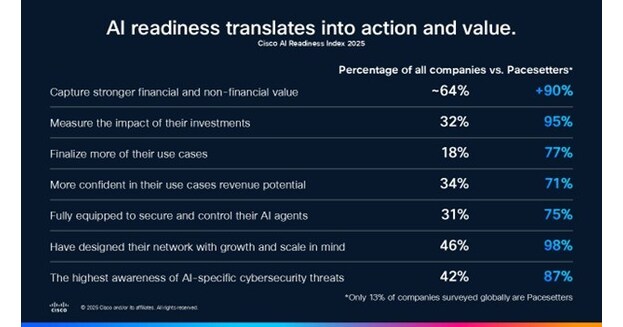
Building the Infrastructure for AI
The report highlights that readiness goes beyond strategy — it’s also about the underlying systems. AI requires massive computing power, scalable networks, and airtight security. Yet, most organizations are lagging behind.
Only 46% of companies say their networks are designed for AI workloads. Among Pacesetters, that figure jumps to 98%. And when it comes to flexibility, 71% of these leaders can scale their networks instantly to support new AI projects, compared with just 15% of others.
Cisco warns that the gap between the ready and the unready could widen as companies move toward deploying AI agents — digital assistants designed to work alongside humans. While 83% of organizations plan to introduce AI agents soon, over half admit their current systems can’t handle the data complexity these tools demand.
The Growing Risk of “AI Infrastructure Debt”
Cisco’s report also introduces a new term: AI Infrastructure Debt — a modern version of the old “technical debt” problem that haunts many IT systems. It refers to the cumulative cost of neglected upgrades and short-term fixes that leave organizations unprepared for AI at scale.
The warning signs are hard to ignore. About two-thirds of business leaders expect workloads to grow by more than 30% within the next three years, yet most still struggle to consolidate their data or access enough GPU power. Only a quarter of companies report having sufficient GPU capacity to meet their AI goals.
The Bottom Line: Strategy Meets Discipline
Cisco’s findings deliver a straightforward message: AI success follows readiness. Companies that take the time to build solid foundations — from strategy and security to infrastructure — are the ones reaping real returns.
In the global race to harness AI, talk is cheap. The winners are those investing early, planning carefully, and treating AI as a long-term business transformation — not just a technology trend.



