

Circle has emerged as the top-performing crypto-linked equity in 2026, rising about 30% year-to-date. The gain reflects accelerating stablecoin adoption even as trading-driven platforms face weaker volumes.
The company’s market capitalization reached $25.7 billion at Friday’s close, according to reported data. In contrast, Coinbase has declined roughly 10% over the same period, underscoring diverging revenue drivers across crypto equities.
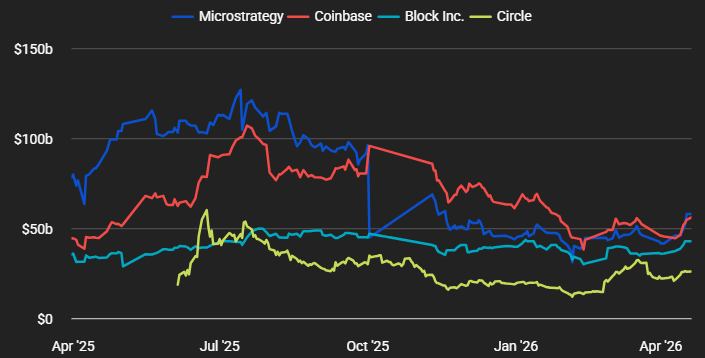
Is Stablecoin Growth Reshaping Crypto Equity Bets?
Circle’s revenue model is closely tied to USD Coin (USDC) supply and short-term Treasury yields. USDC circulation has increased 3.7% year-to-date and more than 30% over the past 12 months, offsetting pressure from declining interest rates on reserve assets.
Coinbase, by comparison, remains heavily exposed to trading activity. The October 2025 crypto liquidation cascade reduced speculative volumes, weakening fee revenue, while contributions from its Base layer-2 network and staking services have not fully compensated.
This divergence highlights a broader structural shift in how public markets price crypto exposure. Strategy-linked equities track bitcoin price movements, while exchange operators respond to trading cycles, and stablecoin issuers reflect payment and liquidity growth.
Analysts note that this dispersion allows institutional investors to express more targeted theses rather than relying on a single proxy. Circle represents a direct play on stablecoin expansion, while Coinbase captures broader market activity and token price sensitivity.
The next inflection point may come from regulation in the United States, where a formal framework for stablecoins could introduce new competition. If bank-issued digital dollars reach similar scale and compliance standing, how durable is Circle’s distribution advantage?
Investor focus now turns to policy developments and whether new entrants compress margins in the stablecoin sector as adoption continues to expand.



